Le biopic de Géraldine Danon livre un portrait plus complexe de la skippeuse que celui d’une simple gagnante.Le biopic de Géraldine Danon livre un portrait plus complexe de la skippeuse que celui d’une simple gagnante.
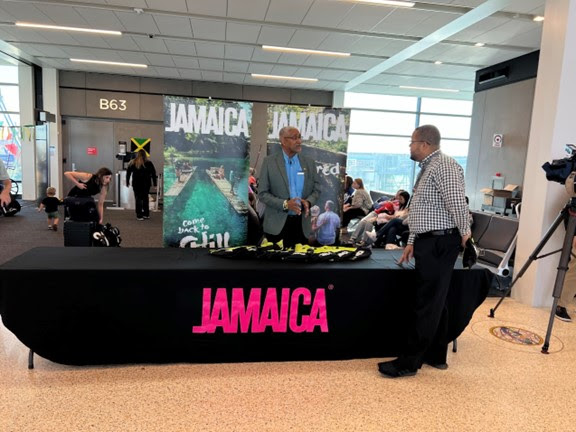
Jamaica welcomed a new non-stop air service from Kansas City International Airport (MCI) in Missouri to Montego Bay’s Sangster International Airport (MBJ) by Southwest Airlines on Saturday, October 7. This service is a continuation of the country’s efforts to build out new gateways and provide more convenient access to the island for U.S. travellers coming from the Midwest. The new flight is scheduled to operate weekly on Saturdays.
Pictured: Christoper Wright, Business Development Officer, Jamaica Tourist Board at the gate for the Southwest inaugural flight from Kansas City International Airport to Montego Bay.
Growing Interest in Jamaica
“The midwestern United States is a growing and vital market for Jamaica and we are excited to see carriers such as Southwest Airlines expand their service to our island paradise,” said the Hon. Edmund Bartlett, Minister of Tourism, Jamaica. “We want to continue to make getting to Jamaica as seamless as possible. Southwest Airlines is an outstanding partner in helping us achieve this goal, as evidenced by its continued gateway growth.”
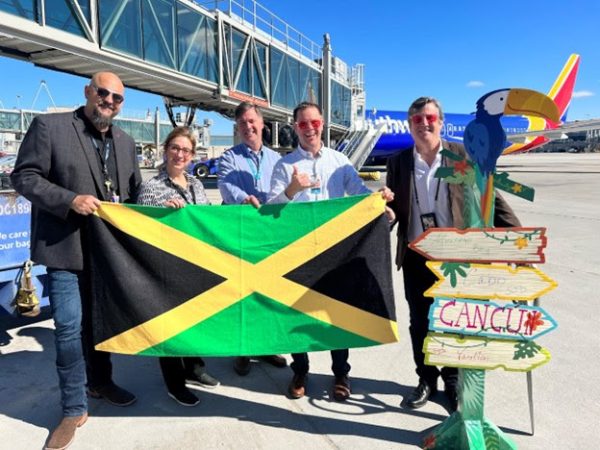
Pictured: Airline, Tourism and Airport Representatives on the tarmac at Kansas City International Airport for the inaugural flight take-off.
Only Direct Flight to Jamaica from Kansas
The new flight is the only non-stop service to Jamaica from the Kansas City market, opening this important area to the destination. With the addition of this new flight, Southwest now has seven gateways into Jamaica flying from Baltimore, Chicago, Fort Lauderdale, Houston, Kansas City, Orlando and St. Louis.
“Jamaica has a unique vibe and culture that not only distinguishes the destination from all others, but makes visitors want to visit over and over again,” said Donovan White, Director of Tourism, Jamaica Tourist Board. “Thanks in large part to the partnership we are grateful to enjoy with Southwest Airlines, we are able to bring more people to experience our island home from more midwestern U.S. gateways.”
Have you ever wondered what’s it like being a Jamaican living in the Cayman Islands? In this episode of “Jamaicans to the World”, Jamaicans.com founder Xavier Murphy speaks with Alicia Reid. She is a Jamaican living in the Cayman Islands. They discuss the food, culture, customs, the people, things to do, the language, music and adjusting to living in the Cayman Islands as an expat. Xavier asks about the must eat foods and must visit places in the Cayman Islands.
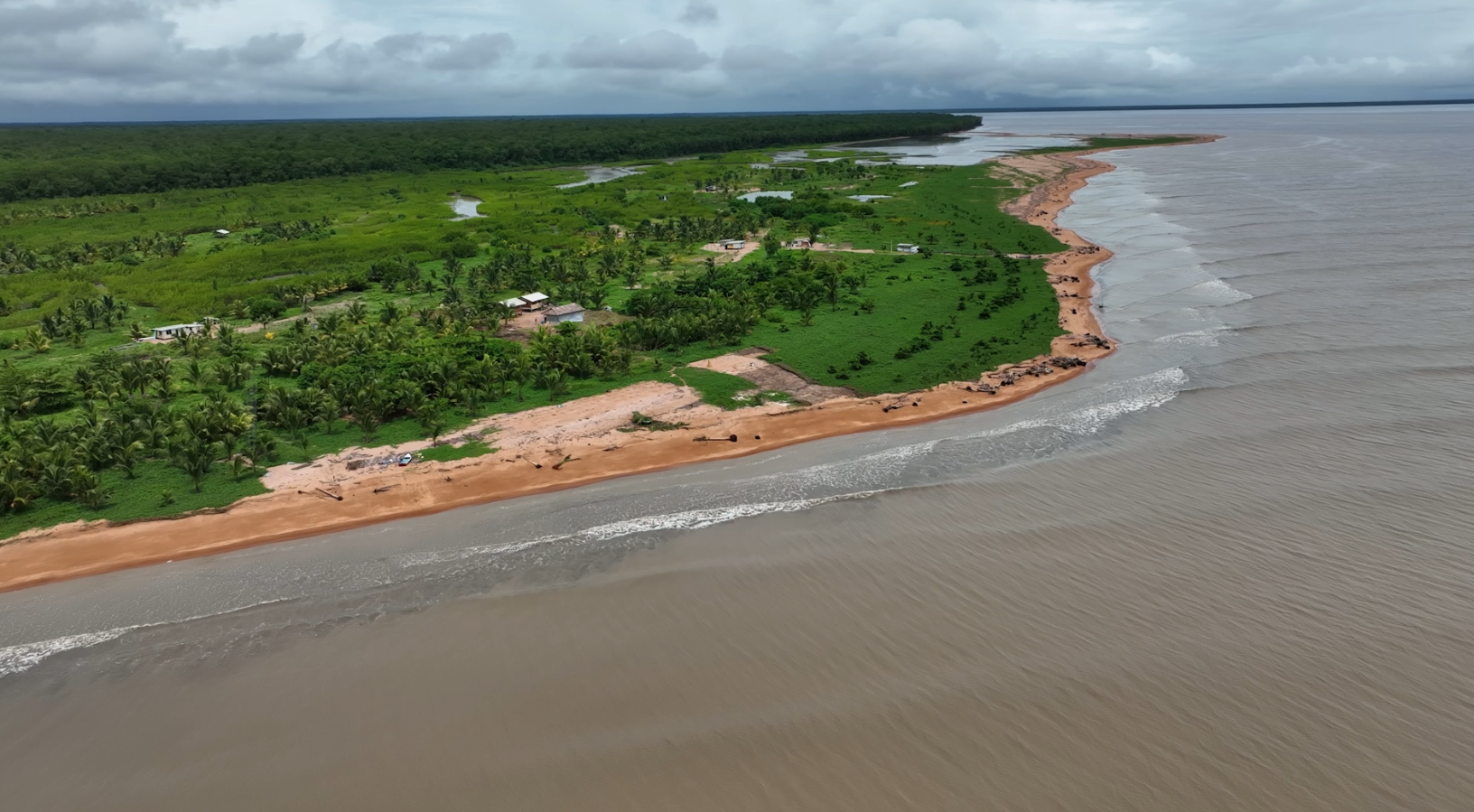
Almond Beach is an Indigenous community and one of 10 beaches found along the 75-mile-long Shell Beach Protected Area in Region One (Barima-Waini).
Every year, you can find four endangered species of sea turtles nesting there. Those turtles are the Leatherback (Dermochelys coriacea), Hawksbill (Eretmochelys imbricata), Olive Ridley (Lepidochelys olivacea), and Green Turtle (Chelonia mydas).
Conservation stakeholders, such as Guyana’s Protected Areas Commission (PAC) and residents of Almond Beach, are among those who have helped protect the turtles and their hatchlings during the annual nesting season, that is, from February to August.
Over the past few years, however, the coastline at Almond Beach and other parts of the Shell Beach area have been eroding at an increasingly fast rate. This poses challenges for the residents and the turtles that have grown accustomed to nesting there every year.
“Over the years, Almond Beach was one of the best places.
“People across the globe know about Almond Beach because of the sea turtle nesting,” Arnold Benjamin, the Almond Beach Community Development Council Chairman, told the News Room during a recent visit to Region One.
Benjamin, however, noted that the erosion has significantly affected life at Almond Beach. For example, the community no longer has the school that was constructed there in response to the growing population in the 1990s.
According to Benjamin, between 1991 and 1997, about 150 people lived on the beach. Because of the population growth, several facilities were constructed: a school, a church, and a ball field (a recreational area).
By 2005, the school was dismantled and moved further inland because the coastline had receded.
“It was really rapid,” Benjamin said.
He added, “It forced people to move. We lost about two miles (of land), farms (and) coconut trees.”
Over the next 10 years, the erosion continued, and the residents moved further inland. Eventually, Benjamin said they asked the government not to dismantle and reconstruct the school; it was just a “waste of money” and families started leaving the beach.
Benjamin is among those people who believe the residents are climate migrants because erosion, as a result of or worsened by climatic changes, forced them to migrate.
So what is causing the erosion?
Based on data collected and analysed between 2019 and 2023, the PAC found that parts of the Shell Beach coastline have been washed away by the Atlantic Ocean.
The PAC is the body with oversight for Guyana’s protected areas, including the Shell Beach Area. The Commission also found that the Shell Beach coastline had a mass area of about 1.3 miles in 2019. In 2022, that was reduced to a mass area of about 0.7 miles.
The beach is eroding from the eastern end, while accretion, which is the dumping of the materials washed away, is happening at the western end.
The coastal changes are part of a seemingly natural 30-year cycle, but the PAC also noted, “These changes are believed to be a result of climatic changes which have resulted in stronger ocean currents and intense wave action.”
PAC’s data revealed there were 70 people living there in 2014; at the beginning of 2023, only three families were living there.
The Thornhills are among those who remained – at least until now.
Residents help save the turtles
Leonard Thornhill moved from Moruca, a Region One community found more inland, to Almond Beach about 35 years ago.
“Over the years, it [the erosion] wasn’t affecting us like how it is during this time.
“Back in the years, the erosion was, like, slow but from like two years back we experienced it moving very fast,” Thornhill said as he sat on the beach recalling the coastal changes he has been observing.
Thornhill said life as he knows it is on Almond Beach so moving would be very difficult.
Seine nets are scattered around his wooden house; his farms are located further inland. These are indications of how he makes a living on the beach.
“Most of my children, they born and grow on Shell Beach so it’s kinda hard to take them from here to somewhere strange.
“… We got our lil farmlands, but you can see the erosion taking place.
“We will still remain until whenever,” he said.
As long as he is on the beach, Thornhill also wants to help monitor and protect the turtles that nest there. And he has been doing just that.
In mid-September, when most of the PAC rangers left the beach, Thornhill found a few hawksbill hatchlings on the beach. He instinctively collected them and kept them safe in his yellow bucket at his house until nightfall, the time when they could be left to venture into the ocean.
If he hadn’t picked them up, intense sunlight or dogs on the beach might’ve harmed them. Like Thornhill, Almond Beach residents all know the importance of protecting these endangered species.
Seeta Augustus, for example, grew up at the beach with her family. She relocated to attend a secondary school in Mabaruma, the capital town about 30 miles inland, but she’s now back as a ranger on the beach, helping to protect the turtles.
She can tell you many facts about the turtles coming to the beach. She also knows about the changes the community grappled with because of the erosion— the loss of the school, the church, and the ball field. The changes make her emotional.
“It’s very sad to know because it’s my hometown.
“…I born and grow up here, and now everything is washing away and it’s very hard to see, like, everybody moving away.”
“It’s really hurting,” Seeta said, trying to laugh away tears.
Coastal changes in Guyana
The Shell Beach area is part of Guyana’s low coastal plain, one of the country’s four natural regions, and the area that hugs the Atlantic Ocean. That coastal plain is particularly vulnerable to rising sea levels because it is itself below sea level.
At other parts of the coast, especially near more populated, urban areas, there are sea defences like mangroves and sea walls. These are necessary to help protect the coast and the people who live there.
Even so, the World Bank, in its 2021 report titled “360° Resilience: A Guide to Prepare the Caribbean for a New Generation of Shocks” found that Guyana could face the Caribbean’s second-highest level of shoreline retreat if high climate change impacts persist.
Essentially, it noted that Guyana risks losing 65 metres of its shoreline by 2050; only neighbouring Suriname (with an estimated retreat of 71 metres) risks losing more of its shoreline.
Local scientist and engineer Dr. Kofi Dalrymple has been studying the impact of climate change and sea level rise on coastal erosion for years.
According to him, the shoreline naturally evolves through a process of erosion and accretion but climate change is exacerbating that. In the case of Guyana’s coastal plain, much of the land was formerly marshland where the Atlantic Ocean would have naturally covered and receded over time.
With land development on the coast, however, he said the ocean has been kept “at bay” instead of allowing it to flow in and out naturally.
“What climate change does to that natural process is, as the sea rises, its ability to go further inland increases.
“So there is a direct link between rising sea levels and, sort of, coastline recession,” Dr. Dalrymple said.
Dr. Dalrymple said more research specific to the Shell Beach area would prove insightful. A study of wave intensity and coastline changes would help stakeholders grasp just how climate change is impacting the protected area.
Already though, the PAC, based on the information provided to the News Room, believes the erosion has “drastically” decreased the Almond Beach coastline and forced residents to migrate.
Still, the PAC believes that Almond Beach and wider, Shell Beach, still serve as a “viable ground for nesting sea turtles.”
Is inland migration a must?
The situation is a bit more complicated for those who still live there. Seeta’s father, Liston Augustus, retired recently after teaching for decades. He knows he should probably move more inland, but fishing and farming on the beach are his main sources of income.
“I have to try because I don’t really have any other alternative to where we can go.
“…When the water reach 10 metres, we normally break down our house and move away. This is the third time now we move away. It happens like every three years or so depending on how fast the water comes in,” Augustus told the News Room.
As long as the turtles continue nesting in the Shell Beach area, there will be efforts to monitor and protect them, but for the remaining residents who face losing their homes and livelihoods, inland migration may be their best bet.
Arnold Benjamin told the News Room that an area at Khan’s Hill, another Indigenous community found much closer to Mabaruma, is being prepared for the remaining families at Almond Beach. According to him, some may move, but some may remain on the beach.
This story was published with the support of the Caribbean Climate Justice Journalism Fellowship, which is a joint venture of Climate Tracker and Open Society Foundations.
Meanwhile, Minister within the Office of the Prime Minister with Responsibility for Public Affairs, Kwame McCoy stressed that the government has continued to show its unwavering commitment to developing the lives of citizens across the country.
“The government has continued to show excellent leadership and so you the people of the country don’t have any doubt about where the monies that we are getting from revenues are going because they are being spent back and invested on our people,” Minister McCoy posited.
He encouraged the contractors to employ persons from right within the various villages so that they could help in the development of their communities.
“We not only build roads, schools, and bridges. We connect with you in the most important ways outside of these public infrastructures. We connect with you day-by-day, sitting in communities and discussing your ideas and thoughts,” the Public Affairs minister told the residents.
Since the administration took office in 2020, over 4,000 roads have been constructed along the East Bank of Demerara, paving the way for improved accessibility. (DPI)
The first activity is set for November 4, 2023 at the Outside Lounge. Telford advises that participants keep their wrist bands for each of the parties hosted as they will have a chance to win a new car as well. He explained that the promotion is another form of “talking the language” of Guyanese consumers.
In terms of artiste lineup, Bounty Killer and Bling Dawg will be at these events.
“I’m bringing in friends from the music industry; a-list artists to come and take the information that they learn and pass it on to people in Guyana.
“You will see these artists up close and personal as opposed to these big shows where you just pay a lot of money and leave,” Telford said.
Guyanese Jasmine Abrams and Emanuel Archibald powered to the podium in the 100m finals, securing the country’s first two medals at the ongoing Pan American Games in Santiago, Chile.
In chilly conditions, Abrams got silver while Archibald dipped to bronze in an epic photo finish at the Julio Martínez Prádanos National Stadium on Tuesday evening.
Heading into the final as the second-fastest qualifier, she maintained her position in Lane 5 and even challenged for gold until Cuban De La Caridad García (11.36s) pulled away in the final meters.
The Guyanese clocked 11.52 seconds, while Trinidadian Michelle-lee Ayhe (11.53s) got bronze.
On the other hand, the Men’s 100m went to the line as just 0.1 seconds separated the medalist.
The eight men certainly had nerves, and the final got underway after two false starts, further adding tension to the marque event.
Archibald made a strong start in Lane 1 and kept with the top two until a close finish, as the Guyanese secured bronze in 10.31s (.310)
Silver went to Brazilian Felipe Bardi, who also had 10.31s (.302), while gold went to Alnardo Gonzalez of the Dominican Republic with 10.30 seconds.
It is the first Athletics medal for Guyana at the Games since Aliann Pompey (400m Bronze) and Marian Burnett (800m Silver) got the podium at the 2003 Games in Santo Domingo, Dominican Republic.
Additionally, it was the first medal for Guyana at the Games since 2011, when squash player Nicolette Fernandes got bronze in Mexico.
Guyana won no medals in 2015 (Canada) and 2019 (Peru).
Abrams and Archibald indicated the focus shifts to the Paris 2024 Olympic Games as they aim to meet the entry standards – 10.00 seconds for men and 11.07 seconds for women in the 100m.
Those times need to be achieved between July 1, 2023, and June 30, 2024.
Abrams holds the national record at 11.07 seconds, while Archibald’s personal best is 10.13 seconds.
Athletes can qualify in two ways for the Paris 2024 Games, with 50% of qualification places based on achieving the entry standard for an event within the qualification period and the other 50% based on the World Athletics Ranking within the ranking period.
On Wednesday (November 1), Aliyah Abrams will run out of Lane 5 in the Women’s 400m final from 19:23h. She enters the race as the second-fastest qualifier.
At 18:15h, Archibald starts in Lane 4 for semi-final one in the Men’s 200m. He enters the race with a season-best of 20.69s.
The top two automatically qualify for the final, along with the two fastest non-direct qualifiers.
Additionally, archer Devin Permaul competes in the Men’s Individual Recurve (ranking round) from 08:00h, while Hemchandra Persaud contests Esport football from Thursday at 10:00h.
Leslain Baird will seek glory in the Men’s Javelin on Saturday from 18:59h.
The Guyana Boxing Association (GBA) will officially stage the 2023 edition of the Lennox Blackmore National Intermediate Championship from November 3-5 at the National Gymnasium, Mandela Avenue.
Participation is expected from notable gyms such as the Guyana Defence Force, the Guyana Police Force, the Forgotten Youth Foundation, Pace and Power, Rose Hall, Vergenoegen and Republican.
Action will start at 18:00h daily.
The medical assessment and weight-in will occur on November 2 at the National Gymnasium from 16:00h.
Terrence Poole, Technical Director of the GBA, said: “The intermediate championship is the stage directly after the novices. It’s a more advanced boxing level because there will be boxers who have represented Guyana competing at this level, so there’s a higher quality of competition. This is the stage where you will see the true potential of the fighters. I anticipate a quality exhibition of the talent due to the fact that the competing pugilists are much more experienced.”
Meanwhile, GBA President Steve Ninvalle stated, “The GBA’s developmental agenda is an excursion rooted in continuity. The Lennox Blackmore National Intermediate Championship is a stepping stone, a structured progression from the previously staged Andrew ‘Six Head’ Lewis National Novices Championships. It is a transitional level, and its importance should not be understated, as it provides a more detailed and comprehensive assessment of the possible future of the sport.”
He added: “The GBA comprehends that development transpires and occurs in an organised and systematic manner, as each tournament under the jurisdiction of the association provides its own particular aim and intrinsic value. As such, this event, which is an annual undertaking, has been tailored to form a pathway for emerging pugilists who harbour national and professional aspirations. This, as a consequence, has always resulted in the exposure of talents, which is the lifeline of the association in its continued dominance of the region.”
The championship is staged in honour of the former Commonwealth champion and world-ranked challenger Lennox Blackmore, who ended his illustrious career with a record of 30 fights, 25 wins and five losses.
Mark Mahase, the owner of ‘Top of the Line lumberyard’ also known as Rohan’s Lumberyard at Block 4 Enmore, East Coast Demerara, is grappling to deal with over $60 million in losses after a brush fire in the community rapidly spread on Monday and destroyed his business.
It took the Guyana Fire Service more than 24 hours to completely get the situation under control and from their investigations, the fire started after residents in the area lit heaps of garbage which was left unattended and spread to a nearby field.
On Tuesday, Mahase told the News Room that several calls were made to the Fire Service hours before the fire spread to the lumberyard.
“The night before, twice the fire service came and [put] out fire at the same place.
“[On Monday], the work men and I recognised that smoke was coming from the back of the lumberyard so I called the fire department and the person told me that the fire tender is engaged at Foulis and that when it’s finished, it will come. I called back about half after and [was] told the same thing again,” Mahase said.
Mohase said a fire tender arrived at about 13:00 hrs and went to the origin of the fire to extinguish it. When the firefighters finally decided to focus on the lumberyard, most of the wood was already on fire.
However, the fire service in a statement on Monday said four fire tenders from Melanie, Mahaica, Alberttown and Campellville responded to the fire at about 12:32 hrs. The Fire Service claimed that the fire spread rapidly due to heavy winds and the flammable materials surrounding it.
The brush fire reignited several times on Tuesday. Because of Guyana’s current severe hot weather, the Fire Service is urging citizens to desist from setting fires to grass and garbage during the dry season.
The situation is devastating for Mahase because he relocated the business from a different area in Enmore in January and he was pleased with the new location; he did not anticipate such tragedy.
According to Mahase, on Saturday, he received a delivery of a truckload of 8,500 logs and was scheduled to fill the orders of several contractors.
Meanwhile, Richard Hardeen, the owner of the field and compound where the lumberyard was, told the News Room that several complaints were made to the NDC about residents who set fire to garbage.
“Despite many efforts through the NDC (Neighbourhood Democratic Council) to solve this problem, we never solve it with the residents at the other side in Haslington. It’s a sore area that never been addressed and that created millions, maybe billions of losses,” Hardeen said.
The man had machinery housed at the lumberyard and all were destroyed.
Several workers who resided at the compound are now displaced. Collin Yhap said “Documents and everything that I had burn up. Entirely the lumberyard where we work, we lose a lot.”
Televizyon Lakay
Jwe Jwèt Gratis!
Quiz, Solitaire ak Mo Kaché Jwèt Ayiti & Karayib — 100% gratis!

 Le biopic de Géraldine Danon livre un portrait plus complexe de la skippeuse que celui d’une simple gagnante.Le biopic de Géraldine Danon livre un portrait plus complexe de la skippeuse que celui d’une simple gagnante.


 Vishani@newsroom.gy
 Almond Beach is one of 10 beaches found along the Shell Beach Protected Area
 Arnold Benjamin (left) and the News Room’s Vishani Ragobeer (Photo: News Room/ September 9, 2023)
 A view of Almond Beach from the Atlantic Ocean (Photo: News Room/ September 9, 2023)
 Changes to the shoreline at the Shell Beach Protected Area between 2019 and 2022 (Photo: Protected Areas Commission)
 Changes to the beach at the Shell Beach Protected Area between 2019 and 2022 (Photo: Protected Areas Commission)
 Leonoard Thornhill engaging the News Room near his Almond Beach house (Photo: News Room/ September 9, 2023)
 A Hawksbill hatchling on Almond Beach (Photo: News Room/ September 9, 2023)
 Seeta Augustus (Photo: News Room/ September 9, 2023)
 Scientist Dr. Kofi Dalrymple (left) and the News Room’s Vishani Ragobeer (Photo: News Room/ October 23, 2023)
 Liston Augustus (right) with the News Room’s Vishani Ragobeer (Photo: News Room/ September 9, 2023)

 Other contractors that present at the signing

 Ron Telford, the Music Executive and CEO of Creative Titans (Photo Voyage LA Magazine)

 akeem@newsroom.gy
 PHOTO FINISH! Emanuel Archibald (right) dips to the line in the Men’s 100m final at the Pan American Games in Chile (Andres Pina /Santiago 2023 via Photosport)
 Proud Guyanese! Emanuel Archibald and Jasmine Abrams celebrate their success in the 100m finals at the Pan American Games in Chile


 The Guyana Boxing Association (GBA) will officially stage the 2023 edition of the Lennox Blackmore National Intermediate Championship from November 3-5 at the National Gymnasium, Mandela Avenue.

 Lazeena@newsroom.gy
 The brush fire at the lumberyard (Photo: Guyana Fire Service)
 Mark Mahase, owner of the Top of the Line Lumberyard at Enmore, East Coast Demerara (Photo: News Room/ October 31, 2023)
 Richard Hardeen, owner of the property at Enmore, East Coast Demerara (Photo: News Room/ October 31, 2023)