Minister within the Ministry of Local Government and Regional Development, Anand Persaud engaging with an engineer of Fidis Guyana Incorporated
Speaking with the Department of Public Information (DPI) at the site, Minister Persaud said that work is about 45 per cent completed.
“The roof should be completed within two months’ time along with the floor and the internal walls,” said Minister Persaud.
Meanwhile, based on the inspection, many works are still to be completed and as such, the company is expected to legally write to the ministry, requesting additional time for the project.
Works ongoing on a section of the building
In 2022, the company was offered an extension with a promising timeline of June 2023.
“I cannot say what extension time they are looking at but once they write to us, we will take it from there and see what we will do,” the local government minister noted.
Another challenge facing the contractor is the constant availability of special sizes of wood that need to be cut. According to the minister, these sizes do not include the regular sizes such as 2 by 4, 1 by 6, or 1 by 4, but rather 9 by 9 and 12 by 12.
“What we found during our visit here is that because this is an old wooden building when we remove a part of the wall, we see the other portion being badly rotted and so that also needs a lot of work,” added Minister Persaud.
Minister Persaud engaging with Town Clerk (ag) Candace Nelson and Assistant City Engineer of the Mayor and City Council, Rasheed Kellman
The project which initially cost $780 million was awarded and signed on September 24, 2021, to Fidis Guyana Incorporated.
However, due to extensive work that was yet to be completed, the government further intervened and allocated some $263.1 million in this year’s budget towards the project. Minister Persaud encouraged the contracting company to make sure that the work is diligently being done and that excellent quality must be possessed at the end. (DPI)
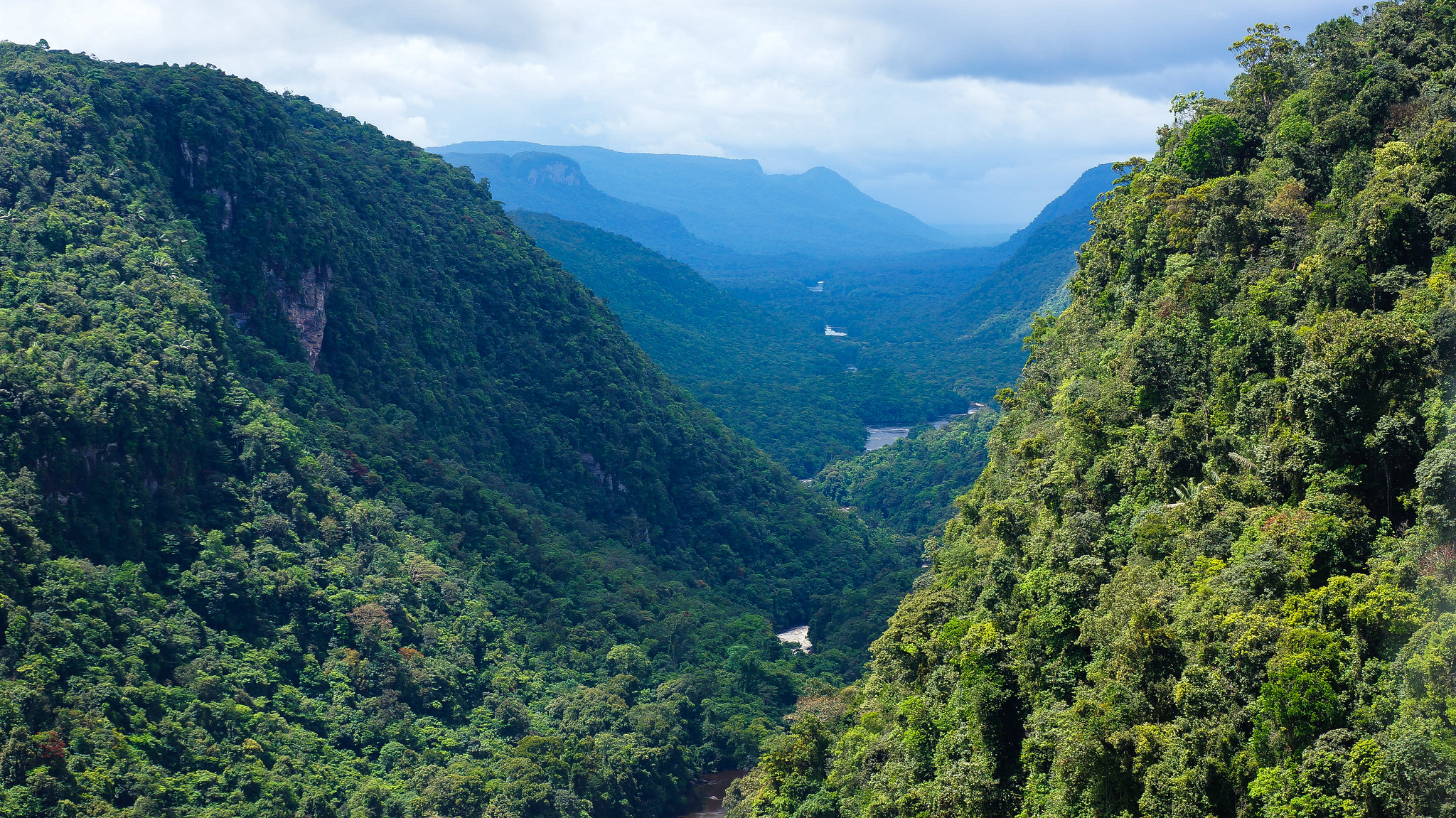
Prolific oil finds offshore Guyana have made the tiny country, located on the northern edge of South America, the talk of the town. With all eyes on Guyana now, the country hopes to bring global attention to its ambitious forest-saving plans.
President Dr. Irfaan Ali travelled around the world over the last two years talking about Guyana’s revised Low Carbon Development Strategy (LCDS). In short, this is a national plan detailing how Guyana will pursue development while protecting its vast, intact forests that help to trap harmful greenhouse gas emissions.
In September, Dr. Ali went from event to event at the United Nations General Assembly (UNGA 78) and on the sidelines, talked about Guyana’s nuanced approach to low carbon development.
At a Concordia event on September 18, he said developing countries should be allowed to exploit their resources because they were not traditionally given the opportunity to do so. For Guyana, that means pursuing a prolific oil and gas industry while earning from the forests that have not been cut down and harnessing other resources.
But he expressed concerns that developing countries seem to be chastised for finally harnessing their resources.
“When are the developing countries going to get the opportunities to exploit their resources to fund development?” President Ali asked during a panel discussion with former Colombian President Iván Duque.
Guyana’s pursuit is a tricky one. The global oil and gas industry is notorious for emitting carbon dioxide and other harmful greenhouse gases which has resulted in the current climate crisis.
On the other hand, Guyana has not been a large emitter of harmful gases but its forests have helped to trap emissions from other countries for years. If cut down and used for other productive activities, like agriculture or mining, those forests would not help to save the environment.
So Guyana is arguing that it must earn money from the forests. It hopes to do so by trading carbon credits, as it has already done with the Hess Corporation, one of the companies benefiting from oil and gas production offshore Guyana.
The plan to attract global attention and support for Guyana’s forest-saving efforts seems to be working.
Mr. Duque, for one, expressed his support for the LCDS. During the Concordia event, he said he was “impressed” by efforts to promote low carbon development while using the money earned from the oil and gas industry to fund development needs.
He isn’t the only person noticing Guyana’s ambitions.
His visit was described as historic since it was the first time a former or sitting British Prime Minister visited the South American country that was once under British rule. Mr. Blair had one public appearance: a conversation on the environment with President Ali at the University of Guyana’s Turkeyen campus.
“I think you’re in a very strong leadership position on this [forest protection and compensation] because you are one of the very few countries in the world that actually preserved their rainforests,” the former British Prime Minister said at that event.
He also opined that Guyana’s plan to harness money earned from oil and gas production to fuel national low carbon development efforts is one that can possibly be used to demonstrate how developing countries can exploit their resources and fund their development.
According to him, a global mechanism must be developed so that the “supposed contrast” of either harnessing your natural resources or protecting the environment is eliminated. For him, the two are not mutually exclusive.
He added, “That’s why this Low Carbon Development Strategy (LCDS) is important because it has worked for you over the years but it can be developed over the next few years if you get the right propulsion from the COP28 to something very, very big.
“… and I think one thing that is quite remarkable given it was done in 2009, and frankly it was quite difficult to do a strategy like that, is that the President will be able to come to COP28 and speak from a position of credibility and frankly, in the climate debate, that’s a quite rare commodity.”
Months before, Executive Vice President of the European Commission, Frans Timmermans expressed support for Guyana’s efforts to balance a low-carbon development agenda with new oil and gas production.
The Executive Vice President told President Ali: “The ambition of your government, Mr. President, to make sure that Guyana in its economic development, in the development of the fossil fuel industry, still maintains its high ambition for climate neutrality and the maintenance of your natural riches is something we want to be part of.”
He also noted that the “example of Guyana” should be seen by the world and the EU would be happy to support Guyana’s showcase at COP28.
Recognition seems to be growing for Guyana’s plans but concerns aren’t nonexistent.Some Indigenous people are worried that Guyana’s new plans to earn from forest protection efforts will limit their ability to use the land as they have traditionally done.
“… We depend on the land for our livelihoods. When we do not have money in our pockets, we go there to fish, we go there to hunt (and) we go there to gather.
“So we fear that they might have restrictions, you know, rules or guidelines that will be made to say how we use our forests,” Immaculata Casimero, a Wapichan Indigenous woman from the South Rupununi community of Aishalton, told a New York University Forum at the sidelines of the UNGA.
She also makes it clear that Indigenous people, like the Wapichan people in the south, have “done the work” to protect the forests. So she believes they too should be adequately compensated.
The LCDS acknowledges this and stipulates that 15% of any money earned through the carbon credits venture will go directly to all 240+ Indigenous communities in Guyana. The money is divided and distributed in sums based on the size of the communities.
With payments from Hess received, these disbursements have started and Indigenous communities are pursuing numerous ventures.
But Laura George, from the local non-governmental organisation the Amerindian People’s Association, told the NYU forum that there are other concerns.
George believes the consultations for the special ART TREES carbon credits certification were not adequate. She also believes the carbon credits venture is “pitting us against each other” because some communities support the venture and want the funds, while some groups have their concerns.
At the recently-concluded National Toshaos Council (NTC) Conference, an annual gathering of Indigenous chiefs, several leaders presented on how they were using the funds in their communities.
As of September, 225 communities received payments and the remaining 17 are due to receive theirs.
This story was published with the support of the Caribbean Climate Justice Journalism Fellowship, which is a joint venture of Climate Tracker and Open Society Foundations.
“We believe that one of the things that the government should do to get investors to make these sorts of investments is to try to minimise the risks they face.
“And you can only do that through a clear vision and policies that support that vision that are friendly to investments and therefore job creation,” Dr. Jagdeo said.
He too believed that there is substantial economic transformation gripping region three and believes that this new mall is a timely investment.
The West Central Mall will be open to the public from Saturday.
Meanwhile, Dr. Jagdeo also said the government was sourcing another 30MW of power. That unit should be delivered to Guyana before yearend and once delivered, power shortages should be reduced.
He also reminded the gathering that the government is constructing a new gas-to-energy project at Wales, West Bank Demerara. Once that project is operational, an additional 300MW of power will be available for local use; that power is expected to be half the cost currently paid.
recent escape of convicted mass murderer Mark Royden Williams from recurring, Home Affairs Minister Robesen Benn has said.
The convicted mass murderer escaped the Mazaruni Prison while being escorted back from a visit with the aid of heavily armed accomplices in a speedboat. The escort party was fired upon with AK-47 automatic rifles by men inside the boat alongside the Mazaruni River.
Noting that the experience was a learning curb for the prison service, Minister Benn on Friday said a review of the prison system was conducted to ensure that the transporting of prisoners, holding areas, and disciplinary orders are more secure to avoid possible dangers, like the escape on May 19.
“A review has been within the prison service itself as to what resorts we have to [take], particularly in relation to where people ought to be kept and what interfacing that they would have with members of the public and also the maintenance of the SOP’s [Standard Operating Procedure], the maintenance of the discipline order; that in the system we cannot relax. We have to be constantly vigilant with certain persons in the prison system,” Minister Benn said.
Six persons, including a Superintendent of Prisons, Alexander Hopkinson, 59 of Bartica Housing Scheme and his second-in-command, Oldfield Romulus, 50, of Victoria Cumberland Village, East Canje, Berbice, were charged with aiding the convicted killer. The minister said this is a matter that the Court is investigating.
Benn said that the positions held by the accused are filled to ensure the prison service is operating at maximum capacity. He added that there has been some difficulty experienced with getting people to work at the prison.
“There are still challenges in relation to the number of people who are willing to work in the prison system.
“I think it has been an area in which people normally don’t want to get involved without understanding the work of the prison system itself,” the minister said.
Two women were shot and injured Thursday night as they attempted to part a fight between two school girls at Freeman Street, East Ruimvedlt Georgetown.
Police Headquarters said the shooting occurred at about 18:45hrs. The Police did not disclose the identities of the injured women.
According to a Police report, a fight broke out between two 16-year-old schoolgirls.
During the process, the Police said the victims intervened in a bid to part the fight and stop the situation from escalating.
However, eyewitnesses recalled that it was at this point that the suspect, who is identified as Kennard Jabar whipped out a firearm from his waist and discharged several rounds in the direction of the women.
As a result, the women sustained gunshots to their right and left hand, respectively.
The suspect made good his escape. Police further stated that an unknown man who was in the suspect’s company retrieved the spent shells from the scene and escaped.
The victims were taken to the Georgetown Public Hospital where they were treated and discharged.
“It is unclear if the suspect is affiliated with any of the victims or the schoolgirls,” Police said.
According to the Police, CCTV cameras were seen in the area and will be reviewed by investigators.
He said, “I firmly believe that buildings, classrooms, laboratories, and equipment- educational infrastructure- are crucial elements of school learning environments. There is strong evidence that high-quality infrastructure facilitates better instruction, improves student outcomes, and reduces dropout rates, among other benefits.”
He said Nursery education is paramount in developing a well-rounded child.
Persaud applauded the Regional Administration and the Department of Education for Region Four for their excellent work to improve the quality of education infrastructure in the region.
Also, present at today’s commissioning was the Regional Education Officer, Mr. Adrian Elgin said that he was honoured to witness the commissioning of the school. On behalf of the Regional Democratic Council and the Department of Education, he thanked the Ministry of Education and the Government of Guyana for ensuring the region and the community of Haslington received a brand-new nursery school.
Televizyon Lakay
Jwe Jwèt Gratis!
Quiz, Solitaire ak Mo Kaché Jwèt Ayiti & Karayib — 100% gratis!


 Minister within the Ministry of Local Government and Regional Development, Anand Persaud engaging with an engineer of Fidis Guyana Incorporated
 Works ongoing on a section of the building
 Minister Persaud engaging with Town Clerk (ag) Candace Nelson and Assistant City Engineer of the Mayor and City Council, Rasheed Kellman
 vishani@newsroom.gy
 President Dr. Irfaan Ali and former Colombian President Iván Duque spoke about low carbon development and the oil industry at a Concordia event held at the sidelines of the ongoing United Nations General Assembly (Photo: Concordia/ Twitter/ September 18, 2023)
 President Dr. Irfaan Ali and Former UK Prime Minister Tony Blair in conversation. The sit-down conversation, moderated by the Vice-Chancellor of the University of Guyana, Professor Paloma Mohamed-Martin (Photo: Office of the President/ August 29, 2023)
 President Dr. Irfaan Ali (centre) alongside Executive President of the European Commission Frans Timmermans (right) and Guyana’s Finance Minister Dr. Ashni Singh (Photo: Office of the President/ June 14, 2023)
 Immaculata Casimero, a Wapichan indigenous woman from Guyana, speaks during a protest in Glasgow that denounces an energy transition that replaces fossil fuels with mining (Photo: Earthworks/ November 10, 2021)

 Ceremonial ribbon cutting to declare the mall officially open


 The Group of 2023 Bursary awardees with GBTI’s Leadership team members


 A woman involved in forestry in Coomacka


 Vice President, Dr Bharrat Jagdeo during a press conference at the Office of the President (Photo: News Room/August 31, 2023)

 recent escape of convicted mass murderer Mark Royden Williams from recurring, Home Affairs Minister Robesen Benn has said.


 The Minister of Education, Priya Manickchand unveiling the plaque with a pupil of the school and the Headmistress. (Photo: Ministry of Education/ September 29, 2023)
