Blog

  • Reg. Two students to access UG Engineering programme from October

    Reg. Two students to access UG Engineering programme from October

    Students in Region Two who want to study engineering at the University of Guyana (UG) will soon be able to do without leaving the Pomeroon-Supenaam district.

    Minister of Education, Sonia Parag and Presidential Advisor on Education (Tertiary Education Reform), Dr Kofi Dalrymple on Thursday conducted a site visit to the Essequibo Technical Institute to examine classrooms and labs suitable for UG’s engineering curriculum.

    The initiative, which is a collaboration between the Ministry of Education and UG, aims to expand access to higher education for students who were not admitted to UG due to space constraints.

    Parag said the team was satisfied with the Essequibo Technical Institute classrooms and labs, noting that the facility could accommodate at least 40 students.

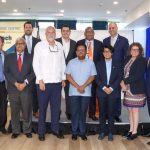
    Minister of Education, Sonia Parag (right) and Presidential Advisor on Education (Tertiary Education Reform), Dr Kofi Dalrymple (second from left) on Thursday conducted a site visit to the Essequibo Technical Institute (Photo: Ministry of Education/FB)

    She expressed optimism that the programmes could be launched by mid-October, with some classes running in sync with the UG main campus and others scheduled by on-site lecturers in Region Two.

    “We have this mandate to have those seats become available by the second week of October so that students can be able to be in a classroom… and pursue the particular programme in engineering and medical sciences.

    “We are satisfied after having visited the classrooms and the labs here so we can have a space that can at least accommodate 40 students at the moment. So we are feeling very optimistic that we can be able to achieve this within the time frame,” Parag said.

    Dr Dalrymple highlighted the dual goals of equity and access.

    Minister of Education, Sonia Parag on Thursday conducted a site visit to the Essequibo Technical Institute to examine classrooms and labs suitable for UG’s engineering curriculum (Photo: Ministry of Education/FB)

    “Equity, so that students in this region can get access to the same quality of education as those in Region Four, because the engineering programmes at UG are going towards accreditation which sets a standard. We want to ensure that the facility, the staff and what we set up can meet those standards,” he said.

    He also acknowledge that many students discontinue programmes because of limited access in their hometowns. Instead, those students are forced to travel elsewhere, a costly, burdensome venture.

    “There is a lot of great things going on in this region…that makes it a lot easier to be able to launch the engineering programme here because we have good human resources already here. Some things we will have to work on. We will need more space and people,” Dr Dalrymple added.

    The initiative fulfills a commitment made by President Irfaan Ali to decentralise medical and engineering studies, starting with Regions Two, Three, and Five, where demand is high but campus capacity is limited.

    The post Reg. Two students to access UG Engineering programme from October appeared first on News Room Guyana.
  • Fallout emerges among FGM coalition partners

    Fallout emerges among FGM coalition partners

    Controversy now surrounds the Forward Guyana Movement, with one party leader within the coalition alleging that she was threatened, and another rejecting the decision of how the single Parliamentary seat won will be shared.

    The Forward Guyana Movement is a coalition of three parties: Forward Guyana, founded by Amanza Walton-Desir after she left the People’s National Congress Reform (PNCR), the Vigilant Political Action Committee (V-PAC) led by Dorwain Bess, and the People’s Movement led by Nigel London.

    The coalition received the fourth-highest number of votes in the 2025 General and Regional Elections, securing a single seat in the National Assembly. However, the sharing of that seat has seemingly drawn some concerns.

    In a post on V-PAC’s Facebook page, Walton-Desir was accused of reneging on an agreement to rotate the seat.

    “The agreement was simple, the parliamentary seats secured by our combined mandate would be rotated equally among the three partners. That was our pact.

    “Walton-Desir tore up that pact the moment it suited her. Instead of honouring the deal, she anointed herself sole power-broker, keeping 60 percent of the seat for herself and handing 40 percent to Nigel London. VPAC, which fought alongside them and helped win that mandate, was cut out entirely. That is not leadership. That is theft,” the V-PAC Facebook post stated.

    But V-PAC’s post came hours after Walton-Desir alleged that she was threatened by someone who told her to reconcile with V-PAC. In a Facebook live, Walton-Desir, who was the coalition’s Presidential Candidate, rejected those threats and chastised persons who sought to silence women.

    “I will always make every effort to reconcile private and internal business privately, but I will not tolerate threats,” Walton-Desir said in the Facebook livestream on Wednesday night.

    In its statement, V-PAC accused Walton-Desir of fabricating the threat. It also vowed to “fight for its rightful share of representation”, noting that the coalition, not individual parties, won votes.

    New parties join forces to contest 2025 elections

    The post Fallout emerges among FGM coalition partners appeared first on News Room Guyana.

  • Strong port regulatory body in the works for improved maritime sector

    Strong port regulatory body in the works for improved maritime sector

    Minister of Public Utilities and Aviation, Deodat Indar on Thursday said an independent port authority body will be developed as Guyana positions itself as a global maritime and aviation hub.

    The minister was speaking at the World Maritime Day Exhibition held at the Guyana National Stadium, Providence. This year, the exhibition aims to promote opportunities within the local maritime sector and to celebrate the men and women within the industry. World Maritime Day is being held under the theme “Our Ocean, Our Obligation, Our Opportunity.”

    Persons engage with a exhibiting company at the World Maritime Day exhibition.

    He said Guyana will become a transshipment hub and the maritime sector must mimic international frameworks.

    “The security apparatus need to be uniformed, and we are working in that step to ensure that the things that come into our country and leave our country are not contraband so that we can protect the image of the maritime sector and Guyana as a whole,” he said.

    Minister of Public Utilities and Aviation, Deodat Indar during his remarks on Thursday.

    As such, Indar said an independent port authority is needed.

    “That will ensure transparency, accountability, and war class efficiency across all maritime operations,” Minister Indar posited.

    Head of Guyana’s Maritime Administration Department (MARAD), Captain Stephen Thomas said this port regulatory body would be an entirely new agency.

    With than 80 per cent of the global trade operated by sea, the maritime sector is critical for national development.

    Minister Indar also said there are massive plans to develop port facilities and infrastructure. He added that the rivers and channels are being expanded to facilitate larger vessels for more efficiency.

    “The economic benefits of deepening and widening the channels, making sure that we have larger vessel dried docks to make sure that the vessels that are operating here don’t have to go to Colombia or to go back to Louisiana or any other place for dry docking,” he said.


    The post Strong port regulatory body in the works for improved maritime sector appeared first on News Room Guyana.

  • Election trial: Court shown police interviews with Lowenfield, Carol Smith-Joseph

    Election trial: Court shown police interviews with Lowenfield, Carol Smith-Joseph

    Video-recorded police interviews with former Chief Elections Officer (CEO) Keith Lowenfield and APNU+AFC Chief Scrutineer Carol Smith-Joseph were presented in court on Wednesday as the trial into attempts to derail the 2020 General and Regional elections continued.

    The trial is being heard before Magistrate Faith McGusty at the Georgetown Magistrates’ Court.

    The court first heard the November 2020 interview with Smith-Joseph, which was conducted in the presence of her attorney, Nigel Hughes, at the Criminal Investigations Department (CID) Headquarters, Eve Leary. That session was a continuation of an earlier interview in September, which was cut short when Joseph fell ill.

    Joseph was questioned about her signature on a declaration prepared by former Returning Officer for District Four, Clairmont Mingo, on March 13, 2020, at GECOM headquarters, Kingston. When shown the document, which was also examined by Hughes, Joseph responded: “I am exercising my rights to silence.”

    Investigators also asked if she had traveled outside of Guyana, to which she again invoked her right to silence. When questioned about whether she held a Guyanese passport, she confirmed she did and acknowledged signing to apply for it. However, when asked to provide a handwriting specimen, Joseph refused, telling investigators, “I would refer to silence on that. You mentioned a lot of documents that you have, so why you need more from me?”

    At one point, Joseph sought clarification on why she was being questioned.

    The court also viewed a video-recorded interview with Lowenfield, which was conducted in October 2020, also at CID Headquarters, and in the presence of Hughes. Like Joseph’s, it was a continuation of an interview from September.

    Lowenfield was asked if he owned a Guyanese passport but declined to answer.

    He was then told that investigators had secured his passport application and submitted it for handwriting analysis alongside documents he signed at GECOM.

    He was shown the documents, including the 2020 elections report and the allocation of seats in the National Assembly, but maintained, “I have nothing to say on this.”

    During the 30-minute interview with Lowenfield, he sought to put on record his position on the investigation.

    Citing Article 163 (1)(b)(i) of the Constitution of Guyana, which grants the High Court exclusive jurisdiction to determine questions about the validity of elections, Lowenfield claimed the investigation was unlawful.

    Nine people are before the court in relation to electoral fraud. They are: former APNU+AFC government minister Volda Lawrence; former GECOM Chief Elections Officer Keith Lowenfield; former GECOM Returning Officer for District Four Clairmont Mingo; former GECOM Deputy Chief Election Officer Roxanne Myers; APNU+AFC’s Chief Scrutineer Carol Smith Joseph; and former GECOM employees Sheffern February, Enrique Liven, Michelle Miller and Denise Babb-Cummings.

    The trial continues on Thursday.

    The post Election trial: Court shown police interviews with Lowenfield, Carol Smith-Joseph appeared first on News Room Guyana.

  • FULL SPEECH: President Ali draws attention to crises confronting Guyana, global community

    FULL SPEECH: President Ali draws attention to crises confronting Guyana, global community

    See below the full address by President Dr Irfaan Ali to the 80th session of the General Assembly of the United Nations: 

    Madam President, Excellencies, Distinguished Delegates, Friends
    I extend my heartfelt congratulations to you, Madam President, on your election as President of the 80th Session of the United Nations General Assembly.

    I also record my profound appreciation to His Excellency Philemon Yang of Cameroon, whose distinguished stewardship and steady hand guided the 79th Session.

    Today, as we mark the 80th anniversary of the entry into force of the United Nations Charter, we find ourselves at a crossroads.

    This Organization, our Organization, has delivered.

    From creating international law, promoting development and human rights, to resolving disputes, providing humanitarian aid and advancing self-determination and independence. The fact remains, over these eight decades, we have worked together for the greater good.

    From 51 Member States in 1945 to 193 today, the UN has established itself as the premier organization for multilateralism. In fact, it is difficult to imagine our world without the United Nations.

    However, as it is with anniversaries, we must reflect honestly and candidly. Where are we at 80?

    Conflicts are raging as geopolitical tensions intensify, food insecurity is worsening, displacement is growing, human rights are being ignored, and climate change is threatening lives and livelihoods.

    Our Sustainable Development Goals are imperiled by shrinking development and budget support! Spending on peacekeeping budgets is diminishing and humanitarian costs are soaring. Meanwhile, global military spending in 2024 saw its steepest annual increase since the Cold War.

    President,

    The United Nations’ noble mission to maintain international peace and security will ring hollow if it allows power to triumph over principle and might to override right.

    In remaining faithful to its Charter, the United Nations must ensure that the survival and progress of humanity are not mortgaged to the ambitions of the powerful.

    The collective will of our membership must be reflected in the institutions and governance structures of the United Nations, including the Security Council.

    On this note, as we prepare to leave the Council at the end of this year, I want to thank our Permanent Representative and the team from Guyana for their exceptional work and leadership at the Security Council.

    It is precisely when the ideals of the United Nations are tested by horrific realities that the collective must act in defence of the UN Charter and international law.

    At present, a dark shadow looms over this 80th Session of the General Assembly; Genocide in Palestine, annexation of Ukrainian territory, persecution of women in Afghanistan, humanitarian catastrophe in Sudan, brutal gang violence in Haiti, increased transnational organized crime, trafficking and illegal migration.

    All this, as new challenges are emerging – cybercrime, cyber terrorism, and the pandemic of misinformation and disinformation, alongside the abuse of social media.

    President,

    Whilst we reiterate our condemnation of the attacks by Hamas on Israel on October 7, 2023 and again call for the immediate and unconditional release of all hostages, Israel’s actions have long shattered any pretense of legitimate self-defense. What we are witnessing is not warfare, but mass extermination—a systematic slaughter and displacement of Palestinian men, women, and children. Those who escape the bombs and bullets are condemned to die slowly, starved of food, water, and hope. This is a war crime.

    The international community must not remain paralysed, while an entire people is annihilated. Impunity must never triumph over justice. We must take urgent action to halt the genocide, return the hostages and accelerate our efforts towards the Two-State Solution. We urge Qatar, Egypt and the United States to continue their efforts in this regard.

    Further, the situation in Ukraine remains of utmost concern. Guyana reiterates its call for an end to the Russia-Ukraine war and reaffirms its support for Ukraine’s sovereignty and territorial integrity.

    Equally, the international community must act decisively in Haiti, where gang violence, displacement, and shortages of food and medicine have pushed the nation into deepening despair. Restoring security is the foremost priority, requiring strict enforcement of the arms embargo and robust support for an UN-authorized mission.

    I emphasize that without urgent humanitarian funding and a Haitian-led and owned political process, stability will remain elusive. We must address the root causes of Haiti’s continuing troubles, including its historical debt burdens which stymies its development prospects and upliftment of its peoples. As President Macron acknowledged, making Haiti pay for its independence was unjust. This is a welcome step.

    President,
    Turning to my own country.

    Guyana, a small and peaceful state. We have endured repeated threats and aggression from the Bolivarian Republic of Venezuela. The territorial controversy between our states is now before the International Court of Justice (ICJ) which has twice affirmed its jurisdiction, and which in 2023, issued provisional measures ordering Venezuela to refrain from altering the status quo.

    Yet, Venezuela persists with unilateral laws and threats of annexation, flagrantly violating international law, the UN Charter, and the very principles that sustain global order.

    If the rights of a small state can be trampled upon, and legally binding orders ignored, what protection remains for any nation under international law? Yet, Guyana continues to repose confidence in international law.
    For us, the principles of sovereignty, territorial integrity and non-interference are not negotiable.

    We will not cower to coercion, intimidation, or unilateral action. We thank our international partners and allies for their solidarity.

    President
    At 80, the time has come for a frank conversation on Cuba; One that would lead to the prosperity of its people, optimizing the full potential Cuba offers to its people and the rest of the world. Central to this dialogue is the lifting of the embargo on Cuba and its removal from the list as a State Sponsor of terrorism.

    Also important to our region is our collective effort against drug trafficking, human trafficking and illegal migration. We support efforts by the international community in addressing these crimes that are destroying the lives of our people, especially young people.

    The region must continue to champion efforts to enhance democracy, promote good governance and respect the will of the people in determining governments of their choice through free and fair elections.

    President,
    This year marks the 30th anniversary of the Beijing Declaration and Platform for Action. The declaration remains a blueprint for achieving gender equality which, despite transformative strides, remains significantly unrealized in most parts of the world.

    In Guyana, the dividends of strategic investments in leadership and capacity building for women and girls, are evident. More women have assumed leadership roles in government, in parliament and in public and private sectors.

    We have achieved gender parity in education at all levels and advanced the socio- economic empowerment of women through land and home ownership and diverse job opportunities in traditional and emerging sectors.

    To enable women to participate equally and competitively in the workforce, government is offering childcare support which will include day and night care centers for children.

    President,
    Survival of our people, our economies, and our planet depends on accelerating action on the Sustainable Development Goals. It requires a people-centered approach that prioritizes ending poverty and hunger, ensuring protection of children, support for persons with disabilities and empowerment of young people.

    Peace, stability, and sustainable development cannot exist in isolation from the urgent need to address climate change, which poses an existential threat to the most vulnerable and to our shared future.

    Guyana repeats the call for accelerated, unified global action to limit global warming.

    We continue to match our words with actions; protecting our forests, investing in sea and river defences, improving drainage and irrigation, and restoring mangrove ecosystems to protect our people, our land, and our livelihoods and our planet.

    Our Low Carbon Development Strategy 2030 demonstrates that economic growth and environmental stewardship can advance hand in hand. As the first country certified under the REDD+ Environmental Excellence Standard, and a successful seller of carbon credits, we are demonstrating that nature has tangible value and that innovation and responsibility can and must be rewarded.

    We call on the international community to deliver predictable, accessible climate finance, to support adaptation and resilience, and to embrace nature-based solutions. We once again commend Prime Minister Mottley and the Bridgetown initiative as the path toward sustainable financing for climate action.

    President,
    This year marks the 10th anniversary of the Sustainable Development Goals. Yet the slow pace of implementation and regression in many areas sound a stark warning that the promise of 2030 is at risk.

    Guyana calls for renewed global commitment to financing for development, including fulfilling Official Development Assistance pledges, mobilizing domestic resources, and addressing the crippling debt burdens that hinder progress in many developing nations.

    Addressing these development challenges requires recognizing that the health of our ecosystems is inseparable from the achievement of the SDGs.

    Guyana proudly convened the inaugural Global Biodiversity Alliance Summit in Georgetown in July 2025, uniting over 140 countries, organizations, community groups, indigenous leaders, scientists, and financial institutions. The Georgetown Declaration, endorsed by this broad coalition of stakeholders, sends a clear and urgent message that biodiversity is a global public good, and its protection must be woven into national development plans, climate strategies, and financial frameworks.
    Building on the global pledge to double protected areas by 2025 and achieve the “30 by 30” goal by 2030, the Summit underscored the urgent need for innovative financing mechanisms including biodiversity credits, green bonds, debt-for-nature swaps to fund nature’s protection.

    Guyana is actively exploring biodiversity credits to create sustainable income streams for forest communities, building on our carbon credit success.

    We have signed a Memorandum of Understanding with the Yale Center for Biodiversity and Global Change to co-develop a National Biodiversity Information System, a digital backbone for data-driven conservation.

    Guyana is demonstrating that economic development and environmental stewardship can advance together. By using natural gas as a bridge away from heavy fuel oil and investing in hydropower, solar, wind, and other renewables, we aim to lower electricity costs for our citizens and businesses while ensuring universal access to affordable, reliable, sustainable, and modern energy.

    Guyana is pursuing an ambitious energy infrastructure and investment plan. While climate change is an existential threat, the reality is that the world still requires energy, sourced from petroleum to power growth and development, for which there is growing demand.

    This is essential for the survival of our economies. AI and digitization are accelerating this demand at an extraordinary pace.

    As you are aware, Guyana is quickly becoming one of the world’s largest energy producers per capita, carefully balancing its green footprint with energy production.

    We will use our vast gas reserves, through a transformational gas to energy project. We will use this resource, taking advantage of our strategic geographic location to establish an AI hyperscale data center.

    Large AI data centers are rarely found in similar sized territories. As such, implementing a project of this scale is of immense pride for Guyana. This investment will improve the competitiveness of our region, accelerate digitization, build out a fintech ecosystem, modernize the service delivery platform of government and accelerate private investment, bringing new job opportunities.

    We recognize the indispensable nature of AI in our collective future. However, while there are immense benefits, there is no clarity on equity, access and applicability. Regulations, ethical standards and governance mechanisms are urgently needed. In this regard, we welcome the recent UN General Assembly decision to establish two global AI governance mechanisms.

    President,
    I now turn to food security. Guyana is actively leading efforts to advance the CARICOM Agri-food Systems Agenda through “Vision 2030,” aiming to boost food production, end hunger, and ensure food security across the Caribbean Region. Our experience demonstrates that strategic investment and political will can transform national and regional food systems.

    Guyana calls for the transformation of global food systems to be more resilient, sustainable, and equitable by strengthening local production and reducing dependence on volatile markets.

    Guyana stands ready to share its experience and partner with others to ensure nutritious food for all.

    As the United Nations commemorates its 80th anniversary, let us recall that this Organization was conceived not in comfort but in crisis, forged from the ashes of war to serve as the conscience and compass of humanity.

    Eight decades later, that duty has not dimmed; it has only grown more urgent.

    If the UN is to remain humanity’s best hope, it must stand firm against aggression and remain fully engaged with the great questions of our time. We must be bold in recognizing the necessity for institutional adjustments that will advance the organization’s success.

    Our generation will be judged not by the eloquence of our declarations, but by the substance of our deeds. From the ruins of Gaza to the streets of Haiti, from Kiev to the drowning coasts of small island states, the peoples of the world cry out for more than words.

    To honour eighty years of promise is to act with courage, to match principle with action, and to bind ourselves once more to the dream of a world united, not by fear or force, but by shared destiny and enduring hope.

    I thank you and may God bless all of our nations and all of our people.

    The post FULL SPEECH: President Ali draws attention to crises confronting Guyana, global community appeared first on News Room Guyana.

  • President Ali says focus on Haitian crisis, ‘frank conversation’ on Cuba needed 

    President Ali says focus on Haitian crisis, ‘frank conversation’ on Cuba needed 

    In his address to the United Nations General Assembly, President Dr Irfaan Ali turned the global spotlight to the Caribbean’s pressing crises, calling for decisive action in Haiti and a bold reassessment of Cuba’s situation.

    His remarks went beyond national interest, positioning Guyana as a voice for Latin America and the Caribbean (LAC) and a champion of solidarity for nations facing humanitarian, political, and developmental challenges.

    Ali offered a stark diagnosis of Haiti’s troubles, calling the situation “one of the most pressing crises of our time.”

    “Gun violence, displacement, and shortages of food and medicine have pushed Haiti into deepening despair,” he told the Assembly.

    For decades, Haiti has struggled with political instability, natural disasters, economic collapse, and social unrest. But in recent years, violence — fuelled by gang activity, corruption, and a weak state — has escalated sharply.

    Access to necessities has become perilous for many Haitians.

    Ali stressed that restoring security was the priority. He called for strict enforcement of the UN arms embargo on Haiti, robust support for a UN-authorised mission to restore order, urgent humanitarian funding to address basic needs, and a Haitian-led political process to ensure lasting stability.

    Guyana’s President Dr Irfaan Ali addressing the Un General Assembly (Photo: September 24, 2025)

    “Without urgent humanitarian funding and a Haitian-led and owned political process, stability will remain elusive,” Ali said.

    He also addressed the deeper causes of Haiti’s fragility, highlighting its historic debt burdens that continue to hinder development. Ali referenced a recent statement by French President Emmanuel Macron, who acknowledged that “making Haiti pay for its independence was unjust” — a view Ali described as “a welcome step” that must lead to meaningful debt relief.

    Ali’s intervention reflects a growing chorus at the UN for stronger international engagement in Haiti. The Haitian crisis is seen not just as a Caribbean problem but as a global one, with migration flows, instability, and humanitarian needs spilling beyond the island.

    Turning to Cuba, Ali said, “The time has come for a frank conversation on Cuba — one that would lead to prosperity for its people.”

    The call came against a backdrop of decades of sanctions and diplomatic tensions, with Cuba’s economic crisis exacerbated by the embargo imposed by the United States and the country’s listing as a state sponsor of terrorism. These measures have limited Cuba’s access to markets, financing, and essential goods.

    Ali argued that lifting the embargo and removing Cuba from the terrorism list would unlock its potential — for its citizens and for the wider region.

    “Optimising the full potential Cuba offers to its people and the rest of the world requires removing these barriers,” he said.

    He framed Cuba’s situation as both a matter of principle and regional solidarity, stressing that Caribbean and Latin American states must champion solutions that promote peace, democracy, and prosperity.

    Ali also tied Cuba to broader regional challenges, pointing to the importance of fighting drug trafficking, human trafficking, and illegal migration — threats that impact security and stability across the Americas.

    “We support the efforts of the international community to address these crimes that are destroying the lives of our people, especially young people,” he said.

    The post President Ali says focus on Haitian crisis, ‘frank conversation’ on Cuba needed  appeared first on News Room Guyana.

  • Guyana is ‘small and peaceful’ but ‘will not cower’ – Pres. Ali confronts Venezuela’s threats at UNGA

    Guyana is ‘small and peaceful’ but ‘will not cower’ – Pres. Ali confronts Venezuela’s threats at UNGA

    President Dr Irfaan Ali took the world stage at the United Nations General Assembly (UNGA) on Wednesday afternoon with an unshakeable message, telling global leaders that while Guyana is a “small and peaceful state,” it will never yield to threats and aggression from neighbouring Venezuela.

    Speaking at the 80th Session of the UNGA, Ali placed Guyana’s ongoing territorial controversy with Venezuela squarely within the broader struggle of small states to defend sovereignty and the rule of law.

    “We will not cower to coercion, intimidation, or unilateral action,” Ali declared.

    The border controversy centres on the Essequibo region, which makes up more than two-thirds of Guyana’s landmass. Venezuela has claimed the territory for decades, even though the 1899 Arbitral Award settled the boundary in Guyana’s favour. In 2018, Guyana referred the matter to the International Court of Justice (ICJ), which has twice affirmed its jurisdiction and, in 2023, issued provisional measures ordering Venezuela to refrain from altering the status quo.

    Yet, as Ali reminded the Assembly, Venezuela has “persisted with unilateral laws and threats of annexation, flagrantly violating international law, the UN Charter, and the very principles that sustain global order.”

    In December 2023, Venezuela held a referendum claiming to incorporate Essequibo as a new state, despite warnings from the ICJ. Since then, political rhetoric from Caracas has remained hostile, with repeated declarations that the territory belongs to Venezuela.

    Ali told delegates that the stakes go beyond Guyana’s borders. “If the rights of a small state can be trampled upon and legally binding orders ignored, what protection remains for any nation under international law?” he asked.

    For Guyana, the defence of Essequibo is not only about territory but about principle and that international law must be respected, regardless of a country’s size or military strength.

    Ali publicly thanked Guyana’s “international partners and allies for their solidarity,” though he did not name countries. In recent years, Guyana has secured vocal backing from the Caribbean Community (CARICOM), the Organisation of American States (OAS), the Commonwealth, and the United States, among others.

    That support, analysts say, is tied to both principle and geopolitics. The Essequibo region is believed to contain significant oil and mineral wealth, with major discoveries offshore already transforming Guyana into one of the fastest-growing economies in the world. A destabilised border controversy could unsettle energy markets and regional security.

    Notably, Venezuela is also scheduled to speak at the UNGA, though its delegation has often used the forum to reiterate claims over Essequibo. Guyana’s decision to highlight the controversy in such stark terms was widely seen as a pre-emptive move, framing the controversy in international law rather than allowing it to be portrayed as a bilateral quarrel.

    Ali’s timing was also deliberate: Guyana is completing its two-year term as a non-permanent member of the UN Security Council in December, giving it a platform to draw attention to the issue at the highest levels of multilateral diplomacy.

    “For us, the principles of sovereignty, territorial integrity, and non-interference are non-negotiable,” Ali told the Assembly.

    The ICJ is expected to rule definitively on the case in the coming years. Until then, Guyana insists it will continue to abide by the court’s processes, while demanding that Venezuela do the same.

    The post Guyana is ‘small and peaceful’ but ‘will not cower’ – Pres. Ali confronts Venezuela’s threats at UNGA appeared first on News Room Guyana.

  • Local gov’t ministry examines new dashboard to monitor, resolve complaints

    Local gov’t ministry examines new dashboard to monitor, resolve complaints

    Minister of Local Government and Regional Development, Priya Manickchand on Wednesday said a new dashboard could be created to help officials track complaints from residents. 

    In a video shared on her Facebook page, she said such a dashboard would help the ministry respond better to the needs of citizens. 

    “We are currently examining building out a dashboard where we could see centrally and locally where the complaints are… not only to see what they are but to make sure that they are resolved effectively,” Manickchand said. 

    Manickchand spoke about the possible venture just after visiting the Caledonia/Good Success Neighbourhood Democratic Council (NDC), as part of her ongoing engagements with local government bodies across the country.

    In a release, the ministry said Manickchand held discussions with the NDC Overseer, Chair, workmen, and other officials on the state of operations within the community during that visit. The conversations centered on the challenges faced at the local level, the delivery of services to residents, and the ways in which the Ministry can provide greater support to ensure effective and efficient functioning of the NDC.

    The engagement at Caledonia/Good Success NDC also included a review of the Single Window System, which is designed to streamline the process of applying for and obtaining approvals for building and extension works, both residential and commercial, through a single, simplified portal. It was also noted that Minister Manickchand examined how the system is functioning at the NDC level and was made aware that it is currently down. She emphasized to officials and staff that the system must work in service to the citizens of Guyana, and that supervisory and mandatory processes will be put in place to ensure this is done.


    The post Local gov’t ministry examines new dashboard to monitor, resolve complaints appeared first on News Room Guyana.

  • CNOOC’S solar project brings 24-hour power to Batavia

    CNOOC’S solar project brings 24-hour power to Batavia

    For the first time in its history, the Indigenous village of Batavia in Guyana’s Cuyuni-Mazaruni Region now enjoys access to stable and reliable electricity, thanks to the commissioning of a state-of-the-art solar microgrid project donated by CNOOC Petroleum Guyana Limited (CPGL) at a cost of USD1.5 million. CPGL is one of the leading companies in Guyana’s petroleum industry and a major investor in the Caribbean region.

    The commissioning ceremony was presided over by Prime Minister, Brigadier (Ret’d) Mark Phillips, who highlighted that the project was carefully designed to meet the specific energy needs of the Batavia community. The facility includes three solar microgrid systems with a total capacity of approximately 220 kilowatts, a 465 kWh battery storage system, more than 10 kilometers of distribution lines, and household connections for 79 homes, six public buildings, and six small businesses.

    Part of the three-point solar panel system on Arian Island, Batavia, Cuyuni-Mazaruni

    The community had previously relied on small, fuel-based generators that could not provide adequate power. He commended CPGL’s vision and generosity in undertaking an initiative that has transformed the lives of Batavia’s residents, aligning with the Government’s Low Carbon Development Strategy. He further emphasized that the project was implemented in accordance with Guyana’s Local Content Policy, with Green Energy Electrical Services (GEES), a local company, engaged to execute the work.

    The Prime Minister welcomed CPGL’s continued partnership in future projects that uplift communities, promote social and economic development, and contribute to building a Guyana where no one is left behind.

    In his remarks, CPGL President, Lian Jihong, described the commissioning as especially meaningful during Amerindian Heritage Month, a time when the nation celebrates the culture, history, and enduring contributions of Guyana’s First Peoples. He emphasized that the solar grid stands as a testament to CPGL’s commitment not only to Batavia but to the people of Guyana as a whole.

    Lian also reflected on CPGL’s wider Corporate Social Responsibility (CSR) efforts across Guyana. These include solar lighting in more than 20 Amerindian villages; US$300,000 annually in educational scholarships for both local and overseas degree programs; disaster relief assistance; refurbishment of schools; the donation of smart TVs and sports gear to more than 20 schools; the furnishing of public spaces with outdoor gymnasiums; and ongoing support to the health sector through knowledge transfer and the provision of critical materials.

    He noted that each project is designed to deliver lasting benefits while also strengthening the bond of friendship between Guyana and China. As a Chinese state-owned enterprise, he said, CNOOC is proud to contribute to these ties while playing an active role in Guyana’s inclusive and sustainable development.

    Mr. Lian reaffirmed CPGL’s readiness to continue working hand-in-hand with Government, the private sector, and communities to advance transformative progress across Guyana. CPGL is a subsidiary of CNOOC International, which operates in more than 20 countries and is the largest Chinese investor in the Caribbean region.

    Toshao of Batavia, Murphy Gomes, warmly welcomed the project, describing it as the start of a new chapter for the village. Residents expressed that children can now study at night and access digital learning resources, health workers are better equipped to provide care, and farmers, miners, and small businesses will benefit from improved efficiency and productivity.

    The ceremony also featured remarks from Lee Hanqing, Counsellor of the Embassy of China, NTC Secretary and Toshao of Karrau, Shane Cornelius, Chairman of Region 7, Kenneth Williams, Deputy Permanent Secretary of the Ministry of Natural Resources, Vishal Ambedkar, and  Alister Charlie MP, representing Minister of Amerindian Affairs, Hon. Sarah Brown. Guests were treated to vibrant cultural performances by Batavia residents, eager to showcase their traditions and talents on this historic occasion (Press release)

    The post CNOOC’S solar project brings 24-hour power to Batavia appeared first on News Room Guyana.

  • Six persons with disabilities get small loans 

    Six persons with disabilities get small loans 

    Six persons living with disabilities on Wednesday received loans totaling $3 million. The cheques were handed over by Minister of Tourism, Industry and Commerce, Hon. Susan Rodrigues and Permanent Secretary, Roger Rogers at the Small Business Bureau.

    The loans were secured through a revolving fund specifically designed to support entrepreneurs living with disabilities, providing them with access to loans of up to GYD $500,000 with zero collateral, zero interest, and a repayment period of up to four years. The initiative is supported by the Ministry of Human Services and Social Security.

    Minister Rodrigues noted that the initiative reflects the government’s ‘One Guyana’ philosophy, which prioritizes inclusivity regardless of race, gender, geography, or physical ability.

    “At its core, this fund is about ensuring that every citizen, regardless of ability or disability, has the opportunity to thrive and contribute meaningfully to national development,” she said.

    The Minister commended the diversity of ventures among the new beneficiaries, which include businesses in cellphone and accessories, landscaping, catering, and retail. She emphasized that sustainability and accountability are critical to the fund’s continued success.

    “This revolving fund creates a cycle of empowerment, where each success story contributes to the empowerment of others, thereby creating a self-sustaining engine of progress.”

    She further assured recipients that the Ministry’s monitoring and evaluation team will follow up to track their progress and provide ongoing support.

    “We must map your progress and provide the additional support needed along the way, so that these businesses are not only established, but positioned for growth,” she explained.

    Since its inception in 2023, the fund has disbursed 41 loans valued at more than GYD $20 million. For 2025 alone, 14 loans totaling GYD $7 million have already been issued.

    Minister Rodrigues urged beneficiaries to make the best use of this opportunity.

    “I encourage you to utilize these funds wisely and for their intended purpose. I look forward to hearing your success stories and to seeing the sustained growth of this fund, so that many more can benefit in the years ahead.” (Ministry of Tourism, Industry and Commerce press release)

    The post Six persons with disabilities get small loans  appeared first on News Room Guyana.

Televizyon Lakay
Televizyon Lakay
Jwe Jwèt Gratis!
Quiz, Solitaire ak Mo Kaché
Jwèt Ayiti & Karayib — 100% gratis!
Jwe Kounya — 100% Gratis →
English · Français · Kreyòl