Chase’s Academic Foundation continued their impressive dominance in the school football scene by clinching their second consecutive title in the Petra-organised Under-18 Schools’ Football League.
The final match on Sunday evening at the Ministry of Education ground on Carifesta Avenue saw Chase overpower Dolphin Secondary with a resounding score of 8-1.
Both teams entered the championship match level on points, each having garnered 18 points from six wins in their previous games, which set the stage for a thrilling showdown.
Bryan Wharton, the tournament’s Most Valuable Player and top scorer, netted five of his 15 goals this season in the final.
Neron Barrow, Omar Sam, and Neeiaz Baksh also contributed to the victory.
The title not only marked a significant achievement for Chase’s Academic Foundation, which finished the league with a perfect record of 7-0 and a total of 21 points, but it also positioned them for future competitions.
Despite the defeat, Dolphin Secondary finished second with 18 points and will also represent Guyana at the upcoming KFC Goodwill International tournament.
In addition to the glory of the championship title, Chase’s Academic Foundation was awarded a cash prize of $300,000, while Dolphin Secondary received $150,000.
The third and fourth-place finishers, Waramuri Secondary and West Ruimveldt Secondary, were also recognized with prizes of $75,000 and $50,000, respectively, all designated for their chosen school projects.
In other matches on the same day, South Ruimveldt delivered an impressive 7-0 victory over East Ruimveldt Secondary, aided by the standout performances of Zaphenath Hutson and Seon Grant, who scored braces.
Furthermore, West Ruimveldt showcased their prowess with an 8-0 demolition of President’s College, highlighted by a remarkable five-goal haul from Jeremiah Griffith, demonstrates the high level of talent in this year’s league.
The Government of Guyana on Monday issued a public notice regarding a letter circulating from a firm called “Project Development Consultancy (PDC),” claiming to conduct a “National Public Opinion Survey” from November 30 to December 13, 2024.
The Government has expressed concern that the survey’s enumerators are misleading the public, suggesting that the survey has official government endorsement. Authorities have clarified that the survey is not being conducted on behalf of the Government of Guyana, nor has it been authorised by any official government agency.
Citizens are being advised that participation in this survey is entirely voluntary and is not required for any national or official purposes. The Government emphasised that individuals should exercise caution if they are approached by representatives of this survey.
The public is reminded that any government-led initiatives or programmes are officially communicated through appropriate channels, including recognised government agencies and the media.
Thirty-nine Guyanese experts, along with 17 from overseas, conducted an expedition in the Acarai-Corentyne Corridor, located in southern Guyana and found new species of plants and animals.
This area is said to be one of the country’s most remote locations that has not been scientifically documented.
The partnership was formed by the Protected Areas Commission (PAC), the Field Museum of Natural History in Chicago, and numerous local Guyanese institutions that boast specialists in geology, plants, fishes, reptiles, amphibians, birds, mammals, soils, and local ecology.
The goal was to complete an assessment that can provide foundational information to inform future conservation decision-making and to determine the viability of the location as a protected area.
A presentation of the preliminary findings of the Rapid Biodiversity Inventory done over the 20-day period was given on Monday at the Umana Yana in Kingston, Georgetown.
Chairman of the PAC Board of Directors Robert Persaud (Photos: PAC/ Facebook/ December 2, 2024)
The team recorded more than 600 species of plants and at least 713 species of vertebrates; 22 species that had never before been recorded in Guyana and at least 23 species that are potentially new to science. Sixteen of the species recorded are considered globally threatened.
Expedition leader and Lead Conservation Ecologist at the Chicago Museum Dr. Lesley de Souza said Guyana is a global hotspot for biodiversity and harbors one of the best-protected tracts of rainforest on earth.
“But this area of Guyana has not been scientifically documented. The Amerindian communities know more about these areas than the foreign scientists who come to study the region’s biodiversity. Our goal is to marry these two bodies of knowledge,” she expressed.
Chairman of the PAC Board of Directors Robert Persaud offered that the location is home to diverse ecosystems and species that would prove beneficial to the country’s environmental health.
“I want you to see that your work here today has only now begun. And what you will be presenting us here today will certainly go a very far way in not only informing what local policies and action we take, but also informing what takes place perhaps at the global level,” he told the team.
The expedition forms part of the programme of work on Guyana’s expanded Low Carbon Development Strategy, LCDS 2030, that integrates forest carbon, watershed management, and biodiversity as priority areas of conservation and sustainable management of a low carbon economy.
The Acarai-Corentyne Corridor is a 1.3-million-hectare expanse of wild forests, creeks and mountains. Bounded by two of Guyana’s largest rivers – the Essequibo to the west and the New River to the east – the Corridor stretches 250 km from the highest peaks of the Acarai Mountains in the south to the lowland forests of central Guyana in the north.
This survey of the Guyanese rainforest is the most comprehensive study of the area’s ecology and biodiversity ever performed.
See below the full release from the Ministry of Finance:
With thousands of persons already registering to receive Government’s $100,000 cash grant, the Government has announced further that the actual distribution of the cash grant in the form of a cheque will commence tomorrow (Tuesday, December 3, 2024) in Region Nine (Upper Takutu/Upper Essequibo).
The distribution process will commence at 10 am at the Tabatinga Sports Complex for residents of Lethem and St. Ignatius and will continue until December 6 for that area. For other villages in the Region, Government has announced as well that these will be listed along with their distribution schedule soonest. Registration for the cash grant in the commenced today in several Regions.However, Region Nine will be the first Region that will receive the grant as Government plans to complete the process as quickly as possible.
Government’s $100,000Cash Grant Initiative was announced by President Irfaan Ali in October last and every Guyanese citizen 18 years old and over will receive the payout. The administration has prioritized public servants and pensioners and over the last several days, registration schedules for National Insurance Scheme and Old Age Pensioners were disseminated to the public via the media, followed by schedules for other members of the public within the last two days.
Vice President Bharrat Jagdeo on Thursday last indicated during his weekly press conference that the initial distribution process of the $100,000 one-off cash grant is expected to see about 300,000 Guyanese receiving their cash grants before the end of 2024, while the remainder of persons should receive theirs in January, 2025 and onward.
“We had already explained that it will take us about five months to complete the task. We are trying to hurry this up so that we could at least get the public servants and the pensioners completed before the end of the year. We may be able to do that and then a number of other people who are registered,” he added. He also assured that every eligible Guyanese will receive the cash grant, as promised by Government. He added that the audit office will play an integral role in the verification and payment process since the administration wants to ensure that the process is transparent and that there is a verifiable system.
On Wednesday the National Assembly approved a $30 billion supplementary provision for the distribution of the cash grant and Government has outlined a four-step process for the initiative which begins with the registration exercise comprising each community having a registration schedule then technical teams with pre-programmed tablets will be dispatched to gather persons’ data. The second stage is the verification of the registrants with the next stage being the cutting of checks then distribution to persons 18 and above. Once this initiative is completed, $60 billion would have been placed in the hands of citizens across the country.
Bangladesh’s counter-attacking batting and accurate fast bowling gave them their best day on this West Indies tour so far.
At stumps on the third day of the Jamaica Test, the visitors lead by 211 runs after they bowled out the home side for 146 runs.
This was only the second time in their history that Bangladesh took a first-innings lead after being bowled out for less than 200 runs.
They fared much better in their second innings – and the game’s third – finishing on 193-5, coming on the back of some hostile bowling from the West Indies fast bowlers.
The fielders, too, brought some heat with their words. Bangladesh, for the most part, appeared to show restraint. Umpires Kumar Dharmasena and Asif Yaqoob intervened several times to talk to a fielder or West Indies captain Kraigg Brathwaite.
Earlier in the day, West Indies had thrown away a solid position to fold for 146, losing their last nine wickets for only 61 runs. Nahid Rana, the sensational fast bowler, led Bangladesh with a maiden five-wicket haul, that included some intimidating bowling of his own.
Rana’s figures of 5-61 in the afternoon also included a bruising of Kemar Roach, who got hit twice on his shoulder while batting. Roach would later come out to bowl only in the 31st over of the third innings, allowing Bangladesh to avoid facing the man with a devastatingly good record against them.
Rana’s morning burst that left West Indies limping was a continuation of his performance on the second evening. Apart from his pace, his height generated extra bounce on the Sabina Park pitch.
It helped remove Brathwaite with a 142kph snorter that caught the batter hopping at the crease. The fend-off resulted in a loopy low catch to substitute Zakir Hasan at gully.
Rana forced Kavem Hodge into a mistimed pull shot shortly afterwards, but Taskin Ahmed couldn’t latch on to the catch running in from fine leg.
It didn’t cost Bangladesh a run, when later in the same over, Litton Das took a superb catch to remove Hodge.
Taskin got into the act when he bowled Alick Athanaze off the under edge. But it wasn’t just pace that knocked West Indies down.
Taijul Islam got one to spin between Justin Greaves’ bat and pad, bowling him for just two. Mehidy Hasan Miraz too picked up a wicket, when he trapped Shamar Joseph lbw shortly after the lunch break.
Rana and Taskin were fired up, and Hasan Mahmud wasn’t too far behind. He trapped Joshua Da Silva lbw and got Keacy Carty caught behind, down the leg side, in the space of three deliveries.
Rana then made light work of Alzarri Joseph, forcing him on the backfoot, before foxing him with a slower ball.
Alzarri timed it straight to mid-off where Mehidy took a tumbling catch. It ended a fine morning session for the visitors, who took seven wickets for 65 runs in 25 overs.
West Indies lasted three more overs after the lunch break when Rana had Kemar Roach lbw, to complete his five-for and give Bangladesh an 18-run lead.
Shamar Joseph picked up two wickets (Photo: Athelstan Bellamy)
Before Bangladesh’s innings began, umpire Dharmasena could be seen speaking to Brathwaite, the WI captain, and also with the slip cordon.
Jayden Seales wouldn’t back down however, continuing to engage the Bangladesh batters before gesticulating towards the Bangladesh dressing room when he dismissed Mahmudul Hasan Joy for a duck.
The chatter from the West Indies bowlers and fielders, though, lost its voice when, Shahadat Hossain, promoted to No. 3, started going after the bowling. He miscued a couple of lofted shots before he cracked Alzarri for a boundary with a square cut.
He curled one through mid-on off Shamar before Brathwaite dropped him on 22. Shahadat however didn’t back off, as he slammed Alzarri through mid-off shortly afterwards, for another boundary.
Shahadat however fell trying one lofted shot too many. Seales took his catch at mid-off when he miscued Alzarri, but Shahadat’s innings of a 26-ball 28 with four fours lifted Bangladesh’s mood.
It resulted in a burst of boundaries from Shadman Islam and Mehidy, who came to bat at No. 4 in the absence of the ill Mominul Haque.
Mehidy struck Shamar for four boundaries in a row in the next over. He struck two straight drives before edging two through the slip cordon.
Shadman and Mehidy then hit three pull shots to get as many boundaries in the following over bowled by Seales. Shadman then struck Seales for two more fours, to make it ten boundaries in the space of four overs.
Shadman however fell shortly after the tea break, edging Shamar in a similar fashion for the second time in the game. He made 46 off 82 balls, including seven fours, most of it coming in that four-over burst.
Shadman’s dismissal ended a whirlwind 70-run stand for the third wicket. Mehidy followed Shadman shortly afterwards, strangled down the leg-side by Shamar and given out after West Indies successfully reviewed a not-out call. Mehidy hit seven fours in his 39-ball 42.
Litton and Jaker Ali then struck Seales and Shamar for two boundaries each, before Da Silva dropped Litton off Shamar’s bowling. It was a slightly difficult chance down the leg-side but wicketkeepers take them regularly.
Litton however fell for 25, almost against the run of play, when he missed Greaves’ off-cutter.
Jaker stayed firm, taking Bangladesh past the 200-run lead. West Indies captain Brathwaite struggled to rotate his bowlers around in Roach’s absence.
Greaves filled in but the main bowlers struggled to keep the visitors quiet. Bangladesh fought tooth and nail against West Indies’ bouncers – of various kinds – to claim a memorable day in Jamaica. (ESPNcricinfo)
See below the full release from the Guyana Manufacturing and Services Association (GMSA):
The Guyana Manufacturing and Services Association (GMSA) expresses grave concern regarding the ongoing industrial action at the Port of Port-of-Spain in Trinidad and Tobago, which has severely disrupted regional trade and impacted businesses in Guyana.
This strike and now ‘go-slow operation,’ which has been persisting for over two months, has caused significant delays in the clearance of containers carrying raw materials and time-sensitive goods. As a result, manufacturers and businesses in Guyana are incurring substantial financial losses, particularly during this critical Christmas season when import volumes are significantly higher. These delays have also contributed to price increases for consumer goods, including basic necessities, as businesses are forced to navigate higher costs associated with supply chain disruptions.
Trinidad and Tobago plays a crucial role as a transshipment hub for the Caribbean, facilitating the movement of goods to Guyana and countries in the Caribbean. Prolonged disruptions at its ports are jeopardising regional supply chains, with dire implications for businesses and consumers alike.
The GMSA calls on the Government of Guyana to work with their counterparts to urgently intervene and facilitate a resolution to this impasse. The Association urges port management and the Seamen and Waterfront Workers Trade Union (SWWTU) to prioritise dialogue and collaboration with the aim of swiftly restoring operations.
The recent Industrial Court ruling directing workers to resume duties is a step forward, but the underlying issues require immediate attention to prevent further disruptions.
The GMSA implores the authorities to recognise the broader regional impact of these disruptions and to take decisive steps toward restoring normalcy at the Port of Port-of Spain. A swift resolution is essential to safeguarding the economic interests of both Trinidad and Tobago and its trading partners across the Caribbean.
Police ranks in Region One (Barima- Waini) on Sunday arrested two businessmen after 79.4 grammes of marijuana and over $270,000 in cash were discovered at their premises at Trainline, Port Kaituma, North West District.
Acting on intelligence, a team of ranks led by an Inspector, went to the residence and business premises of the two men: Lancelot Glen, a 40-year-old businessman, and George Whittaker Hope, a 31-year-old businessman.
When they arrived at the premises, 31-year-old Hope was seen shirtless, sitting outside. On seeing the ranks, Hope hurriedly ran inside, locked the entrance door, and turned off the lights, raising the officers’ suspicions. The team called out to Hope, who initially failed to respond. After several minutes of knocking on the wooden door, it was opened, and Hope presented himself.
The ranks informed him of their presence and the reason for the visit; that is, to conduct a search for narcotics, illegal arms, and ammunition. Hope consented to the search, allowing the officers to enter through the main entrance. When asked if he was alone, he replied that he was, as 40-year-old Glen was not present.
During the search, the team discovered a bulky black plastic bag on a table inside the building.
The bag was opened in Hope’s presence, revealing 113 small transparent ziplock bags, each containing marijuana.
The suspect was then informed of the offence, and when cautioned responded by saying: “That’s all I have, officer.”
He was then arrested.
Additionally, a quantity of cash in various denominations (20’s, 50’s, 100’s, 500’s, 1000’s, and 5000’s) was found in different areas of the building. When counted in Hope’s presence, the cash totalled $270,320.
The cash was seized as it was suspected to be proceeds from narcotics sales.
Subsequently, contact was made with Glen, the other occupant of the building. Glen was shown the suspected narcotics, informed of the offence, and cautioned.
He replied, “I live there, but I don’t know anything about any drugs.” He was also arrested and placed into custody.
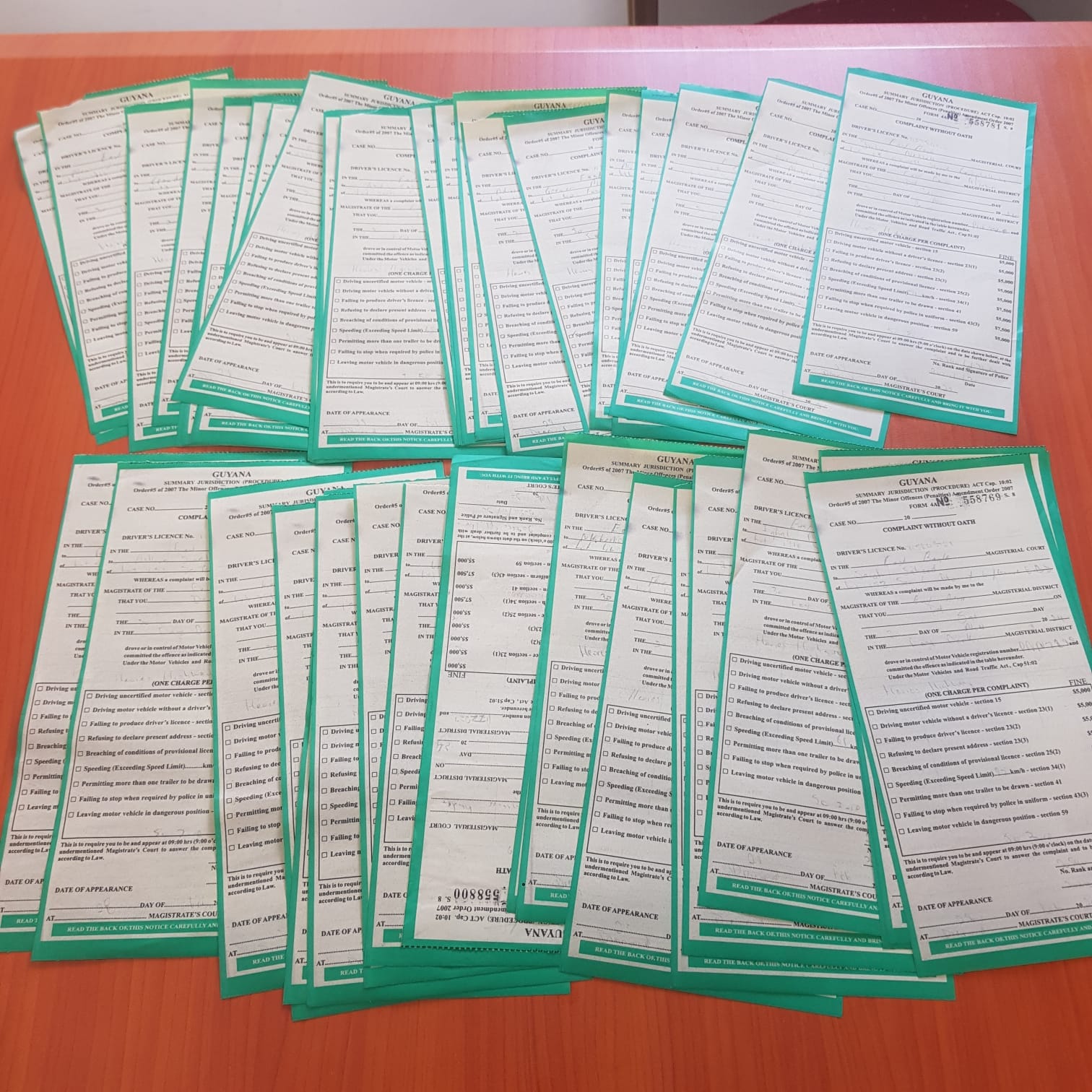
A total of 4, 276 traffic cases were recorded during the period November 24 to November 30, 2024, according to a statement from the Guyana Police Force.
The offences were found during rigid traffic enforcement campaigns across the country in all Regional Police Divisions.
As far as possible and with the deployment of available resources, traffic ranks were out and about seeking to prevent accidents and improve road safety.
Below is a breakdown of the offences;
Exceeding the Speed limit: 791 cases with 190 tickets issued on the Heroes Highway alone
Failure to wear seat belt: 192 cases
Faulty packing of load: 76 cases with motor lorries transporting construction materials being the major contributor
Failure to wear a safety helmet and driver permitting pillion rider without a safety helmet: 297 cases
Press Release from the Powerlifting Federation president Franklin Wilson
On behalf of the executive and members of the Powerlifting fraternity, I would like to extend congratulations to Mr. Dominic Tyrrell, who was voted runner-up for the 2023 Sportsman-of-the Year award at the awards presentation on November 28 on the lawns of Castellani House.
Your dedication, discipline, and commitment to the sport have been duly recognised and rewarded.
To the other nominees- Romeo Hunter, Nadina Taharally, the Fesupo and World Masters Championships Teams- special congratulations for keeping the torch alight as you continue to represent the Golden Arrowhead proudly and successfully on the world stage.
This is the start of bigger things that will come to the sport.
The sport has made tremendous strides in the past two years on and off the platform, as we build on the foundation of our determined predecessors who scorched the platform to position us for the successes enjoyed.
The sport of powerlifting has a bright future, and I encourage you all to continue being committed and disciplined in your pursuits.
The President of Barbados Dame Sandra Mason presented Eddy Grant with the Honorary Order of Freedom of Barbados at the 58th Anniversary of Independence Ceremony at the Kensington Oval on Saturday 30th November 2024.
The Honorary Order of Freedom of Barbados was awarded to prominent
entrepreneur Richard Edghill and two other global icons in an honorary capacity.
This honour acknowledges a distinguished person who is not a citizen of Barbados
but whose contributions make it desirable for the nation to confer such recognition.
The recipients are Prime Minister of India Narendra Modi and musical doyen
Edmond Eddy Grant.
Prime Minister Modi is being honoured for his “leading role and reputation for
responsiveness and care. Under his strategic leadership, the Government of the
Republic of India took urgent action to assist countries like Barbados with
Covishield vaccines, which changed the course of the COVID-19 pandemic and
minimised its social and economic impacts”.
Eddy Grant is being cited for his exceptional achievements as a global cultural icon, innovator of unique music genres including soca and Ringbang, vociferous
promoter of indigenous music, socio-political commentator, and matchless talent as a singer, songwriter, and multi-instrumentalist.
The OFB also honours Grant’s excellent contributions to the development of local,
regional, and international recording artistes (Press release)

</p>
<p>” data-medium-file=”https://newsroom.gy/wp-content/uploads/2024/12/468899847_983510713821991_5161913774166896311_n-200×300.jpg” data-large-file=”https://newsroom.gy/wp-content/uploads/2024/12/468899847_983510713821991_5161913774166896311_n-683×1024.jpg” class=”wp-image-189586 ” src=”https://newsroom.gy/wp-content/uploads/2024/12/468899847_983510713821991_5161913774166896311_n.jpg” alt=”” width=”493″ height=”740″ srcset=”https://newsroom.gy/wp-content/uploads/2024/12/468899847_983510713821991_5161913774166896311_n.jpg 1365w, https://newsroom.gy/wp-content/uploads/2024/12/468899847_983510713821991_5161913774166896311_n-200×300.jpg 200w, https://newsroom.gy/wp-content/uploads/2024/12/468899847_983510713821991_5161913774166896311_n-683×1024.jpg 683w, https://newsroom.gy/wp-content/uploads/2024/12/468899847_983510713821991_5161913774166896311_n-768×1152.jpg 768w, https://newsroom.gy/wp-content/uploads/2024/12/468899847_983510713821991_5161913774166896311_n-1024×1536.jpg 1024w, https://newsroom.gy/wp-content/uploads/2024/12/468899847_983510713821991_5161913774166896311_n-280×420.jpg 280w, https://newsroom.gy/wp-content/uploads/2024/12/468899847_983510713821991_5161913774166896311_n-640×960.jpg 640w, https://newsroom.gy/wp-content/uploads/2024/12/468899847_983510713821991_5161913774166896311_n-681×1022.jpg 681w” sizes=”(max-width: 493px) 100vw, 493px”><figcaption class=) Chairman of the PAC Board of Directors Robert Persaud (Photos: PAC/ Facebook/ December 2, 2024)
Chairman of the PAC Board of Directors Robert Persaud (Photos: PAC/ Facebook/ December 2, 2024)</p>
<p>” data-medium-file=”https://newsroom.gy/wp-content/uploads/2024/12/Screenshot-2024-12-02-192845-300×208.png” data-large-file=”https://newsroom.gy/wp-content/uploads/2024/12/Screenshot-2024-12-02-192845-1024×711.png” class=” wp-image-189581″ src=”https://newsroom.gy/wp-content/uploads/2024/12/Screenshot-2024-12-02-192845-300×208.png” alt=”” width=”1250″ height=”867″ srcset=”https://newsroom.gy/wp-content/uploads/2024/12/Screenshot-2024-12-02-192845-300×208.png 300w, https://newsroom.gy/wp-content/uploads/2024/12/Screenshot-2024-12-02-192845-1024×711.png 1024w, https://newsroom.gy/wp-content/uploads/2024/12/Screenshot-2024-12-02-192845-768×533.png 768w, https://newsroom.gy/wp-content/uploads/2024/12/Screenshot-2024-12-02-192845-605×420.png 605w, https://newsroom.gy/wp-content/uploads/2024/12/Screenshot-2024-12-02-192845-640×444.png 640w, https://newsroom.gy/wp-content/uploads/2024/12/Screenshot-2024-12-02-192845-681×473.png 681w, https://newsroom.gy/wp-content/uploads/2024/12/Screenshot-2024-12-02-192845.png 1160w” sizes=”(max-width: 1250px) 100vw, 1250px”><figcaption class=) Shamar Joseph picked up two wickets (Photo: Athelstan Bellamy)
Shamar Joseph picked up two wickets (Photo: Athelstan Bellamy)