To significantly boost local participation in the oil and gas industry, the Local Content Secretariat invested approximately $314 million in procurement opportunities, hiring 4,500 locals as of June 2024.
This aims to strengthen the role of Guyanese businesses in the sector, with a marked increase in local employment and opportunities for local suppliers.
“We have all seen the important role of the local content law. The policy that we have introduced, this year alone, mid-January our procurement opportunities spent on local companies was somewhere around $314 million,” said Martin Pertab, Director of the Local Content Secretariat.
“New hires for the year as of June this year is around 424, for 40 major tier 1 companies…Total employment is somewhere around 4,500, but if we consider all the tier 1 and tier 2 companies, it’s closer to 6,500.”
Director of the Local Content Secretariat Martin Pertab (Photo: News Room/February 16, 2022)
Speaking at a steel strike ceremony for the Jaguar FPSO on Tuesday, Pertab highlighted that these figures represent a “huge” increase compared to the previous year, underscoring the success of the Local Content Bill passed in December 2021.
With a focus on further expanding local business involvement, Pertab emphasized that the government’s efforts this year have been more aggressive, with a series of engagements to address challenges faced by local companies.
“We want to push the boundaries some more on local content. We want to shift the focus from the low-hanging fruits and take it a step further to focus more on some of the suffocated line of services,” he stated.
To ensure that these opportunities are maximized, Pertab stressed the importance of continued dialogue with local companies.
“At the end of the day, we want to strike the right balance where companies here operating in Guyana feel comfortable, knowing there is predictability and confidence in the market. At the same time, local businesses should feel supported by the secretariat and the government’s guidance to help their growth,” he explained.
Pertab also announced plans to launch a local content app before the end of the year, designed to connect local businesses with Tier 1 companies more efficiently. “We want to ensure that it is user-friendly and we can make maximum use of the technology,” he said, signaling a further step toward streamlining opportunities for local players in the thriving oil and gas sector.
Amid intensified discussions on the attempts to derail the 2020 General and Regional Elections, President Dr. Irfaan Ali on Wednesday suggested that a new code of conduct should be in place to bar any undemocratic behaviours from persons seeking public office.
The President, during an interview with five woman journalists as part of his new ‘In the Seat’ programme, spoke about the 2020 elections and his view on the pace at which the elections’ trial has been unfolding.
For him, there should be “some amount of expediency” in dealing with such national issues. However, he acknowledged that the judiciary is an independent body whose work must not be interfered with.
Nevertheless, the Head of State expressed some concerns about parties and party members who were involved in the “heist” and may be seeking public office once again.
“A lot of people asked me the question: ‘What about those people who defended this heist?’
“Should some sort of code of conduct be applied, especially for public office?” he quizzed.
Dr. Ali added, “If they can defend that 32 is greater than 33, and if they defend attempts to rig an election… then they are showing they can defend something they are capable of doing, they are defending something that was beneficial to them and they are defending something they were part of.”
The March 2020 Elections were marred by controversy. It took five months before Irfaan Ali and the People’s Progressive Party Civic (PPP/C) were officially declared the winners through Statements of Poll (SoPs) that showed this victory were produced by the PPP/C days after the elections.
For the past four years, the APNU+AFC has not produced their SoPs which they insist show that they won the 2020 elections. And year later, members of the parties are challenging the recount which was accepted by the Caribbean Court of Justice (CCJ) and all international observer missions in Guyana at the time.
Nigel Hughes, the recently- elected leader of the Alliance For Change (AFC), is one political leader who has faced questions over the past few weeks and has come under pressure to apologise for the party’s role in derailing the 2020 General and Regional Elections
In a live broadcast, Hughes said he promised to conduct a review of the party’s performance in his acceptance speech for party leader earlier this year. And he said until that assessment is complete, he will not speak on the concerns raised.
Meanwhile, the President also noted on Wednesday that a previously announced ‘Order of Democracy’ National Award will be issued next year. This award, he explained, is for those persons who helped to defend Guyana against the threats to democracy in 2020.
President Dr. Irfaan Ali said that some groups of people, including public sector employees and pensioners, will get their $100,000 cash grant before the end of November.
The Guyanese Head of State said this on Wednesday during the inaugural edition of his new ‘In the Seat’ programme with local journalists.
Already, the President said a new software application- an app- has been developed to gather citizens’ information and ensure that the distribution of the one-off cash grant is done in a seamless, transparent manner.
President Dr. Irfaan Ali during his inaugural ‘In the Seat’ engagement (Photo: November 13, 2024)
And with persons trained to use that app, community engagements will start to unfold so that people’s data can be collected and the grant, distributed. The President reiterated that the government prefers to distribute this special grant via cheques.
“… We are starting this weekend in Region Nine for example.
“The app would be up and running, and before the end of the month, the easy datasets like public sector employees, the pensioners, all of that would be easily paid out,” President Ali told the five women journalists part of his programme.
He added that the government will endeavour to distribute the grant across the hinterland as soon as possible since it is more challenging to engage residents in those areas than it is to on the coast.
The cash grant was part of a suite of measures recently announced by President Ali. It was previously noted that the distribution of the grant to all Guyanese adults should take about five months.
All Guyanese adults (that is, persons aged 18 years and older) will be eligible for the $100,000. Guyanese adults living abroad are also eligible for the cash grant but they must possess the relevant Guyanese identification documents and they must uplift the grant in Guyana themselves.
After a weekend of majestic run-scoring and massive six-hitting, Village Rams, Tropix Falcons, District Renegades and Eclipse Carnage have advanced to the playoff of the inaugural One Guyana Local Franchise Cup.
The six-team, 10-over tapeball competition commenced with preliminary round matches on the tarmac of the National Track and Field Centre, West Coast Demerara.
The tournament is being coordinated by Deopersaud Lalta, Devon Paul and Sheik Hassan. Notably, the competition dictates one female player in every XI.
Tropix Falcons
Village Rams, Tropix Falcons and District Renegades all emerged with four wins from their five matches each, while Eclipse Carnage, with two victories, finished in the top four.
Power Hitterz, with just a solitary win, and the winless West Side Warriors failed to make playoff, which are slated for Sunday, November 17 at the same venue.
District Renegades
In Qualifier One at 10:00h, Village Rams will clash with Tropix Falcons with the winner advancing to the final, followed by District Renegades versus Eclipse Carnage from 11:30h in the Eliminator.
At 14:30h, Qualifier Two will bring together the loser of Qualifier One against the winner of the Eliminator to determine the other finalist.
Before the grand final at 19:00h, there will be an exhibition game between Deo XI and Devon XI, starting at 17:00h.
Eclipse Carnage
Runs galore
The preliminary matches saw some top individual performances, no less than Shakiel Wong, who slammed back-to-back hundreds for Power Hitterz.
The opener smashed 112* off 37 balls (9x4s, 11x6s) against Tropix Falcons and followed up with an unbeaten 108 off 27 (2x4s, 16x6s) against West Side Warriors.
Shakiel Wong (right) receives a prize from Assistant Director of Sport, Franklin Wilson
Local tapeball maestro Jonte Thomas blasted a belligerent 143 not out off just 33 balls (2x4s, 21x6s) for Tropix Falcons against West Side Warriors, along with 55 against District Renegades and 50 against Power Hitterz.
Jonte Thomas (left) receives his Player-of-the-Match trophy from one of the organisers Deopersaud Lalta
Thomas’ teammate Ershaad Ali also joined the century club, blasting 118* off 32 (3x4s, 16x6s) against Village Rams, and added 72* against Power Hitterz and 66 against West Side Warriors.
Kevon Boodie made 104* off 31 (14x6s) in a losing cause for West Side Warriors against Tropix Falcons.
There were several half-centuries as well- Andy Lall (92 and 82), Andrew Lim (65 and 98), Bepaul Bandoo (50 and 91*), Jonathan Van Lange (58* and 53*), Quazim Yusuf (55* and 82*), Rickey Sargeant (77*), Sheldon Alexander (61), Avinash Mohabir (78*), Quentin Sampson (75), U. Persaud (67)
Below are the summarised scores from the games
GAME ONE: District Renegades defeated Tropix Falcons by seven wickets
SUMMARY: Tropix Falcons 193-4 from 10 overs (Andrew Lim 65, Jonte Thomas 55, Deonarine Seegobin 31; Rickey Sargeant 1-12, Irfaan Ali 1-20, Jimol Marks 1-26) vs District Renegades 195-3 from 9.3 overs (Rickey Sargeant 77*, Bepaul Bandoo 50, Andy Lall 47; Andrew Lim 1-11, Deonarine Seegobin 1-18)
GAME TWO: Eclipse Carnage defeated West Side Warriors by seven wickets
SUMMARY: West Side Warriors 74-8 from 10 overs (Medha Dhanpaul 18, Akib Mullin 10; Devindra Latchman 2-4, Nandkumar Ramanan 2-7) vs Eclipse Carnage 79-3 from four overs (Jonathan Van Lange 58*; Avishkar Ramgobin 3-21)
GAME THREE: District Renegades defeated Eclipse Carnage by four wickets
SUMMARY: Eclipse Carnage 122-4 from 10 overs (Jonathan Van Lange 33, Arnim Griffith 31, Devindra Latchman 21; Bepaul Bandoo 2-29) vs District Renegades 128-6 from 8.4 overs (Troy Gonsalves 23, Tekeram Persaud 22, Rickey Sargeant 20; Chatram Nauth 2-5)
GAME FOUR: Tropix Falcons defeated Power Hitterz by six wickets
SUMMARY: Power Hitterz 161-3 from 10 overs (Shakiel Wong 112*, Avinash Mohabir 19; Neiland Cadogan 1-16, Andrew Lim 1-19) vs Tropix Falcons 168-4 from eight overs (Ershaad Ali 72*, Jonte Thomas 50; Anthony Antonio 3-19)
GAME FIVE: District Renegades defeated West Side Warriors by 70 runs (DLS)
SUMMARY: District Renegades 192-5 from 10 overs (Andy Lall 92, Troy Gonsalves 46*; Avishkar Ramgobin 2-34) vs West Side Warriors 69-3 from 7.2 overs (Akeim Wieira 29; Vibert Johnson 2-6)
GAME SIX: Village Rams defeated Power Hitterz by 74 runs
SUMMARY: Village Rams 142-6 from 10 overs (Quazim Yusuf 55*, U. Persaud 41; Darwin La Rose 1-8, Clint Jones 1-20, Derrick Calman 1-34, Ricardo David 1-36) vs Power Hitterz 68-9 from 10 overs (Clint Jones 22; Shiveshwar Sankar 3-22)
GAME SEVEN: Tropix Falcons defeated Village Rams by nine wickets
SUMMARY: Village Rams 150-2 from 10 overs (Quazim Yusuf 82*, U. Persaud 44; Ayodha Joseph 1-22) vs Tropix Falcons 154-1 from 8.3 overs (Ershaad Ali 118*, Jonte Thomas 28; Mark Jeffers 1-20)
GAME EIGHT: Village Rams defeated Eclipse Carnage by 55 runs
SUMMARY: Village Rams 155-3 from 10 overs (Sheldon Alexander 61, Quazim Yusuf 35; Devindra Latchman 1-25, Nandkumar Ramanan 1-28, Chatram Nauth 1-33) vs Eclipse Carnage 100-5 from 10 overs (Lincoln Leander 34, Keshan Persaud 29; Rajpaul Basdeo 2-9)
GAME NINE: Power Hitterz defeated West Side Warriors by 81 runs
SUMMARY: Power Hitterz 222-5 from 10 overs (Shakiel Wong 108*; Avinash Mohabir 78*; Akeim Wieira 3-32) vs West Side Warriors 141-5 from 10 overs (Sachin Basdeo 41, Shazim Ali 35, Medha Dhanpaul 31; Derrick Calman 2-21)
GAME 10: Tropix Falcons defeated West Side Warriors by 102 runs
SUMMARY: Tropix Falcons 249-3 from 10 overs (Jonte Thomas 143*; Ershaad Ali 66; Sarah Bheir 1-38, Raul Ganpat 1-44) vs West Side Warriors 147-5 from 10 overs (Kevon Boodie 104*; Ntini Permaul 2-13)
GAME 11: Village Rams defeated District Renegades by 24 runs
SUMMARY: Village Rams 156-2 from 10 overs (Quentin Sampson 75, Sagar Hathirmani 49, U. Persaud 32*; Bepaul Bandoo 1-25, Troy Gonsalves 1-34) vs District Renegades 132-6 from 10 overs (Andy Lall 82; Quentin Sampson 2-9)
GAME 12: Eclipse Carnage defeated Power Hitterz by nine wickets
SUMMARY: Power Hitterz 92-5 from 10 overs (Avinash Mohabir 31, Anthony Antonio 22, Ronaldo Blair 20*; Plaffiana Millington 1-8, Rashidi Benjamin 1-10, Mahendra Persaud 1-15, Nandkumar Ramanan 1-18, Chatram Nauth 1-35) vs Eclipse Carnage 93-1 from five overs (Jonathan Van Lange 53*, Keshan Persaud 32)
GAME 13: Village Rams defeated West Side Warriors by 113 runs
SUMMARY: Village Rams 207-5 from 10 overs (U. Persaud 67, Sagar Hathirmani 47, Sheldon Alexander 25; Shazim Ali 2-8, Yogistir Singh 2-44) vs West Side Warriors 94-6 from 10 overs (Akib Mullin 41, Sachin Basdeo 25; U. Persaud 2-7)
GAME 14: District Renegades defeated Power Hitterz by 10 wickets
SUMMARY: Power Hitterz 134-6 from 10 overs (Shakiel Wong 42, Anthony Antonio 23; Vibert Johnson 2-22, Bepaul Bandoo 2-32) vs District Renegades 135-0 from six overs (Bepaul Bandoo 91*, Andy Lall 37*)
GAME 15: Tropix Falcons defeated Eclipse Carnage by 57 runs
SUMMARY: Tropix Falcons 174-4 from 10 overs (Andrew Lim 98, Deonarine Seegobin 34*; Mahendra Persaud 2-28, Rashidi Benjamin 1-23) vs Eclipse Carnage 117-6 from 10 overs (Keshan Persaud 47, Ravindra Beharry 23*, Darren Monahar 20; Neiland Cadogan 2-8, Ershaad Ali 2-16, Jonte Thomas 1-14)
The Guyana Football Federation (GFF) has embarked on enhancing the landscape of women’s football in Guyana by partnering with the National Milling Company (NAMILCO) to host a seven-a-side Women’s Cup in Georgetown.
This collaboration marks a significant step forward in creating more opportunities for female athletes in the sport.
The tournament will be played under the auspices of NAMILCO’s Maid Marian Wheat Up brand, showcasing the company’s commitment to supporting local sports.
NAMILCO’s involvement represents a broader vision for the development of football in the country, as they expand their support from the traditional boys’ under-17 level to include women’s football.
This shift highlights a growing recognition of the importance of fostering female talent in the sport.
GFF President Wayne Forde has expressed optimism about the tournament, noting that it will feature teams from various notable clubs across the region.
He acknowledged that, currently, there is no extensive core of female footballers in Guyana, making this tournament a crucial opportunity for both competition and development.
Forde emphasised that the Women’s Cup is not just a tournament but a platform for nurturing and showcasing female talent, thereby paving the way for future growth in women’s football.
The matches will be structured to last 60 minutes, creating an engaging and fast-paced environment for players.
The tournament will kick off on November 30, 2024, and run until January 4, 2025.
Games are primarily scheduled for Saturdays.
The champions will receive $500,000 prize, the runners-up $200,000, and the third-place team $100,000.
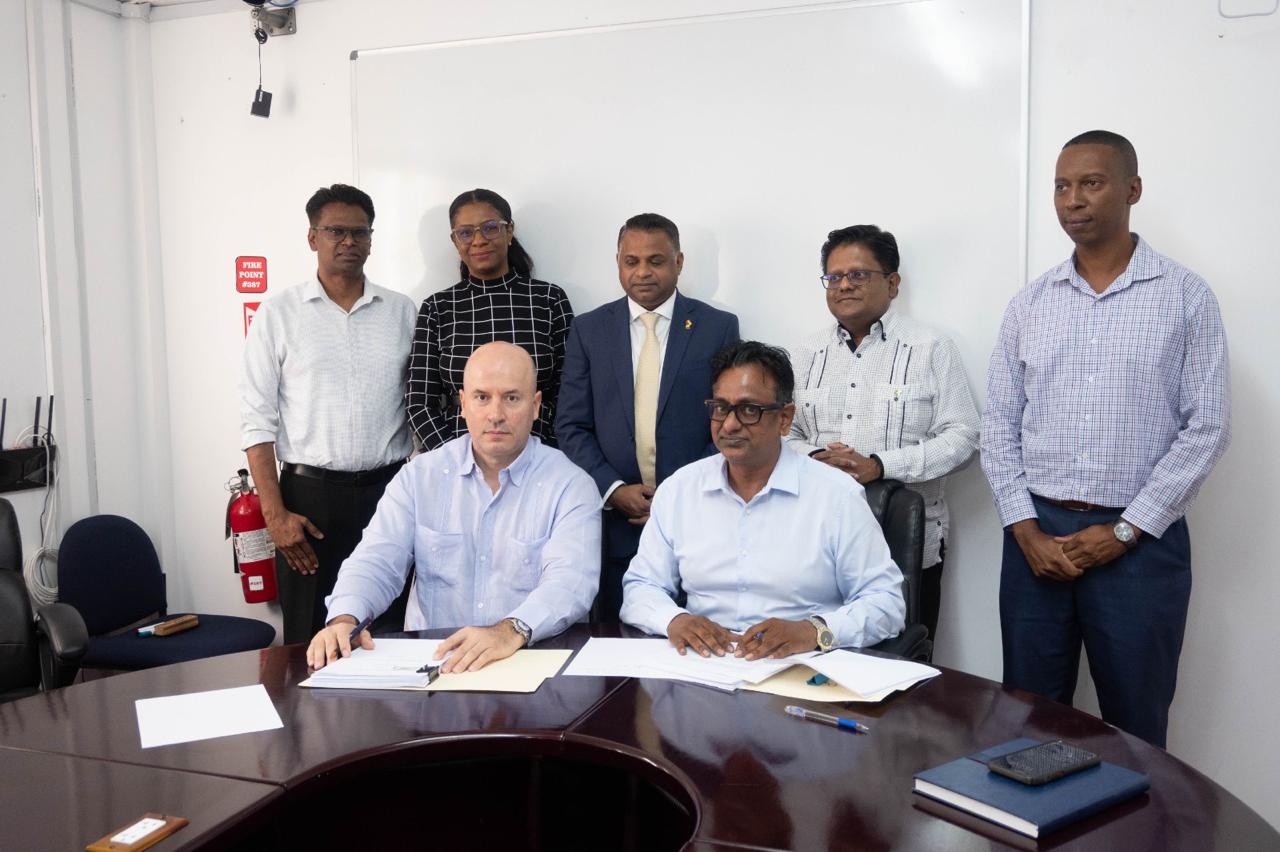
Senior Minister in the Office of the President with Responsibility for Finance and the Public Service, Dr. Ashni Singh and Minister within the Ministry of Public Works. Mr. Deodat Indar today oversaw the signing of a second agreement between the Guyana Power and Light Company (GPL) and UCC Holdings for a second powership to be deployed to Guyana in another month to assist in supplying the continuous increasing demand for reliable power in the country. The powership will be stationed in the Demerara River and will in its first phase, deliver 60 megawatts of generating capacity to the national grid while in its second phase, 15 additional megawatts of power will be delivered to the grid, bringing the total amount to be supplied to 75 megawatts. Signing the agreement at GPL’s Duke Street office were its Executive Management Committee Head Mr. Kesh Nandlall and Managing Director of the Americas, UCC Holdings Mr. Antonio Neto.
The powership will be the second one that Government, through GPL, has chartered to assist in offsetting generation shortfalls of the national grid. The first was deployed to Guyana in May this year and stationed in the Berbice River through an agreement with the consortium. This has been supplying 36 megawatts of power to the Demerara to Berbice interconnected grid.
Speaking at the signing ceremony today, Dr. Singh pointed out that Government will continue to supply the country’s growing demand in the short term as it continues to work on meeting the growing economy’s demands in the longer term through larger projects such as the Gas to Energy Project.
“President Ali’s instructions are very clear that in the first instance. we must meet the immediate demand for electricity, and where that means bringing in emergency power, we must bring in that emergency power. And secondly, we must make the investments that are needed for the medium- and longer-term demand that we will see for electricity,” the finance minister explained as he outlined the various actions the government has taken thus far.
“On the short-term side, you’ve seen the several sets we have brought in and commissioned since we came into office including the floating sets on the Berbice River concluded with the consortium, that power ship is now supplying 36 megawatts of reliable power to the Demerara to Berbice interconnected system. But even at the time that we plugged in that ship we said very clearly that the demand will continue to grow and that we will need more power,” he added.
He noted that for the longer-term Government anticipates that its Gas to Energy Project, once it comes on stream will deliver an additional 300 megawatts of power to the country.
“This PPP/C Government is looking even further and projecting what we anticipate will be the demand for electricity further down the road, and in that regard we anticipate that there will be need for even more power so we have gone out with another request for proposal for additional generating capability that will help us again to better be able to meet the long term needs,” Dr. Singh concluded.
Also speaking at the signing, Minister Indar pointed to the importance of Government providing the generating capability for the country to accommodate the current growth in demand as well as future demand and especially with the holidays fast approaching.
He added that at the time the PPP/C Government took office, generating capacity was between 96 to 100 megawatts with a demand of 115/116 megawatts. Since then, through government’s interventions and initiatives to enable baseload capacity, and with peak demand now at about 205 megawatts, another 75 megawatts being added to the grid through this second powership will assist the power company in better supplying the larger demand.
Meanwhile, UCC Holdings Representative Mr. Neto indicated that the company will be mobilizing as soon as possible to have the powership deployed to Guyana.
In addition to the two recent powerships and since it assumed office in 2020, the PPP/C has implemented several initiatives in order to bring immediate relief to citizens, including installing 10 megawatts of emergency power, operationalizing the 46.5 megawatts at Garden of Eden in October, 2022, as well as procuring an additional 28.9 megawatts situated at Colombia.
In recognition of their dedication and sacrifice, Commander-in-Chief of the Armed Forces, President Dr. Irfaan Ali, has unveiled a series of measures aimed at improving the well-being of military veterans and their families.
These include extended medical services, enhanced facilities, and a brand-new specialized minivan to facilitate transportation for veterans.
The announcement was made on Wednesday during a wreath-laying ceremony marking Veterans Day, where the President honoured the men and women who served the nation.
Veterans Day is observed annually to honor all service members, especially those who gave their lives in the line of duty (Photo: News Room/ November 13, 2024)
Additionally, President Ali presented a cheque to the Veterans Legion as part of ongoing support for the country’s retired servicemen and women.
The specialised minivan is designed to aid veterans, particularly those with mobility challenges, in accessing transportation.
Plans are also in place for the rehabilitation of veteran homes and other facilities to improve living conditions.
These initiatives reflect the government’s ongoing commitment to ensuring that veterans live comfortably in retirement.
“There is absolutely no doubt about the GDF commitment nor the government to our serving members and our veterans. All I ask is for us to be continuously fair in our assessment, in our evaluation and always be true to our conscience… Once as a country we are true to our conscience, we will all be in a position to make better decisions in our daily lives,” President Ali urged the veterans.
Veterans Day is observed annually to honor all service members, especially those who gave their lives in the line of duty (Photo: Office of the Prime Minister/ November 13, 2024)
In his address, President Ali also emphasized the importance of recognizing the global challenges that could potentially escalate into conflict.
He explained, “Deep-seated challenges that if not managed, if not contained, can lead us into a war of immense magnitude and that is why with our strong partners… we are working closely to avoid escalation and to promote de-escalation and we want to be part of any movement that will de-escalate the challenges we face globally so that we can avoid any catastrophic.”
Veterans Day is observed annually to honor all service members, especially those who gave their lives in the line of duty (Photo: Office of the Prime Minister/ November 13, 2024)
The Head of State reassured that while Guyana seeks no conflict, the nation remains steadfast in its commitment to safeguarding its sovereignty and territorial integrity.
“We rededicate ourselves to remembering those who have fallen, their courage and sacrifices are woven into the very fabric of our nation’s identity. We pledge to never forget the extraordinary price they paid for our freedom and to keep their memory alive,” he added.
Veterans Day is observed annually to honor all service members, especially those who gave their lives in the line of duty.
President Dr Irfaan Ali address veterans and those gathered at the wreath laying ceremony (Photo: Office of the Prime Minister/ November 13, 2024)
During the ceremony, wreaths were laid at the Veterans Monument located on the Front Lawns of Base Camp Ayanganna, a tribute to soldiers who died while serving the country.
Chief of Defence Staff, Brigadier Omar Khan, in his remarks, praised the veterans as the foundation of the nation’s strength. “Your commitment, bravery, and patriotism shaped the very fabric of modern-day Guyana. It is through your sacrifices that we have the privilege of living in a free, independent, and democratic nation,” Brigadier Khan said.
Prime Minister Brigadier (ret’d) Mark Phillips at the wreath laying ceremony (Photo: Office of the Prime Minister/ November 13, 2024)
He also stressed the importance of maintaining vigilance in a rapidly changing world.
“The GDF has become a symbol of national pride in defending our sovereignty and territorial integrity. It is a force that has been integral in protecting our borders, supporting civil governance during national emergencies, and contributing to national and regional missions,” Brigadier Khan concluded.
Veterans Day serves as a reminder of the sacrifices made by soldiers in defense of the nation and its values.
President Dr. Irfaan Ali has indicated that several discussions are ongoing with Indian officials, which will result in the signing of some Memorandums of Understanding when the Prime Minister of India, Narendra Modi, makes his historic visit to Guyana soon.
Speaking at a reception in honor of a visiting UK Trade Mission on Tuesday night at the British Residence in Bel Air Gardens, Georgetown, he pointed out how successful India has been in incubating businesses, and how Guyana will be looking to expand and explore new areas of investment.
“They are very advanced in innovation, digitization, and, of course, they are very good at incubating businesses. And that is where the success story lies: the way in which they’ve been able to incubate new businesses,” Dr. Ali told reporters.
The president further noted that Guyana has been collaborating with India on agriculture, the military, infrastructure, technical training, and scholarships.
“I am sure we will be looking to expand these and explore new areas of investment, as well as new areas through which Indian credit and expertise can be made available, especially as we build out the innovative and modern Guyana.”
At the invitation of President Ali, Modi will visit Guyana from November 19 to 21, 2024.
During his State Visit, Modi will engage in summit-level bilateral discussions with Dr. Ali and will co-chair the 2nd India-CARICOM Summit in Georgetown, Guyana, alongside Prime Minister of Grenada Dickon Mitchell and President Ali.
Modi is also scheduled to address the National Assembly of the Parliament of Guyana. He will offer a floral tribute at the Mahatma Gandhi statue at the Promenade Garden in Georgetown, which was installed in 1969 during the Mahatma Gandhi centenary celebrations.
He will also visit the Indian Arrival Monument in the Monument Garden, which commemorates the arrival of the first ship carrying Indian indentured laborers to the Caribbean. The ship arrived on the shores of what was then British Guiana in 1838.
In a significant move to improve educational access and foster stronger community ties, Minister of Education, Priya Manickchand, inaugurated new libraries at Tuschen Primary School, Greenwich Park Primary School, and Parika Salem Primary School. The ribbon-cutting ceremonies were followed by public meetings where the Minister engaged directly with local residents, addressing both education-related issues and broader community concerns.
The new libraries are part of the Ministry of Education’s ongoing efforts to enhance educational resources for students across the country. These libraries aim to foster literacy, creativity, and independent learning, providing crucial spaces for children to develop essential academic skills. However, Minister Manickchand’s visit wasn’t just about cutting ribbons—it also marked an opportunity for meaningful dialogue with the public.
At each school, the Minister held in-depth discussions with local residents, who raised a wide range of concerns, including infrastructure quality, public health, safety, and social services. While some of the issues raised fell outside the scope of the Ministry of Education, Minister Manickchand assured residents that their concerns would be forwarded to the relevant government departments for further action.
At Tuschen Primary School, the Minister engaged in a lively exchange with the community, addressing issues such as road safety, public health, and infrastructure needs. Although some concerns were related to other ministries, the Minister emphasized that all issues would be taken seriously and included in future development plans.
In Greenwich Park, Minister Manickchand focused on the government’s ongoing education reforms, explaining how these would positively impact both teachers and students. She also addressed concerns raised by parents and teachers regarding infrastructure needs, student transportation, and broader community challenges. The Minister acknowledged that some of these issues would take time to resolve but assured the community that they would not be overlooked.
At Parika Salem Primary School, the discussion centered not only on education but also on pressing local concerns like road conditions and healthcare access. Minister Manickchand listened attentively to the challenges faced by both parents and teachers, reinforcing the government’s commitment to addressing these issues through coordinated efforts across different ministries.
Throughout her visits, Minister Manickchand reaffirmed that education remains a cornerstone of the government’s development strategy. She emphasized that quality education is not only about access to schools but also about addressing the broader needs of the community to ensure sustainable growth and a better future for all.
“Access to education is key to our national development, but so is ensuring that our communities have the necessary infrastructure and services to thrive,” said Minister Manickchand. “These libraries are just one step in our ongoing efforts to enhance educational outcomes. We are equally committed to ensuring that local concerns are heard and acted upon.”
The Minister also reaffirmed her full support for the Libraries in Primary Schools Initiative, stressing that access to books and educational materials is vital to the intellectual growth of children and plays a key role in developing well-rounded, informed citizens.
Today’s library inaugurations and public meetings are part of the Ministry of Education’s broader effort to engage with local communities and improve educational access across the country. The government plans to continue opening more school libraries in the coming months and will host additional public meetings to ensure that residents can voice their concerns and participate in decision-making processes.
Minister Manickchand concluded her visit by thanking the residents of Tuschen, Greenwich Park, and Parika Salem for their active participation, encouraging them to continue collaborating with the Ministry to drive meaningful change. She also promised that the concerns raised during her visits would be addressed promptly and followed up with relevant government agencies.
As the Ministry of Education continues to work towards enhancing educational infrastructure and resources, it remains committed to ensuring that the needs of all communities are heard, understood, and acted upon in a timely and effective manner.
Guyana and the United Kingdom will co-chair the Forest and Climate Leaders’ Partnership (FCLP), an initiative aimed at advancing global efforts to halt and reverse deforestation by 2030.
The FCLP brings together government leaders, private-sector partners, Indigenous representatives, and civil society in a bid to address deforestation and land degradation while promoting sustainable development and rural economic transformation.
The FCLP, established as part of a broader commitment to protect forests, aims to accelerate progress toward conservation goals by offering a political platform for countries to share solutions and coordinate strategies.
“I am incredibly honoured that the UK will be taking on this leadership role alongside Guyana, a country that is home to some of the most globally significant forests and is a pioneer on forest finance,” said Ed Milliband, the UK’s Secretary of State for Energy Security and Net Zero.
Speaking at a high-level event at the ongoing 29th meeting of the Conference of Parties (COP29) of the United Nations Framework Convention on Climate Change in Baku, Azerbaijan, he added that “forests are essential for our climate, for biodiversity, for our health and prosperity, and crucially for the livelihoods of people around the world.”
The UK, under Milliband’s leadership, announced several priority areas for the partnership, including tackling illegal deforestation, strengthening forest governance, transforming supply chains, and mobilizing investment for forest protection and restoration.
Guyana’s Minister of Natural Resources, Vickram Bharrat, welcomed the role, emphasising the need for “practical pathways” to achieve ambitious conservation goals.
“The coming year will be vital for global efforts on forests, with Brazil’s hosting of the next COP bringing much-needed focus to this priority,” Bharrat stated in a news release by the FCLP.
“The good news is that forest countries and communities are not lacking in ambition – what they need is to be able to access practical pathways to realise that ambition.”
Pradeepa Bholanath, a climate economist attached to the Ministry of Natural Resources in Guyana, is attending the UN Climate Summit in Baku, and noted the acknowledgement by the UK and other countries of Guyana’s pioneering work on forests, and in showing other countries how forest conversation and sustainable forest management could be key instruments in maintaining global forest cover.
Pradeepa Bholanath, a climate economist attached to the Ministry of Natural Resources in Guyana, is attending the UN Climate Summit in Baku
“So, Guyana looks forward to taking the co-chair position in the FCLP over the next few years and having that also be an instrument through which we engage with other countries and partner with other countries as we protect the world’s forests,” said Bholanath.
Eyes on COP30 in Brazil: A Key Moment for Global Forest Conservation
The 2025 COP30 summit, to be held in Brazil’s Amazon city of Bèlem, will serve as a milestone for forest conservation efforts, marking four years since the Glasgow Leaders’ Declaration on Forests and Land Use.
Brazil’s Minister of Environment and Climate Change, Marina Silva, announced at COP28 the creation of the Tropical Forests Forever Facility (TFFF), a mechanism aimed at channeling financial incentives toward forest preservation.
“We are moving from Baku to Bèlem and are committed to protecting tropical forests in order to conserve prosperity for future generations, so that they have the same opportunities that we have had,” Silva said.
The TFFF, scheduled for implementation by COP30, offers payments per hectare of conserved forest to countries, focusing on private financing and sovereign investments to establish a long-term fund for forest protection.
Expanding Investment and Recognising Indigenous Rights
At present, forests sequester about 20% of global carbon emissions but receive only 3% of the world’s climate mitigation finance. FCLP aims to address this imbalance by promoting financing options through mechanisms like Country Packages, forest carbon markets, and the TFFF to support national conservation targets.
Additionally, the FCLP underscores the importance of Indigenous Peoples and local communities (IP&LC) in achieving climate and biodiversity goals. Recognizing and upholding IP&LC land rights remains a focal point, with FCLP partners affirming their commitment to scaling land tenure recognition.
With high-level backing from Guyana and the UK, the FCLP will bring attention to the urgent need for coordinated action on forests, climate, and sustainable development, particularly as the countdown to COP30 begins.
(Published as part of Climate Tracker COP29 Caribbean Reporting Fellowship)

</p>
<p>” data-medium-file=”https://newsroom.gy/wp-content/uploads/2022/02/Pertab-1-300×200.jpg” data-large-file=”https://newsroom.gy/wp-content/uploads/2022/02/Pertab-1-1024×684.jpg” class=”wp-image-135526 size-full” src=”https://newsroom.gy/wp-content/uploads/2022/02/Pertab-1-scaled.jpg” alt=”” width=”2560″ height=”1710″ srcset=”https://newsroom.gy/wp-content/uploads/2022/02/Pertab-1-scaled.jpg 2560w, https://newsroom.gy/wp-content/uploads/2022/02/Pertab-1-300×200.jpg 300w, https://newsroom.gy/wp-content/uploads/2022/02/Pertab-1-1024×684.jpg 1024w, https://newsroom.gy/wp-content/uploads/2022/02/Pertab-1-768×513.jpg 768w, https://newsroom.gy/wp-content/uploads/2022/02/Pertab-1-1536×1026.jpg 1536w, https://newsroom.gy/wp-content/uploads/2022/02/Pertab-1-2048×1368.jpg 2048w” sizes=”(max-width: 2560px) 100vw, 2560px”><figcaption class=) Director of the Local Content Secretariat Martin Pertab (Photo: News Room/February 16, 2022)
Director of the Local Content Secretariat Martin Pertab (Photo: News Room/February 16, 2022)<br />
” data-medium-file=”https://newsroom.gy/wp-content/uploads/2024/11/image-3-300×206.png” data-large-file=”https://newsroom.gy/wp-content/uploads/2024/11/image-3.png” class=”wp-image-188766 size-full” src=”https://newsroom.gy/wp-content/uploads/2024/11/image-3.png” alt=”” width=”769″ height=”528″ srcset=”https://newsroom.gy/wp-content/uploads/2024/11/image-3.png 769w, https://newsroom.gy/wp-content/uploads/2024/11/image-3-300×206.png 300w, https://newsroom.gy/wp-content/uploads/2024/11/image-3-612×420.png 612w, https://newsroom.gy/wp-content/uploads/2024/11/image-3-640×439.png 640w, https://newsroom.gy/wp-content/uploads/2024/11/image-3-681×468.png 681w” sizes=”(max-width: 769px) 100vw, 769px”><figcaption class=) President Dr. Irfaan Ali during his inaugural ‘In the Seat’ engagement (Photo: November 13, 2024)
President Dr. Irfaan Ali during his inaugural ‘In the Seat’ engagement (Photo: November 13, 2024) 100vw, 658px”><figcaption class=) Tropix Falcons
Tropix Falcons 100vw, 1247px”><figcaption class=) District Renegades
District Renegades 100vw, 1245px”><figcaption class=) Eclipse Carnage
Eclipse Carnage receives a prize from Assistant Director of Sport, Franklin Wilson </p>
<p>” data-medium-file=”https://newsroom.gy/wp-content/uploads/2024/11/WhatsApp-Image-2024-11-13-at-09.42.27-300×206.jpeg” data-large-file=”https://newsroom.gy/wp-content/uploads/2024/11/WhatsApp-Image-2024-11-13-at-09.42.27.jpeg” class=” wp-image-188775″ alt=”” width=”660″ height=”453″ srcset=”https://newsroom.gy/wp-content/uploads/2024/11/WhatsApp-Image-2024-11-13-at-09.42.27-300×206.jpeg 300w, https://newsroom.gy/wp-content/uploads/2024/11/WhatsApp-Image-2024-11-13-at-09.42.27-768×527.jpeg 768w, https://newsroom.gy/wp-content/uploads/2024/11/WhatsApp-Image-2024-11-13-at-09.42.27-613×420.jpeg 613w, https://newsroom.gy/wp-content/uploads/2024/11/WhatsApp-Image-2024-11-13-at-09.42.27-640×439.jpeg 640w, https://newsroom.gy/wp-content/uploads/2024/11/WhatsApp-Image-2024-11-13-at-09.42.27-681×467.jpeg 681w, https://newsroom.gy/wp-content/uploads/2024/11/WhatsApp-Image-2024-11-13-at-09.42.27.jpeg 900w” sizes=”(max-width: 660px) 100vw, 660px”><figcaption class=) Shakiel Wong (right) receives a prize from Assistant Director of Sport, Franklin Wilson
Shakiel Wong (right) receives a prize from Assistant Director of Sport, Franklin Wilson receives his Player-of-the-Match trophy from organiser Deopersaud Lalta</p>
<p>” data-medium-file=”https://newsroom.gy/wp-content/uploads/2024/11/WhatsApp-Image-2024-11-13-at-09.42.27-1-300×230.jpeg” data-large-file=”https://newsroom.gy/wp-content/uploads/2024/11/WhatsApp-Image-2024-11-13-at-09.42.27-1-1024×786.jpeg” class=” wp-image-188776″ alt=”” width=”800″ height=”613″ srcset=”https://newsroom.gy/wp-content/uploads/2024/11/WhatsApp-Image-2024-11-13-at-09.42.27-1-300×230.jpeg 300w, https://newsroom.gy/wp-content/uploads/2024/11/WhatsApp-Image-2024-11-13-at-09.42.27-1-1024×786.jpeg 1024w, https://newsroom.gy/wp-content/uploads/2024/11/WhatsApp-Image-2024-11-13-at-09.42.27-1-768×589.jpeg 768w, https://newsroom.gy/wp-content/uploads/2024/11/WhatsApp-Image-2024-11-13-at-09.42.27-1-547×420.jpeg 547w, https://newsroom.gy/wp-content/uploads/2024/11/WhatsApp-Image-2024-11-13-at-09.42.27-1-80×60.jpeg 80w, https://newsroom.gy/wp-content/uploads/2024/11/WhatsApp-Image-2024-11-13-at-09.42.27-1-640×491.jpeg 640w, https://newsroom.gy/wp-content/uploads/2024/11/WhatsApp-Image-2024-11-13-at-09.42.27-1-681×522.jpeg 681w, https://newsroom.gy/wp-content/uploads/2024/11/WhatsApp-Image-2024-11-13-at-09.42.27-1.jpeg 1061w” sizes=”(max-width: 800px) 100vw, 800px”><figcaption class=) Jonte Thomas (left) receives his Player-of-the-Match trophy from one of the organisers Deopersaud Lalta
Jonte Thomas (left) receives his Player-of-the-Match trophy from one of the organisers Deopersaud Lalta
</p>
<p>” data-medium-file=”https://newsroom.gy/wp-content/uploads/2024/11/MVI_0081.MP4.00_00_03_39.Still001-300×169.jpg” data-large-file=”https://newsroom.gy/wp-content/uploads/2024/11/MVI_0081.MP4.00_00_03_39.Still001-1024×576.jpg” class=”wp-image-188751 size-full” alt=”” width=”1920″ height=”1080″ srcset=”https://newsroom.gy/wp-content/uploads/2024/11/MVI_0081.MP4.00_00_03_39.Still001.jpg 1920w, https://newsroom.gy/wp-content/uploads/2024/11/MVI_0081.MP4.00_00_03_39.Still001-300×169.jpg 300w, https://newsroom.gy/wp-content/uploads/2024/11/MVI_0081.MP4.00_00_03_39.Still001-1024×576.jpg 1024w, https://newsroom.gy/wp-content/uploads/2024/11/MVI_0081.MP4.00_00_03_39.Still001-768×432.jpg 768w, https://newsroom.gy/wp-content/uploads/2024/11/MVI_0081.MP4.00_00_03_39.Still001-1536×864.jpg 1536w, https://newsroom.gy/wp-content/uploads/2024/11/MVI_0081.MP4.00_00_03_39.Still001-747×420.jpg 747w, https://newsroom.gy/wp-content/uploads/2024/11/MVI_0081.MP4.00_00_03_39.Still001-640×360.jpg 640w, https://newsroom.gy/wp-content/uploads/2024/11/MVI_0081.MP4.00_00_03_39.Still001-681×383.jpg 681w” sizes=”(max-width: 1920px) 100vw, 1920px”><figcaption class=) Veterans Day is observed annually to honor all service members, especially those who gave their lives in the line of duty (Photo: News Room/ November 13, 2024)
Veterans Day is observed annually to honor all service members, especially those who gave their lives in the line of duty (Photo: News Room/ November 13, 2024)</p>
<p>” data-medium-file=”https://newsroom.gy/wp-content/uploads/2024/11/466832185_1077167137530857_1800966896504297193_n-200×300.jpg” data-large-file=”https://newsroom.gy/wp-content/uploads/2024/11/466832185_1077167137530857_1800966896504297193_n.jpg” class=”wp-image-188759 size-full” alt=”” width=”641″ height=”960″ srcset=”https://newsroom.gy/wp-content/uploads/2024/11/466832185_1077167137530857_1800966896504297193_n.jpg 641w, https://newsroom.gy/wp-content/uploads/2024/11/466832185_1077167137530857_1800966896504297193_n-200×300.jpg 200w, https://newsroom.gy/wp-content/uploads/2024/11/466832185_1077167137530857_1800966896504297193_n-280×420.jpg 280w” sizes=”(max-width: 641px) 100vw, 641px”><figcaption class=) Veterans Day is observed annually to honor all service members, especially those who gave their lives in the line of duty (Photo: Office of the Prime Minister/ November 13, 2024)
Veterans Day is observed annually to honor all service members, especially those who gave their lives in the line of duty (Photo: Office of the Prime Minister/ November 13, 2024)</p>
<p>” data-medium-file=”https://newsroom.gy/wp-content/uploads/2024/11/466973719_1077165854197652_3949820210423931929_n-300×200.jpg” data-large-file=”https://newsroom.gy/wp-content/uploads/2024/11/466973719_1077165854197652_3949820210423931929_n.jpg” class=”wp-image-188755 size-full” alt=”” width=”960″ height=”641″ srcset=”https://newsroom.gy/wp-content/uploads/2024/11/466973719_1077165854197652_3949820210423931929_n.jpg 960w, https://newsroom.gy/wp-content/uploads/2024/11/466973719_1077165854197652_3949820210423931929_n-300×200.jpg 300w, https://newsroom.gy/wp-content/uploads/2024/11/466973719_1077165854197652_3949820210423931929_n-768×513.jpg 768w, https://newsroom.gy/wp-content/uploads/2024/11/466973719_1077165854197652_3949820210423931929_n-629×420.jpg 629w, https://newsroom.gy/wp-content/uploads/2024/11/466973719_1077165854197652_3949820210423931929_n-537×360.jpg 537w, https://newsroom.gy/wp-content/uploads/2024/11/466973719_1077165854197652_3949820210423931929_n-640×427.jpg 640w, https://newsroom.gy/wp-content/uploads/2024/11/466973719_1077165854197652_3949820210423931929_n-681×455.jpg 681w” sizes=”(max-width: 960px) 100vw, 960px”><figcaption class=) Veterans Day is observed annually to honor all service members, especially those who gave their lives in the line of duty (Photo: Office of the Prime Minister/ November 13, 2024)
Veterans Day is observed annually to honor all service members, especially those who gave their lives in the line of duty (Photo: Office of the Prime Minister/ November 13, 2024)</p>
<p>” data-medium-file=”https://newsroom.gy/wp-content/uploads/2024/11/467013194_1077179004196337_8279351200973698869_n-300×200.jpg” data-large-file=”https://newsroom.gy/wp-content/uploads/2024/11/467013194_1077179004196337_8279351200973698869_n.jpg” class=”wp-image-188757 size-full” alt=”” width=”960″ height=”641″ srcset=”https://newsroom.gy/wp-content/uploads/2024/11/467013194_1077179004196337_8279351200973698869_n.jpg 960w, https://newsroom.gy/wp-content/uploads/2024/11/467013194_1077179004196337_8279351200973698869_n-300×200.jpg 300w, https://newsroom.gy/wp-content/uploads/2024/11/467013194_1077179004196337_8279351200973698869_n-768×513.jpg 768w, https://newsroom.gy/wp-content/uploads/2024/11/467013194_1077179004196337_8279351200973698869_n-629×420.jpg 629w, https://newsroom.gy/wp-content/uploads/2024/11/467013194_1077179004196337_8279351200973698869_n-537×360.jpg 537w, https://newsroom.gy/wp-content/uploads/2024/11/467013194_1077179004196337_8279351200973698869_n-640×427.jpg 640w, https://newsroom.gy/wp-content/uploads/2024/11/467013194_1077179004196337_8279351200973698869_n-681×455.jpg 681w” sizes=”(max-width: 960px) 100vw, 960px”><figcaption class=) President Dr Irfaan Ali address veterans and those gathered at the wreath laying ceremony (Photo: Office of the Prime Minister/ November 13, 2024)
President Dr Irfaan Ali address veterans and those gathered at the wreath laying ceremony (Photo: Office of the Prime Minister/ November 13, 2024) Mark Phillips at the wreath laying ceremony (Photo: Office of the Prime Minister/ November 13, 2024)</p>
<p>” data-medium-file=”https://newsroom.gy/wp-content/uploads/2024/11/466791084_1077183110862593_8879817784037559394_n-300×200.jpg” data-large-file=”https://newsroom.gy/wp-content/uploads/2024/11/466791084_1077183110862593_8879817784037559394_n-1024×683.jpg” class=”wp-image-188758 size-full” alt=”” width=”2048″ height=”1366″ srcset=”https://newsroom.gy/wp-content/uploads/2024/11/466791084_1077183110862593_8879817784037559394_n.jpg 2048w, https://newsroom.gy/wp-content/uploads/2024/11/466791084_1077183110862593_8879817784037559394_n-300×200.jpg 300w, https://newsroom.gy/wp-content/uploads/2024/11/466791084_1077183110862593_8879817784037559394_n-1024×683.jpg 1024w, https://newsroom.gy/wp-content/uploads/2024/11/466791084_1077183110862593_8879817784037559394_n-768×512.jpg 768w, https://newsroom.gy/wp-content/uploads/2024/11/466791084_1077183110862593_8879817784037559394_n-1536×1025.jpg 1536w, https://newsroom.gy/wp-content/uploads/2024/11/466791084_1077183110862593_8879817784037559394_n-630×420.jpg 630w, https://newsroom.gy/wp-content/uploads/2024/11/466791084_1077183110862593_8879817784037559394_n-640×427.jpg 640w, https://newsroom.gy/wp-content/uploads/2024/11/466791084_1077183110862593_8879817784037559394_n-681×454.jpg 681w” sizes=”(max-width: 2048px) 100vw, 2048px”><figcaption class=) Prime Minister Brigadier (ret’d) Mark Phillips at the wreath laying ceremony (Photo: Office of the Prime Minister/ November 13, 2024)
Prime Minister Brigadier (ret’d) Mark Phillips at the wreath laying ceremony (Photo: Office of the Prime Minister/ November 13, 2024) 100vw, 940px”><figcaption class=) Pradeepa Bholanath, a climate economist attached to the Ministry of Natural Resources in Guyana, is attending the UN Climate Summit in Baku
Pradeepa Bholanath, a climate economist attached to the Ministry of Natural Resources in Guyana, is attending the UN Climate Summit in Baku