Roberto Vannacci, 55 ans, polémiste aux écrits ouvertement xénophobes, envisage de se présenter aux élections européennes de juin 2024. Mais le militaire est cerné par les sanctions et les affaires judiciaires.
Artisan du traité de libre-échange avec les Etats-Unis, ce Québécois s’opposa aussi fermement au régime d’apartheid en Afrique du Sud. Il avait 84 ans.
A la quasi-unanimité de ses neuf juges républicains, la Cour suprême de cet Etat du Sud a qualifié les embryons congelés d’« enfants extra-utérins » méritant la protection de la Constitution. Ce qui empêche toute fécondation in vitro en Alabama.
“It’s not only selling you a camera, it’s teaching you how to configure, how to get the best out of the product…because the main issue that we find in many projects is that the pre-sales was not done well enough,” Luna said.
According to Luna, Hikvision Guyana is hoping to facilitate the first training by May this year through Safeway Security Inc.
“The main purpose of our products is to make whole solutions. To make whole solution for our customers…to have all system integrated on one platform,” he said.
Money for what? To bounce back after being hit with one problem after the other. The COVID-19 pandemic crippled tourism, the backbone of the islands. Russia barged into sovereign Ukraine and that led to disruptions in global shipping, just as COVID did, driving prices up. And now, the war in Gaza has made things worse.
But that’s not the end of the problems. Climate change threatens the very existence of the small island states. And let’s not leave Guyana out of that equation. The coast, lapped by the Atlantic Ocean, where almost everything happens, is in a precarious position – it’s below sea level. With temperatures rising, gigantic rivers of ice in areas such as Antarctica and Greenland melts, swelling the oceans. Also, when water gets warmer, the volume of the water increases. Expert data shows the sea has risen by four inches from what it was in 1993.
So how does the Caribbean find money to (a) bounce back, stay afloat and grow and (b) adapt to climate change, meaning handle the effects of the rising sea but also finding new ways of doing things, like agriculture?
Leaders of the 15-nation Caribbean Community (CARICOM) are sure the money two meet these two pressing needs is out there.
There are doing two things to get it:
Replenish the CARICOM Development Fund (CDF) and find others to buy in. The Fund was set up to provide financial and/or technical assistance to disadvantaged countries, regions and sectors, in the implementation of the Caribbean Single Market and Economy (CSME). The CSME is the arrangement for free movement of goods, services, persons, capital and technology and it confers the right of CARICOM Nationals to establish a business in any participating CARICOM Member State
Kickstart the Blue-Green Investment Corporation (BGIC), a public-private initiative of Barbados largely intended to finance the Caribbean’s adaptation measures. It hopes to draw financing from banks, credit unions, pension funds and insurance companies to finance low-carbon projects in various sectors such as agriculture, energy generation, water conservation and housing.
There is no mistake about the urgency with which Caribbean leaders see the need for funding.
“This is a case for us of how do we resume normal business? The last few years have been difficult and we’ve moved from crisis management to crisis management to crisis management, but we are at a stage now where we have to resume our normal economic growth trajectory,” said Mia Mottley, Prime Minister of Barbados Wednesday at the concluding press conference of the CARICOM Heads of Government meeting in Georgetown.
So how is Guyana helping?
In comes Dr Bharrat Jagdeo, Vice President of Guyana, an economist by training.
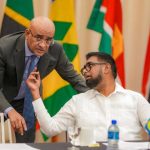
He will chair a working group that will pursue the financing the Caribbean needs. He will work with Mottley. They have been given four months to do some serious work.
According to Mottley, the job is to come up with “the reports and the recommendations necessary to unlock more funding to capitalise the Caricom Development Fund.”
The Fund has already benefited from two funding cycles and the third cycle is coming up. As Mottley admits, it’s been a “contentious issue” over the years.
But they made some progress in Georgetown.
“…we were able, under the very careful and strong leadership of President Ali…to settle the contribution cycle for the next few years,” Mottley reported.
But even if member states replenish the Fund, “it is not going to be enough,” Mottley said.
“…we need to have a pathway to be able to secure a sustainable growth – fair and equitable growth – for our people.”
And that’s the pathway she and Jagdeo will look to build – getting banks to release the liquidity, or the cash that they have on hand and can lend instead of holding it, so “governments can get access to concessional funding to be able to promote growth.”
“It is our view that the region is full of liquidity, but what is missing is the appropriate mechanism to unlock that liquidity and to allow those countries that need access to concessional funding – as is available under the Caricom Development Fund – to be able to access them so that we can build out the systems to promote growth…,” said Mottley.
Apart from Jagdeo’s leadership in the hunt for financing, how else is Guyana helping?
We go back to the Blue Green initiative. Guyana has committed US$15 million. This is the similar amount that has been committed by Barbados, the Bahamas, the Green Climate Fund and the Latin American Development Bank. There is also a commitment of US$2.5 million from the United States Agency for International Development. So that’s over US$75 million, but they are looking to get at least a US$100 million in seed capital.
“Barbados has a draft bill for the institution, and we hope to operationalize this institution as a matter of urgency to service the needs of the Caribbean Community with respect to resilience and adaptation,” said Mottley.
As if it needed to be said, she explained the urgency.
“What faces our region now is the reality that we are both trying to build resilience through adaptation and those adaptational systems and adaptation infrastructure to better face the climate crisis that is already bedeviling the region, both in terms of hurricanes and floods, but also in terms of droughts and sargassum seaweed, that we need to be able to have a clear platform for access for funding for adaptation.”
But Guyana is doing more than just putting in money into the Blue Green initiative.
“We have made it very clear that Guyana will support the Blue Green initiative and Guyana will be playing a critical role in helping to mobilise resources from international financial institutions, and also leveraging regional capital to invest in the Blue Green bank,” Dr Irfaan Ali, Guyana’s President told the News Room on Thursday.
He sees the potential of the initiative.
“This is a facility that can allow us to raise capital for commercially viable projects also, thinking about renewables, thinking about energy transition, thinking about public infrastructure projects. So ,from an investment perspective, Guyana will be working closely with Barbados and other stakeholders in raising resources, to support not only transition and resilient adaptation, but to support commercial type opportunities in the whole context of transition.”
Does it make sense to invest in adaptation? Mottley is sure of it.
“I say simply to you, every dollar we spend in adaptation and building resilience, we save $7.00 in losses, and this has been studied, recorded and accepted globally.”
Guyana’s President Dr. Irfaan Ali and his Brazilian counterpart, Luiz Inacio Lula Da Silva met for bilateral talks on Thursday and the two sides agreed to deepen their cooperation in the areas of defence, private sector developments and infrastructure development.
President Lula travelled to Guyana on Wednesday for a special engagement with Caribbean Community (CARICOM) leaders who were in Georgetown this week for their biannual summit.
On Thursday morning, he engaged President Ali directly. Following their talks, President Ali said there are many areas the two countries will be strengthening their cooperation on.
“For Guyana and Brazil, the opportunity is now,” President Ali said.
Connecting the two countries via roads, ports and air transport is a key focus. Dr. Ali disclosed that the two sides also discussed their “deep cooperation on defence” and the tourism sector, though additional details on what areas of cooperation will be targeted were not provided.
He, however, noted that a “working mechanism” was set up to advance defence and tourism cooperation.
There is also a private sector push with a Guyanese private sector group expected to travel to Brazil in the second half of this year.
“There is a technical working group that will commence working immediately so that we can mobilise finance for the deployment of investments in the various projects for our two countries, especially the infrastructure link,” President Ali said too.
The infrastructure link referenced is the Linden to Lethem Highway in Guyana, which serves as a land connection for northern Brazil all the way to Guyana’s capital city, Georgetown.
In a meeting at the sidelines of the CARICOM summit on Wednesday, Presidents Ali, Lula and the Suriname President Chandrikapersad Santokhi discussed this road link, and another to connect the Brazilian state of Amapá and the capitals of Guyana and Suriname.
Meanwhile, President Lula, in turn, supported much of what the President said. For him, journeying to Guyana and deepening bilateral relations is part of his efforts to strengthen his country’s ties with its neighbours and strategic partners while also reversing some of the poor policies of his predecessor, Jair Bolsonaro.
“My visit here is to reclaim a policy that we were moving forward and advancing in 2010,” President Lula said.
Both leaders also emphasised that the region must remain a zone of peace and that aggressions must be avoided.
Televizyon Lakay
Jwe Jwèt Gratis!
Quiz, Solitaire ak Mo Kaché Jwèt Ayiti & Karayib — 100% gratis!
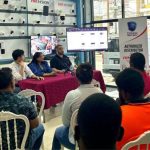

 Some of the surveillance equipment offered by Safeway Security Inc and Hikvision (Photo: News Room/February 29, 2024)
 neil@newsroom.gy
 Seasonal (3-month) sea level estimates from Church and White (2011) (light blue line) and University of Hawaii Fast Delivery sea level data (dark blue). The values are shown as change in sea level in millimeters compared to the 1993-2008 average. (NOAA Climate.gov image based on analysis and data from Philip Thompson, University of Hawaii Sea Level Center)
 People walk along Shell Beach in Guyana’s Northwest district. It’s one of the areas vulnerable to climate change which causes the sea to rise. (Shaconeil Burnette/News Room photo)
 President of Guyana and Chairman of CARICOM, Dr Irfaan Ali is flanked byPrime Minister of Barbados Mia Mottley and other CARICOM leaders (Photo: News Room/Yusuf Ali/February 28, 2024)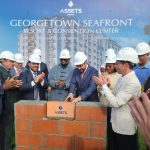

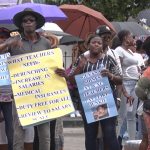

 Vice-President Dr. Bharrat Jagdeo and General Secretary of the GTU, Coretta McDonald.
 https://guyanachess.gy/caricom2024/ and stay connected with the Federation’s Facebook and Instagram platforms for updates on tournament results.
 Vishani@newsroom.gy
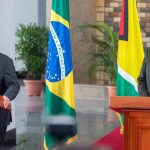
 Brazilian President Luiz Inacio Lula Da Silva and Guyana’s President Dr. Irfaan Ali at the Arthur Chung Conference Centre (Photo: News Room/ February 29, 2024)
 Brazilian President Luiz Inacio Lula Da Silva at the Arthur Chung Conference Centre (Photo: News Room/ February 29, 2024)