Le championnat iranien de première division en est déjà à sa troisième journée, et Esteghlal est le leader incontesté après trois victoires pendant que Duckens Nazon, désormais ex-joueur de cette formation, est dans le flou quant à son avenir. Une situation que le Grenadier doit vite régler.
Depuis février 2026, Duckens Nazon n’a pas joué en club. Le buteur haïtien a en effet fui l’Iran suites aux frappes orchestrées par les États-Unis et l’Israël. Après avoir disputé la Coupe du monde sous les couleurs de la sélection haïtienne, le natif de Châtenay-Malabry voit sa situation stagner.
Alors que le championnat iranien en est déjà à trois journées, l’attaquant de 32 ans est aux abonnés absents. Et partout à travers l’Europe, les différentes ligues ont déjà démarré, aussi bien en première division que dans les divisions inférieures. Rejoindre un club en cours de route et sans pré-saison dans les jambes demande un temps d’adaptation beaucoup plus long, ce qui rend la chose encore plus compliquée.
Cette situation contractuelle est une vraie anomalie pour le buteur haïtien, lui qui aime tant la compétition et qui sûrement, voudrait retrouver les pelouses aussi rapidement que possible, surtout que les Grenadiers ont des rendez-vous importants à négocier entre fin septembre et début octobre.
En effet avec ces échéances qui approchent et l’arrivée d’un nouveau coach, la sélection haïtienne de football aura besoin de joueurs qui ont un minimum de minutes dans les jambes, histoire de faire bonne figure en Ligue des Nations. Duckens Nazon serait donc bien inspiré de refouler les pelouses car sa situation actuelle pourrait avoir des répercussions sur une possible convocation.
Le FC Sochaux confirme son intérêt pour Deedson Louicius. Le directeur sportif du club doubiste, Julien Cordonnier, a cité l’international haïtien parmi les joueurs avec lesquels le club mène actuellement des discussions approfondies. Le Grenadier de 25 ans pourrait ainsi retrouver l’Europe après une expérience mitigée en MLS.
Arrivé au FC Dallas en juillet 2025, Deedson Louicius pourrait donc effectuer son retour sur le Vieux Continent. L’ailier international haïtien a passé 6 années au Danemark, où il a évolué sous les couleurs de Hobro IK et d’Odense BK, dans les deux premières divisions du pays. Malgré des performances peu convaincantes en MLS, il conserve une belle cote grâce notamment à ses prestations avec la sélection haïtienne, avec laquelle il a disputé la Coupe du monde 2026.
Interrogé cette semaine sur le mercato sochalien, Julien Cordonnier a confirmé la piste : « Il fait partie de 2-3 garçons sur lesquels on a des discussions approfondies. Il est intéressé par le projet du club. (…) Il correspond au profil que l’on cherche avec l’entraîneur Vincent Hognon. »
De retour en Ligue 2 cette saison, le FC Sochaux cherche à renforcer son secteur offensif après le départ d’Aymen Boutoutaou. Le club travaille sur plusieurs profils et espère finaliser l’arrivée d’un nouveau joueur dans les prochains jours. Deedson Louicius fait donc bien partie des options étudiées pour renforcer l’attaque sochalienne.
Tel Obélix, je suis tombé dans la marmite de l’information quand j’étais petit. Ado, je rêvais de ressembler aux plus grands journalistes et puis la réalité a fini par me rattraper. Fan de foot et de boxe, j’arpente désormais les allées du web, armé de ma plume pour dénicher les infos les plus croustillantes… pour votre plaisir, bien sûr ! Pour moi, le journalisme est plus qu’un métier, c’est une passion. ☎️ Contacts : rodchild32@gmail.com / +509 43866407 et +509 34315983 🔘 Je suis également chanteur et professeur d’EPS. Un grand fan de la lecture, la philosophie et la musique pop urbaine française.
Après 5 années loin du championnat national, Arcahaie FC s’apprête à retrouver l’élite du football haïtien. Le club de la Cité du Drapeau a annoncé ce mercredi, à travers ses réseaux sociaux, son retour à la compétition, une nouvelle qui devrait réjouir les supporters archelois.
Arcahaie FC a marqué les esprits dans le paysage récent du football haïtien. En 2019, la formation archeloise avait remporté la série d’ouverture du championnat avant de confirmer ses ambitions lors de la saison 2020-2021 en atteignant la finale. Elle s’était alors inclinée face au Violette AC dans une finale restée tristement célèbre.
Depuis 2021, le club avait été éloigné du championnat national. L’arrêt de la compétition, provoqué par la dégradation de la situation sécuritaire dans le pays, avait contraint Arcahaie FC à rester à l’écart des terrains comme tous les équipes engagées. Lors de la reprise organisée par la Ligue Haïtienne de Football (LHF) la saison dernière, le club n’avait également pas pris part à la compétition. 5 ans après sa dernière apparition, il se prépare donc à effectuer son retour.
Cette réintégration doit toutefois encore être officialisée par la LHF. Si elle se confirme, AFC devrait logiquement intégrer le groupe Sud, qui compte actuellement 6 équipes, contre huit dans le groupe Nord. Cela permettrait ainsi de renforcer cette poule et de réduire l’écart entre les deux groupes.
Reste cependant une question majeure : celle de la sécurité. La situation à Arcahaie et dans ses environs, marquée notamment par la présence de groupes armés, pourrait compliquer l’organisation des rencontres à domicile et les déplacements des équipes visiteuses.
Tel Obélix, je suis tombé dans la marmite de l’information quand j’étais petit. Ado, je rêvais de ressembler aux plus grands journalistes et puis la réalité a fini par me rattraper. Fan de foot et de boxe, j’arpente désormais les allées du web, armé de ma plume pour dénicher les infos les plus croustillantes… pour votre plaisir, bien sûr ! Pour moi, le journalisme est plus qu’un métier, c’est une passion. ☎️ Contacts : rodchild32@gmail.com / +509 43866407 et +509 34315983 🔘 Je suis également chanteur et professeur d’EPS. Un grand fan de la lecture, la philosophie et la musique pop urbaine française.
The Guyana Football Federation (GFF) has formally opened the public tender process for Phase One of the Blue Water Shipping Stadium, a release from the federation indicated Wednesday.
According to the GFF, the opening of the tender “marks a defining milestone in the Federation’s drive to transform football infrastructure in Guyana and establish a modern national venue capable of hosting international football at the highest level.”
The GFF went on to share in the missive, “The commencement of the tender follows an extensive and highly collaborative planning and technical review process involving the GFF, FIFA, Confederation of North, Central America and Caribbean Association Football (CONCACAF) and the project’s engineering consultants, undertaken to ensure that the stadium design and functionality are aligned with the applicable international standards and requirements for international football.”
The GFF has officially opened public tender for the Blue Water Stadium construction
The process has now received positive technical confirmation from both FIFA and CONCACAF. In a letter dated August 21, 2026, FIFA Chief Member Associations Officer Elkhan Mammadov acknowledged the GFF’s collaborative approach in developing its stadium infrastructure, specifically noting the Federation’s efforts in sharing stadium designs and facilitating input from FIFA’s infrastructure experts.
“The designs were completed in compliance with the applicable standards for stadiums intended to host international matches and were reviewed with reference to the CONCACAF Stadium Guidelines 2026–2027.”
FIFA further acknowledged the GFF’s efforts “to develop football infrastructure and expand the availability of facilities for football activities in Guyana” and confirmed its continued availability to provide support within the framework of FIFA’s development programmes and regulations.
CONCACAF has provided an even more specific assessment of the Blue Water Shipping Stadium. In a letter dated August 10, 2026, CONCACAF Chief Football Competitions Officer Carlos Fernández confirmed:
“Following our own technical review of the proposed stadium design, together with subsequent consultations and engagements with representatives of the Guyana Football Federation and the project’s engineering consultants, CONCACAF is satisfied that the proposed Blue Water Shipping Stadium has been designed to meet the hosting and operational requirements for CONCACAF Nations League A matches.”
An artistic rendering of the Blue Water Stadium
The confirmation is subject to the project being constructed in accordance with the approved design specifications and applicable technical standards discussed with CONCACAF. CONCACAF also described the project as “a significant investment in the future of football in Guyana”, commending the GFF for its “vision and leadership” and confirming its commitment to providing technical guidance, oversight and support throughout implementation and beyond.
The opening of the public tender represents the transition of the Blue Water Shipping Stadium from planning and technical validation into physical implementation. S&PM (Surveying & Project Management Inc) has been contracted by the GFF to manage the public tender process. The tender is expected to remain open for approximately six to eight weeks, with construction expected to commence immediately following the conclusion of the procurement and contracting process.
Phase One of the project will comprise general site development, two FIFA Arena mini-pitches, spectator bleachers for both mini-pitches, mini-pitch floodlighting, male and female dressing rooms and washroom facilities, a security station, perimeter fencing, bridge and culvert infrastructure, and the main entrance and associated access works.
The GFF is committed to conducting the procurement process in a manner that promotes transparency, competitiveness, accountability and value for money, consistent with the significance of the investment and the Federation’s responsibility to Guyanese football and its stakeholders. The Blue Water Shipping Stadium is a ground-breaking infrastructure project being undertaken by the Guyana Football Federation in partnership with Blue Water Shipping Guyana.
Richard DeNobrega, Sr, Vice President of Sales & Development, said, “This marks yet another step towards progressing the realisation of the Blue Water Shipping Stadium in Guyana. Congratulations to the GFF on securing positive feedback from both FIFA and CONCACAF. We look forward to seeing this project move ahead and are excited for the benefits it will bring for football in Guyana. Blue Water Shipping continues to witness, along with the rest of Guyana, the solid strides forward the GFF continues to make in nurturing young Guyanese talent. Strong performances at the Female U14 CFU tournament in 2025 and the most recent championship title at the Male U14 CFU tournament are testament to the efforts and bode well for the promising future of Guyanese football. The Blue Water Shipping stadium will enhance the football infrastructure locally and enable even further development of the sport.
When fully completed, the stadium is designed to accommodate approximately 10,400 spectators, providing Guyana with a modern venue capable of hosting international football and major domestic competitions, while also being designed to accommodate concerts and other public events as part of its long-term sustainability model.
The project is being developed on approximately 7.3 acres of land granted to the GFF by the Government of Guyana on a 50-year lease. The GFF expresses its appreciation to the Government of Guyana for this important contribution to the development of national sporting infrastructure and looks forward to continuing to work closely with the Government, FIFA, CONCACAF, the Caribbean Football Union (CFU), Blue Water Shipping Guyana and other partners and stakeholders to deliver the project successfully.
For the GFF, the significance of the project extends well beyond the construction of the main stadium.
The two FIFA Arena Mini-Pitches included in Phase One will provide accessible, high-quality spaces for young people and communities while supporting the delivery of the FIFA Football for Schools (F4S) programme, grassroots football and the GFF’s recently introduced Youth Ensemble Programme.
The facility will therefore form part of a broader football ecosystem designed to connect grassroots participation, youth development, education, community football, elite competition and national team development. This approach reflects the Federation’s wider football-first philosophy: investing not only in facilities for today’s players but also creating sustainable pathways for the next generation.
GFF President Wayne Forde described the opening of the tender as a defining moment in the Federation’s long-term vision for Guyanese football.
“Our philosophy has always been simple: football must come first, and football must be accessible to every Guyanese child. We are not building this stadium simply to have a bigger venue; we are building infrastructure that creates opportunities, removes barriers and gives our young people a place to dream, develop and compete.
This project represents our belief that talent exists everywhere in Guyana, but opportunity must be created everywhere as well. By investing in modern facilities, from the FIFA Arena Mini-Pitches to a stadium capable of hosting international football, we are creating a more equitable football landscape and building a stronger pathway from the community to the national team.
We want Guyana to be respected not only for the talent of our players but also for the quality of the environment we create around them. This is how we strengthen our football, raise our standards, empower our youth and improve Guyana’s standing within the CONCACAF region. The Blue Water Shipping Stadium is therefore much more than a construction project. It is an investment in people, an investment in football and an investment in Guyana’s future.”
The GFF believes the Blue Water Shipping Stadium will become an important national asset and a lasting legacy for Guyanese football. The international technical engagement undertaken during the design phase reflects the Federation’s commitment to standards, accountability and collaboration. FIFA has acknowledged GFF’s collaborative approach and the involvement of its infrastructure experts, while CONCACAF has independently reviewed the proposed design and confirmed its suitability for the operational requirements of CONCACAF Nations League A matches.
With the public tender now officially underway, the GFF is ready to move from vision to construction and from planning to delivery. The Federation looks forward to working with the Government of Guyana, FIFA, CONCACAF, CFU, Blue Water Shipping Guyana, contractors, technical professionals and other stakeholders to deliver a facility that will serve Guyanese footballers, communities and supporters for generations to come.”
Tender Information
Interested contractors may access the tender information and bidding documents on the official GFF website. Tender documents may also be collected directly from the head office of S&PM, which has been appointed by the GFF to manage the public tender process.
Further details regarding the tender process, submission requirements and deadlines are provided in the tender documentation.
The quality of a tourism destination extends far beyond attractions, accommodation and hospitality as food is an equally important component of the visitor experience, and the standards applied to food preparation, handling and service can significantly influence perceptions of a destination. Against this backdrop, the Guyana Tourism Authority’s (GTA) collaboration with the Guyana National Bureau of Standards (GNBS) to provide Food Safety Prerequisites Training represents a timely and constructive investment in the country’s tourism product.
Such initiatives deserve continued support because a growing tourism industry requires consistent standards capable of protecting visitors, strengthening consumer confidence and ensuring that local businesses can meet the expectations associated with a developing destination.
Food safety is particularly important as Guyana seeks to expand the role of local producers within the hospitality sector. Only recently, the Ministry of Agriculture engaged tourism industry stakeholders on establishing stronger direct market linkages between local farmers and hotels, restaurants and other hospitality establishments. Greater use of locally produced fruits, vegetables and other food products can create valuable opportunities for farmers while reducing gaps between agricultural production and tourism consumption.
However, stronger connections between agriculture and tourism must be accompanied by equally strong attention to food safety, quality and traceability. A local supply chain can only deliver its full value when the products entering hotels, restaurants and other establishments are handled and stored according to appropriate standards.
The GTA’s training therefore fits within a much broader national effort to strengthen the systems that support the food sector. President Dr Irfaan Ali has recently called for stronger surveillance, monitoring and testing systems as part of efforts to improve oversight of food products available in supermarkets and markets across the country. The focus includes ensuring that food products meet required standards for quality, safety, labelling, product description and nutritional content.
Health Minister Dr Frank Anthony has also identified laboratory capacity, staffing and inter-Ministerial coordination as areas requiring attention. Collaboration between the Ministries of Health and Agriculture, together with the agencies responsible for standards and tourism, can help create a more coordinated approach to food safety across the entire supply chain.
Tourism businesses stand to benefit directly from such improvements as proper food safety practices reduce risks associated with contamination and foodborne illness, while better knowledge of hygiene and handling requirements can strengthen operational standards. For vendors and small hospitality operators, training can also provide practical knowledge that supports compliance and improves the consistency of services offered to visitors.
Every meal served to a visitor contributes to the overall impression of Guyana. Local cuisine has the potential to become one of the country’s strongest tourism assets, particularly as visitors increasingly seek authentic experiences and locally produced food. That potential must be matched by reliable standards.
Capacity building should therefore remain an integral part of tourism development. Training programmes should reach not only established tourism operators but also vendors, caterers, food producers and emerging entrepreneurs seeking opportunities within the sector. Continued collaboration among the GTA, GNBS, the Ministries of Agriculture and Health, and other relevant institutions can help ensure that standards are understood and applied consistently.
Guyana’s tourism sector is expanding alongside efforts to increase local agricultural production and improve food safety oversight. Aligning these developments presents an opportunity to build a tourism product that is not only attractive but also dependable and responsibly managed.
The Food Safety Prerequisites Training is a positive step in that direction. Sustained investment in knowledge, standards, testing, traceability and enforcement can strengthen confidence in Guyana as a destination while creating better opportunities for local businesses and farmers. A tourism industry built on safe food, quality service and strong standards will be better positioned to support long-term economic growth and deliver experiences that encourage visitors to return.
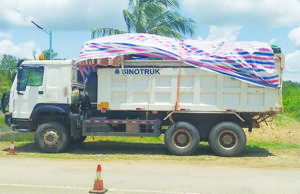
The police have intercepted a large shipment of suspected cyanide at the Burnside checkpoint in Coronie, which is believed to have been illegally brought into Suriname from Guyana. According to information obtained by Starnieuws, it involves more than two tonnes of the dangerous chemical. The cargo was transported in two trucks. Several people have been arrested in connection with the transport. The shipment was to be transported to Paramaribo.
One of the intercepted trucks with a cargo of cyanide at Brunside (Starnieuws photo)
The exact quantity, the origin of the shipment, and the final destination are still under investigation. It must also be officially determined exactly what type of cyanide-containing product is involved and whether permits were in place for the import and transport. The interception is noteworthy given the heightened focus on the import, transport and use of cyanide in Suriname. Cyanide is used in gold mining, among other things, but poses a serious danger to people and the environment if stored, transported or used improperly. The Government has previously indicated that the import of cyanide is subject to regulations. Following serious problems surrounding the use of cyanide in the gold sector, it was decided to take stricter action against irresponsible use. (Starnieuws)
Pandemonium broke out at the Enterprise Community Centre Ground, East Coast Demerara (ECD), on Tuesday afternoon as the Berbice Educational Institute (BEI) defended 92 runs, en route to the Beharry Group Under-19 Secondary Schools’ T20 Tournament title.
What seemed to be a small score initially turned out to be a mountain for Annandale Secondary to cross, as they were bowled out for just 31 in 14 overs.
Gilbert Griffith, the BEI skipper, was the leading man, conceding just two runs and bowling two wicket maidens for 3-2 from three overs.
Though the toss did not go the way of the eventual victors, Griffith later told Guyana Times Sport that his team took it on the chin and readjusted.
“First and foremost, I would like to give thanks to the Almighty, and the sponsors as well for holding the tournament. The tournament went well, no corruption,” Captain Griffith said, reacting to his team’s win in the midst of the celebrations.
He added, “We lose the toss, and we didn’t want to bat first, but we just had to reset our mind and go out and bat.”
The national all-rounder went on to discuss defending the small total, detailing when he became sure that his team would win.
Griffith expressed, “I feel that was enough runs because of how the wicket was playing. We bowlers just go out and do our stuff. The first over I bowled, and I bowled very perfect; just two runs came off of it. From then on, I was just very confident that we would win,” the teenager recollected.
The BEI skipper later shared what the win means to his school.
“Well, you know it’s the first tournament, and the name will go around; BEI, BEI, BEI. BEI won the first tournament, so people will look out for the strongest team and for BEI,” he told this publication.
Asked about whether or not BEI would be keen on defending their title in the next edition of the tournament, Griffith responded, “Yes, for sure.”
Griffith was also amongst the tournament’s best individual performers, snaring 17 wickets, the second-highest in the competition behind Ruel Dindyal’s 18.
…boat unregistered, Mohamed not licensed to operate vessel – MARAD
…MP arrested over firearm found in vehicle, released on $200,000 bail
Following the arrest of United States (US)-sanctioned and indicted Opposition Leader Azruddin Mohamed and the impounding of his boat by the Joint Services late Tuesday evening, the Maritime Administration (MARAD) has revealed that the vessel was unregistered and Mohamed was not licensed to operate the vessel. On Tuesday evening, ranks of the Guyana Police Force (GPF) and the Guyana Defence Force’s (GDF) Coast Guard intercepted a go-fast vessel at Friendship, East Bank Demerara (EBD). According to the police, the vessel had entered the Demerara River at high speed and failed to stop at a siren signal. The vessel was eventually intercepted at a wharf at Friendship, where Mohamed and several opposition Members of Parliament (MPs) were found onboard.
Based on a video the Team Mohamed’s Facebook page, the boat was towed after failure to produce the necessary documentation to law enforcement. According to MARAD in a statement on Wednesday, “…based on its records, neither the fast craft nor Mr Azruddin Mohamed is licensed or otherwise authorised to operate.” The maritime regulatory body pointed out that the operation of vessels by unlicensed persons, or the use of unlicensed or unregistered vessels, presents a serious and unacceptable risk to passengers, crew, other waterway users, property and the marine environment. “These activities contribute to preventable maritime accidents and incidents and compromise the safety of Guyana’s waterways. Persons found operating vessels without the required licences or authorisation may be subject to enforcement action in accordance with the applicable laws and regulations,” the missive detailed.
Comply with law, safety requirements
To this end, MARAD is urging all owners, operators and users of Guyana’s waterways to ensure that their vessels and operations comply with all applicable legal and safety requirements. It went onto remind that the GDF’s Coast Guard, pursuant to its mandate under the Defence Act, Cap. 15:01, is empowered to enforce the provisions of every law relating to maritime safety and security. The Police Force, in a statement just before midnight on Tuesday, said a routine joint maritime patrol observed a ‘go-fast’ vessel entering the mouth of the Demerara River at a high rate of speed at approximately 21:45h. The vessel was signalled by siren to stop but failed to comply, prompting a pursuit. It was subsequently intercepted at Friendship. “Upon arrival, three persons were found aboard the vessel, including the Leader of the Opposition (LOO). Five other persons, suspected to have travelled aboard the vessel were observed at the wharf facility,” the GPF noted.
In a subsequent statement hours later, the police said “During the pursuit, ranks reported observing a bag being thrown from the vessel into the Demerara River. At this stage, it has not been determined who threw the bag or what it contained.”
Nevertheless, it was noted that efforts are ongoing to locate and recover the bag and determine its contents as part of the investigation into the circumstances surrounding the incident. Meanwhile, the Opposition in its own statement on Wednesday, said the vessel was towed to the Marine Wing of the Ruimveldt Police Station, where it was searched but nothing illegal was found.
Firearm found
Additionally, Opposition MP Natasha Singh-Lewis was arrested for alleged unlawful possession of a firearm and ammunition. The weapon was found in her vehicle while she was leaving the Friendship facility. However, the Opposition said the firearm is licensed to MP Dawn Hastings, who had placed the weapon along with her other belongings in Singh-Lewis’ vehicle since they intended to travel down to Georgetown together on Tuesday evening before being intercepted by the joint services. MP Singh-Lewis was eventually released on station bail to the tune of $200,000 on Wednesday. Meanwhile, in the video recorded during the interception, one of the Opposition MPs can be heard making discretionary racial remarks against a young Amerindian captain in one of the vessels.
Repeat offender
Tuesday’s interception comes of the heels of a similar incident earlier this month when the Coast Guard flagged a vessel transporting the US-indicated man to Region One (Barima-Waini) for not having the relevant documentations. On August 5, the GDF said Coast Guard ranks stationed at the Pomeroon Floating Base stopped and inspected a vessel transporting Mohamed and others as part of routine operations.
The GDF had explained that the vessel’s captain failed to produce required licences and certification for its voyage to Region One. In accordance with established procedures, all vessel operators are required to register their journey with the Floating Base and present a valid Boat Master’s Licence, Vessel Licence and Certificate of Inspection before proceeding. However, the captain of Mohamed’s vessel was unable to produce the required licences and certification. As a result, the vessel was directed to return to Charity to obtain the relevant documentation before resuming its voyage. However, despite knowing why he was stopped and the failure to produce the licence, Mohamed released a video on social media, complaining of being stopped by Coast Guard ranks while on route to Region One where he planned to engage in protests. Nevertheless, these two incidents of maritime breaches come on the heels of the Opposition Leader just last month being critical of MARAD and its handling of safety on Guyana’s waterways following the MV Barima tragedy on July 18. In fact, Mohamed and his MPs were returning from a Region One outreach where they engaged the survivors and families of victims from this tragedy, when they were incepted on Tuesday night.
Dear Editor,
When one examines the ongoing debate regarding recent comments made by President Irfaan Ali in response to a question about the rising cost of living, it becomes painfully obvious that public discourse in Guyana continues to lose nuance, context, and analytical depth at an alarming rate.
This is what the President was asked by Demerara Waves Journalist Denis Chabrol at his August 18 press conference: “What more can Government do to assist with the rising cost of living?”
President Ali’s response was multipronged, touching on high energy costs, imported inflation, and the main point of contention, a change in consumer behaviour.
The President pointed to three observable changes in consumer behaviour: first, that more Guyanese are choosing to shop at supermarkets as opposed to farmers’ markets; second, that more Guyanese are now eating out more frequently; and third, that there is a change in diet – a claim supported by consumption data.
These were his words: “But we have also changed our eating pattern in the country, and that is something we [the Government] have to address. More persons today are shopping in the supermarket than were shopping in the supermarket four years ago. So that’s a cultural issue that has come upon us [the Government] that needs to be addressed. The same person who was buying sweet potato and cassava and plantain in the market are now buying it in the supermarket; and they [the supermarkets] have a whole different margin of profit because, of course, they have higher overheads – the AC and shopping in that environment, sometimes rental and so on – so that is another issue, the changing shopping pattern, the changing eating pattern.”
What followed was a coordinated campaign, by public personalities supported by sections of the media, to deliberately misconstrue those words to suggest that Guyanese were “living above their means” by shopping at supermarkets and eating out often.
Kaieteur News, for example, in its August 21, 2026, edition, misquoted the President in its headline, which read: “‘Change your eating habits.’ – Pres Ali blames citizens’ lifestyles for the rising cost of living”.
At no point did the President say, explicitly or implicitly, that Guyanese ought to change their buying or eating habits as a measure to reduce the cost of living. But social media provided fertile ground for this idea to germinate and proliferate.
Even Red Thread, in an August 24 statement, jumped at the opportunity to rebuke the President for telling Guyanese “where to shop” and, ironically, urging the Head of State to “first get his facts right”.
What was lost upon Red Thread and those who participated in the spreading of misinformation was the President’s commitment to having his Government – and not consumers – “address” the issue of higher cost, which is a consequence of changes in consumer behaviour.
This involves Government redesigning aspects of the choice environment so that affordable options become more accessible without dictating what consumers must choose. How do we know this? Because the President said so in his response to the Journalist:
“And then, of course, we have the issue of the exorbitant profit lines that the retailers are charging, or the add-on. So, the farmers, when you go to the wholesale market, the farmers are saying, ‘Look, we’re selling plantain at X dollar’, but when it gets to the [retail] market, it’s 10X. So, we [the Government] may need to look at the creation of farmers’ markets across the country as a permanent part of our buying ecosystem so that farmers have direct access to the market.”
This proposed policy intervention in the market, if pursued, would not be an attempt to reverse consumer behaviour but rather to redesign the choice environment within which those behaviours have emerged to make more affordable alternatives more accessible and attractive.
The President’s observation of the changes in consumer behaviour was therefore diagnostic to inform policymaking. He was simply saying that the way Guyanese buy and consume food has changed over the last four years, and this change has implications for the cost of living, which is why his Government must examine and address it by intervening in the market to bring relief to citizens.
That in the age of technological and intellectual advancement this simple point was lost on so many is of profound concern.
Jamaican stories are moving beyond the familiar images of beaches, music and crime to examine the beliefs, prejudices and uncomfortable realities shaping life on the island.
Storm Saulter’s Possession has been attracting international attention with a story rooted in Obeah, Jonkonnu, slavery, inheritance and reparations, while Get Millie Black confronted colonialism, sexism, homophobia and the marginalisation of queer Jamaicans.
Back home, the Jamaican psychological thriller Stew Peas has also had audiences talking by bringing together a deeply held belief involving Obeah with infidelity, misogyny and class prejudice.
This is not unfamiliar territory for the film’s writer, director and producer, Sosiessia Nixon-Kelly. Her award-winning short film Raw Materials explored sexuality, abuse, homophobia and restrictive ideas about masculinity. With Stew Peas, she once again uses entertainment to place difficult subjects on screen and force audiences to examine their own beliefs.
What Is Stew Peas About?
Stew Peas follows Detective Tessa Riley, played by Kerry-Ann “Chiney K” Collins, as she investigates the unresolved murder of her best friend. Nearly two years into the case, the pressure of the investigation begins to affect her marriage to Neil, played by Tarique Barrett, and her relationship with their daughter.
Marcia, a domestic worker played by Quera South, enters the family’s home and begins providing the food, attention and care she believes the family is missing. However, her intentions extend beyond helping with the household.
Marcia attempts to “tie” Neil by adding menstrual blood to stew peas. According to the belief explored in the film, the blood is concealed by the colour of the red peas and used to bind a man emotionally and sexually to the woman who prepared the meal.
Nixon-Kelly said the idea for the film came during Hurricane Beryl when her husband referenced the belief in tying someone through stew peas.
“I was like, ‘You know, I’m going to write a film about this,’” she recalled.
What begins with that culturally specific belief develops into a psychological thriller about manipulation, desperation and what happens when someone attempts to control another person’s choices.
Central to Stew Peas is the belief in tying, which Nixon-Kelly uses to explore the danger of interfering with another person’s free will. Marcia does not simply pursue Neil; she attempts to remove his ability to choose by spiritually binding him to her.
For Nixon-Kelly, that question of agency carries one of the film’s main messages.
“Do not interfere with other people’s agency. Allow people to always choose,” she said.
She also hopes women who believe they must resort to tying to keep a man will recognise that it is not worth the consequences.
Another theme the film explores is “bun,” particularly the normalisation of male infidelity and the unequal expectations placed on women within relationships. Tessa works in a male-dominated profession while still being expected to fulfil traditional responsibilities as a wife and mother. Neil wants an independent and professionally successful partner, but also expects her to maintain the home and remain emotionally available.
“Most men are like that,” Nixon-Kelly said. “They want their women to be independent, but they still need the household duties to be taken care of. Sometimes women find it really difficult to balance the two.”
Tessa’s determination to solve her best friend’s murder creates distance within the family, giving Marcia an opportunity to provide the attention and domestic care they believe is missing.
The relationship between the two women also brings the film’s examination of class prejudice into focus. This becomes especially clear when Tessa describes Marcia as “nobody, just the helper.”
Nixon-Kelly said the remark becomes a turning point for Marcia, who had begun to believe that she and Tessa were developing a genuine friendship. It also reflects the contradictory treatment of domestic workers, who may be trusted with people’s homes, food, children and private lives while still being viewed as socially inferior.
“Persons just tend to look down on you because you’re in a certain job or you have a certain skin colour or whatever,” Nixon-Kelly said. “They don’t understand the implications that these things do to people.”
Marcia’s treatment does not excuse her actions, but it asks viewers to consider how class, occupation and complexion influence the value placed on people.
Stew Peas continues Nixon-Kelly’s history of using film to examine uncomfortable aspects of Jamaican society. Her award-winning short film Raw Materials, the first locally produced Jamaican film to qualify for Academy Award consideration, explored sexuality, homophobia, abuse and restrictive ideas about masculinity.
While her stories may begin with a spontaneous idea, their deeper themes are deliberately developed as she gets to know the characters and refines the script.
“Everything I write is intentional,” Nixon-Kelly said.
Her films are not intended to moralise or dictate what audiences should believe. Instead, she uses storytelling to place difficult realities before viewers and encourage them to examine their own assumptions.
“It’s definitely an opportunity for you to think and an opportunity to have discussions,” she said. “It’s an opportunity to bring certain things to the forefront, things that persons are uncomfortable talking about, but we’re living these things every day.”
Nixon-Kelly also understands that audiences must first be engaged before those messages can resonate.
“I want to hit the themes and I want to get the messages out, but I also want it to be entertaining,” she said.
That combination of social commentary and entertainment has become central to her work. Through Raw Materials and now Stew Peas, Nixon-Kelly uses film to make Jamaicans confront the beliefs, prejudices and behaviours shaping their society while leaving them to reach their own conclusions.
A Completely Jamaican Production
Perhaps the second most remarkable thing about Stew Peas, apart from how cleverly it transforms cultural taboos into a psychological thriller, is that the production is Jamaican from top to bottom.
The film was conceived in Jamaica, written and directed by a Jamaican filmmaker, and produced through Ikon Media and Films, the Jamaican-based production company Nixon-Kelly runs with her husband. It was also filmed entirely on the island with a Jamaican cast and crew.
Working with a limited budget, the team completed production in just 12 days, a demanding schedule that required extensive preparation and discipline from everyone involved. For Nixon-Kelly, the accomplishment reflects both the capabilities of Jamaica’s film industry and the challenges under which its creatives continue to work.
She believes the industry needs greater access to financing, education and international markets. Filmmakers, she says, must also understand that creating a film is only one part of the process.
“A lot of creatives in Jamaica don’t understand that film is a business,” she said.
That means thinking about licensing and distribution, as well as how to reach audiences willing to pay for Jamaican stories. It also means Jamaicans taking greater control of how the country and its culture are represented internationally.
“Persons have been milking our culture,” Nixon-Kelly said. “Why can’t we represent ourselves and tell our own stories?”
Stew Peas premiered to a sold-out audience at Carib 5 on June 27 before opening across Palace Amusement cinemas. Nixon-Kelly, who places greater value on authentic audience reactions than reviews and awards, sat at the back of the theatre to experience the film from the audience’s perspective. As viewers laughed, shouted at the screen and interacted with the story, she knew the film had connected with them.
“I was like, ‘Oh my gosh, my craziness is being enjoyed,’” she recalled. “For a moment there, I felt good. I was like, ‘Job well done.’”
Stew Peas has received seven nominations at the inaugural Caribbean Film Awards, including Best Feature Film, Best Director, Best Actress, Best Screenplay, Caribbean Heritage Film Award, Caribbean Film of the Year and the Emerging Filmmaker Award.
Although grateful, Nixon-Kelly does not believe awards validate her stories or motivate her to continue creating.
“They’re just objects on a shelf,” she said. “They don’t help me to tell my stories.”
The film made its United States debut in Maryland on August 23rd, with regional screenings planned for Trinidad and Tobago, Suriname, Saint Lucia and other markets. Negotiations were also underway for Stew Peas to reach a streaming platform before the end of 2026, although no platform had been confirmed at the time of the interview.
Televizyon Lakay
Jwe Jwèt Gratis!
Quiz, Solitaire ak Mo Kaché Jwèt Ayiti & Karayib — 100% gratis!