
A new US$20 million National Control Centre is set to become the “brain” of Guyana’s electricity grid, giving Guyana Power and Light (GPL) real-time visibility and remote control of substations, power plants and transmission infrastructure across the country. While an official commissioning date was not revealed, when ready, the new National Control Centre will serve as a highly secure, modern facility for monitoring and managing Guyana’s electricity grid. The centre will allow operators to monitor the entire grid at both the transmission and distribution levels, providing real-time visibility of power flows from generators through to customers.
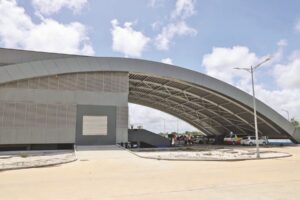
According to GPL, the facility will enable the utility to better manage the grid, identify potential issues and respond quickly to disruptions, helping to prevent interruptions to customers. This information was revealed during an inspection conducted by Head of GPL’s Executive Management Committee, Kesh Nandlall, along with Deputy Chief Executive Officer (CEO), Strategic Operations, Bharat Harjohn and Director Ryan Ross. Nandlall provided updates on the ongoing works and outlined the importance of the projects to the continued development of the company’s transmission and distribution network. He said that the facility is equipped with modern infrastructure and a building management system designed to control several aspects of the facility. “It’s a smart building. Everything in here is controlled by a building management system. So, you have temperature controls, cooling, heating, you have the security controls, ultra-central system, the water, fuel and so on, all of that. You have PV (photovoltaic) on the roof of this building, right, 160 kilowatts (kW) of PV. So, in our view here, it’s one of our infrastructures that we’re very proud of as a company when we built this out. And we’re just about to operationalise this building.” Meanwhile, Deputy CEO, Strategic Operations, Bharat Harjohn highlighted the capabilities of the facility, noting that it will be the first time GPL has a dedicated control centre capable of monitoring power flows across all of its substations. “…it’s the first time GPL will have a control centre on the power flow of all of our substations. Our existing control centre equipment are limited; we’re just trying to make use of it as much as possible. Most of our communication is via radio. Now, at this control centre, our communication is so set up that we have five optic cables connected to all of our substations, all of our power plants. So, whatever is happening at the power plant and the substation, all the devices that are connected there from the communication side, those signals come straight to the control centre.” The National Control Centre will allow GPL operators to remotely operate substations with the click of a button and monitor power flows from transformers and power plants in real time. The centre is expected to serve as the “brain” of the national grid, providing real-time information on power flows and disturbances and enabling operators to make informed decisions. Some responses will also be automated through the system’s self-healing capabilities, giving GPL greater visibility and control across the grid and improving the reliability of the power supply. The development will be implemented in two phases. The first phase will focus on monitoring the transmission network and substations, while the second phase will extend monitoring capabilities down to feeders, transformers and customer meters. Harjohn said the second phase of the project will focus on extending the monitoring capabilities into the distribution network.
“We [are] now [going] into a second phase, where we look at the distribution cycle. That is from the feeder all the way to the customer meter. So, we can now see straight to the customer meter [however] we do have some amounts of distribution management to our AMI (Advanced Metering Infrastructure) system, which is kind of independent from here now.” The National Control Centre will operate 24 hours a day, seven days a week, with staff monitoring the electricity grid around the clock. The facility is also designed to support continuous operations in the event that access to the building is disrupted, with provisions to accommodate staff for extended periods. This will require communication equipment to be installed throughout the distribution network. The overall objective is to have a fully functional smart grid in Guyana by 2030, with the National Control Centre serving as a key component of that transformation. Harjohn also explained how the system will respond to faults and disturbances on the grid. “If there is a fault on the line or at the power plant or at substation, which normally occurs, and that was we have disturbances and the system, the frequency started to drop and the system collapsed, here we are able to know where the fault originates from. And decision will be taken automatically as a first step to isolate. And also, we can do it manually to be able to isolate the fault. “And with the redundancy that we have in this transmission line, we will be able to at least send power to all the substations. So, as we re-power, at the same time, simultaneously, we’re repairing that fault. And that is why sometimes we can be backed up so fast.”
The post US$20M ‘brain’ of Guyana’s power grid set to transform GPL operations appeared first on Guyana Times.

