
By Mishael Henry
There was something about the scenery at the Sophia Exhibition Site that made time feel almost timeless. Even with the influx of patrons, the colourful displays, and the steady hum of conversation, Guyana’s past seemed to find a place in the present – etched into pieces of wood, woven from straw and Tibisiri, and fashioned into objects carrying stories handed down through generations. This year’s celebrations are being held under the theme, ‘Observing Our Cultural Heritage During Our Diamond Jubilee: Honouring Our Traditions, Culture, and Contributions.’ Quite by coincidence, the Guyana Times encountered artisan Roland Taylor at his booth, immersed in the craft to which he has devoted himself. His work had already begun attracting attention, with several pieces purchased and others bearing the unmistakable signs of a successful exhibition – sold-out pieces. For Taylor, however, the attraction was about more than simply purchasing a beautiful object.
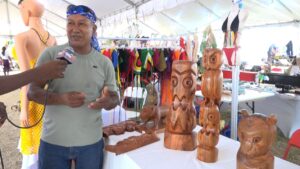
“The vibes are good. You just have to come yourself to get the vibes down here at Sophia,” he said, encouraging members of the public to visit the exhibition. “If you don’t come, you miss out. I understand you have to wait till next year. So, the vibes are right down here. You have to come to Sophia Exhibition Site and get the real thing.” With the exhibition continuing into the following day, Taylor urged people not to miss the opportunity to experience the displays, noting that activities begin at 10:00h. Taylor explained that his creations begin with simple tools and carefully selected pieces of timber. After the initial carving comes the finishing process, requiring several grades of sandpaper. “And I use all the finishing sandpaper, like from starting with the big grains till the finishing grain,” he added. Yet Taylor’s work is not merely about transforming a piece of wood into something pleasing to the eye. Among his creations are representations of the owl, the mystical man, the jaguar, and the black panther – figures rooted in Indigenous beliefs, traditions, and understandings of the natural world. Pointing to the mystical man, Taylor explained that the piece speaks to the different tribes and the distinct forms of power and belief that exist within Indigenous communities. He stressed that no tribe could simply be considered more powerful than another, since each community possesses its own beliefs, traditions, and understanding of power. “You cannot say, ‘Oh, I’m stronger than another tribe.’ That tribe has its own power within their life,” he said. For Taylor, the forest itself is filled with signs and meanings – things that may appear mysterious or frightening to an outsider but carry significance to those who understand the traditional knowledge of Indigenous communities. Among the most intriguing of his pieces is the owl board, which he described as being connected to secret knowledge within Indigenous livelihood. According to Taylor, the owl has traditionally been regarded as a messenger capable of revealing certain occurrences within a family or community. He explained that when a girl becomes pregnant, the owl may come and howl, serving as a signal to those familiar with the traditional understanding of the forest. The bat too has its own place in this traditional system of signs. Taylor explained that when a boy child is expected, the bat is believed to bring a seed and drop it in the yard or along a path where people walk. For those who inherit and understand these traditions, such occurrences are not simply random events. They form part of a wider body of knowledge – signals read from the natural world and understood within the community. When asked about the sizable pieces of wood from which some of his sculptures were fashioned, Taylor explained that he does not necessarily have to travel far to find his raw materials. “One here is from my backyard,” he said, pointing to one piece. Another, he explained, was found along the main road.
A sculpture representing a jaguar, for instance, was priced at $100,000, while another piece was priced at $80,000 and another at $60,000. Some of Taylor’s work had already been sold, demonstrating the value visitors place not only on the craftsmanship but also on the cultural stories embodied in each piece. Among his creations was also a horse’s head incorporating an Indigenous man. Taylor connected the work to the Indigenous communities of the Rupununi savannahs, where horses have long been part of community life. A few booths away, another expression of Indigenous heritage was taking shape – this time not beneath the blade of a chisel, but through the patient weaving of straw and Tibisiri.
Older Guyana
Martina Samuels sat at her booth as visitors moved through the exhibition, surrounded by objects that spoke quietly of an older Guyana. There were headbands associated with Amerindian traditional leadership, including those worn by Toshaos and chiefs, as well as necklaces and other forms of adornment.
Behind her stood earrings fashioned from Tibisiri and feathers, fittingly displayed during a month when Indigenous identity and culture occupy a particularly prominent place in the national consciousness. Tibisiri is a thin, pale, flexible fiber or straw-like material extracted from the young leaves and shoots of the Ité palm (also called the eté or eta palm) by the indigenous Amerindian people of Guyana. The display continued with traditional clothing, including women’s bras and skirts, alongside bags, fruit bowls, jewelry boxes, arambos, fans, and trays. There was also a small matapi and a sifter, traditional implements associated with the preparation of cassava bread. Asked whether it was important for Indigenous people to know and preserve their culture, she was unequivocal. “I think it’s important because we are Arawaks. We deal with tibisiri, straw, and that’s why we try to, you know, hand it down to the younger ones as they come. Because when we get old, we try to hand down to the young ones that they must know the work, what to do,” she said.
Traditional flavours
Meanwhile, the taste of Indigenous culture was also being served up at the exhibition, as Jason and Michelle’s Churrascaria offered visitors an opportunity to experience traditional and regional flavours. “Well, we usually do the kebabs. We have beef, chicken, pork, calabrese. They do the kebab on the stick. You can have a look if you want to ; we also do – you can see – the beef, and then we have the chicken, we have pork, and we have the calabrese. We also have cassava bread. We also do a Brazilian cocktail; it’s called caipirinha,” she added. For Jason and Michelle’s Native Churrascaria, the Heritage Exhibition has also become a place where culture is shared across communities. “This is actually our third year selling with the Heritage Exhibition,” they explained.
While they are not from a particular region, they noted that their mother is from Region Eight. For them, however, the significance of the exhibition stretches far beyond their own Indigenous heritage. “Well, it’s a very wonderful feeling because it’s not just only about our Indigenous people. It’s about all the different races coming together to see our culture, what it’s about. So, it’s a really wonderful feeling,” they said. Amerindian Heritage Month is celebrated annually throughout September, with activities being held across Guyana to promote greater recognition, appreciation and respect for the culture and contributions of the country’s First Peoples.
The post Where the past lives in the present – Amerindian heritage comes alive at Sophia appeared first on Guyana Times.

