…speeding accounts for 75% of fatal crashes – Home Affairs PS

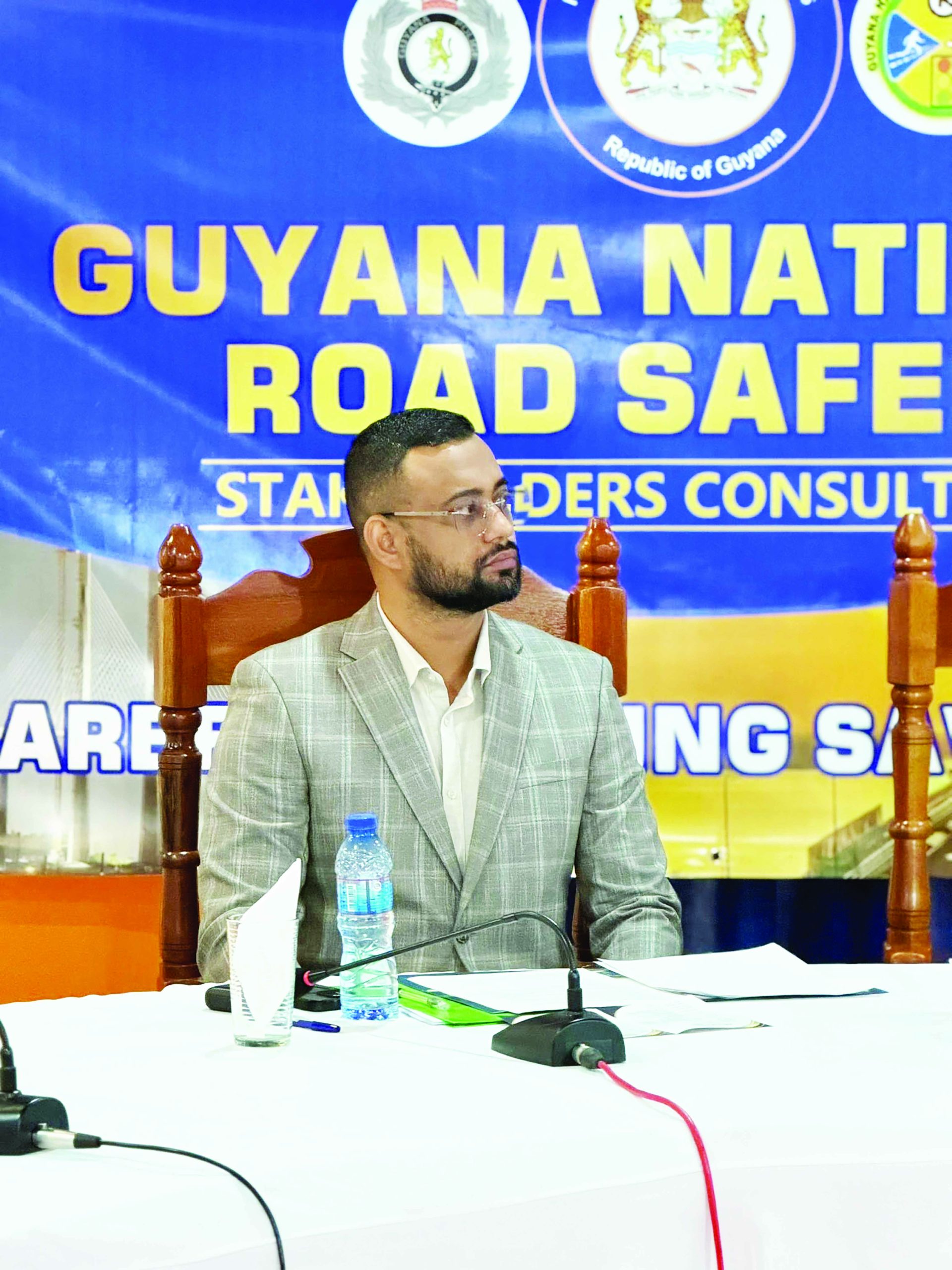
A higher number of road deaths has been recorded in Guyana during the first 170 days of 2026 when compared to the same period last year. Permanent Secretary (PS) of the Home Affairs Ministry Andre Ally disclosed this during the Guyana National Road Safety Stakeholders Consultation on Friday.
“Between 2020 and 2025, Guyana experienced significant fluctuations in road fatalities. Deaths reached a peak of 175 in 2023. While fatalities declined to 132 in 2024 and 2025, we must not mistake that decline for victory. One preventable death is one too many. For the first 170 days of this year, 2026, when compared to the same period in 2025, fatal accidents increased from 54 to 56 and the number of deaths increased from 58 to 62.” He cautioned that Guyana’s road safety challenge must also be understood within a global context.
Citing statistics to support his statements, he noted that the United Nations (UN) has recognised road safety as a major development priority. Through the Second Decade of Action for Road Safety (2021–2030), the UN has set a target of reducing road deaths and injuries by at least 50 per cent by 2030.
“The WHO’s Global Status Report on Road Safety 2023 estimates that approximately 1.19 million people die annually in road traffic crashes. It also reminds us that road traffic injuries remain the leading cause of death among children and young people aged five to 29 years.”
According to him, these figures should serve as a warning to every country, including Guyana. Road safety is connected to sustainable development, health, education, safe communities, decent work, poverty reduction and social protection. He explained that when people die or are seriously injured on the roads, families suffer, workers are removed from the labour force, businesses lose productivity and the economy absorbs costs that could have been avoided. As such, he stated that road safety is not only about preventing crashes, but also about protecting development. Road safety matters because life matters. It matters because children must be able to travel to school safely.

“Road safety matters because workers must return home to their families. It matters because pedestrians, cyclists, drivers, passengers, elderly persons and persons with disabilities all have an equal right to safety. A modern Guyana must be a safe Guyana. Our roads are not simply corridors for vehicles. They are shared public spaces that connect people to opportunity, trade, tourism, investment, public services and community life. If those spaces are unsafe, the benefits of development are undermined. That is why road safety must be treated as a national priority and why today’s consultation must produce more than discussion. It must produce direction. The data identifies clear areas of concern.”
In his view, the meeting is both timely and necessary. It brings together the people and institutions whose cooperation is essential to making Guyana’s roads safer.
“We are here to confront a national public safety issue. Road safety is about lives, families, children, communities, mobility and national development. Road safety is not only a matter of policing. It is a matter of national policy, public health, economic development, social responsibility and human dignity. Across Guyana, our country is changing rapidly. Our economy is expanding, our road networks are growing, new communities are being connected and more vehicles are using our roads every day.”
According to him, road crashes are often described in numbers – fatalities, accidents, violations, percentages and trends. However, he stressed that behind every statistic is a human being and a human life. Behind every fatal crash is a grieving family. He further emphasised that behind every serious injury is a life changed, a household disrupted, a breadwinner unable to work and a community forced to carry the weight of a preventable loss.
Speeding
Meanwhile, he shared statistics on speeding, noting that speeding remains the leading contributor to fatal accidents. “In 2024, speeding accounted for 94 per cent of fatal accidents. In the first half of 2026, it already accounts for 75 per cent of fatal accidents. This is a policy signal we cannot ignore. Speed determines whether a crash occurs, how severe the injury is, whether pedestrians survive, and whether a family receives a phone call about an injury or a death. Therefore, speed management must remain at the centre of our national priority,” Ally said.
Looking closely at this year’s statistics, he noted that, due to the size, weight and braking distance of trucks, these vehicles can have devastating consequences when involved in collisions. He stressed that this is why truck safety, driver discipline, fleet compliance and speed control must form part of Guyana’s national road safety policy. He added that prevention must also include practical measures that reduce the ability of high-risk vehicles to travel at unsafe speeds.
“This is why the installation of speed limiters on trucks is an important intervention. Speed limiters will help regulate the maximum speed at which trucks can operate, reducing the risk of high-impact collisions and strengthening compliance before a violation even occurs.” He added.
“We cannot only act after speeding happens. We must also reduce the conditions that allow dangerous speeding to occur in the first place. The UN and global road safety partners have encouraged countries to adopt the Safe System Approach, which recognises a simple truth. Speeding must not be treated as a skill. Reckless driving must not be treated as confidence. Driving under the influence must not be excused.”
The post 62 die on Guyana’s roads in 1st 170 days of 2026 appeared first on Guyana Times.