
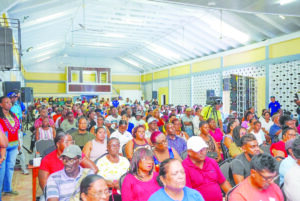
New Amsterdam could be reshaped into a cleaner, greener and more pedestrian-friendly town under a redevelopment plan that includes a modern municipal market, an organised vendors’ hub, a transformed Esplanade, upgraded roads and drainage, recreational spaces, fire hydrants and expanded security-camera coverage. The wide-ranging concept, presented to residents during a public consultation under the Government’s ‘Model Village’ Initiative, seeks to address some of the longstanding problems confronting Guyana’s oldest townships while preserving the character and history that have helped define New Amsterdam.
President Dr Irfaan Ali and Senior Minister in the Office of the President with responsibility for Finance, Dr Ashni Singh, outlined a vision extending well beyond repairing roads and cleaning drains, with Ali arguing that the ultimate goal is to create a town in which residents can take pride and enjoy a better quality of life. “We want your community to be livable, and for you to love living in your community. We want people to find peace in their community. For the community to be their place of joy, their sanctuary of peace, of upliftment, of hope,” the President told residents. He said achieving that requires infrastructure, the environment and people to work together, stressing that physical structures alone do not create a community. “At the centre of this is the people in the community. A community is just a set of infrastructure, buildings and other facilities, and not what a community is made up of. A community becomes alive and becomes a community because of the people that live in that community,” Ali said. The plans presented to residents offer one of the most comprehensive proposed makeovers of New Amsterdam in recent years. Among the most striking concepts is a complete transformation of the historic New Amsterdam Municipal Market. Renderings presented during the consultation envisage a modern, organised complex with designated areas for fresh produce, meat, fish, dry goods and clothing, together with a food court and spaces capable of sustaining commercial activity throughout the week.
Modern commercial centre
Meanwhile, Singh acknowledged that the existing market has played an important role in the town for generations but said its physical condition and layout no longer meet the requirements of a modern commercial centre. “The New Amsterdam Market is an important historic market, and it perhaps has served its role historically, perhaps for more than a century. It has been a major marketplace in the town, but you know that it has outlived its useful life,” he said. The concept, he explained, is not to remove the vibrancy traditionally associated with a Caribbean market but to marry that character with greater order, cleanliness and comfort.
The proposed market would be properly zoned, ventilated and organised to improve the experience of both vendors and shoppers. A separate vendors’ hub is also proposed as part of efforts to deal with roadside vending without depriving persons of their livelihoods. Surveys conducted ahead of the consultation identified roadside vendors at numerous locations around the town. Singh stressed that the intention is not simply to clear them away. “The objective is not to want to move roadside people. The objective is to place them in the places that are hygienic, safe, attractive and so on,” he said. The proposed vendors’ facility incorporates organised vending areas, improved drainage, pedestrian access, parking, lighting, landscaping and a traffic-flow system allowing vehicles to enter and leave more efficiently. Singh said designated vending locations could improve conditions on both sides of a transaction, providing vendors with secure and orderly places to conduct business while allowing customers to shop in greater comfort.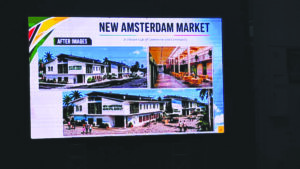
Reimagined
Another major component is the proposed redevelopment of the New Amsterdam Esplanade. Concept images show the existing green space transformed into a landscaped recreational park incorporating walking areas, children’s facilities, sporting spaces, seating and shelters, lighting and areas for families and community gatherings. Ali said the objective is to create quality recreational spaces rather than simply leaving open areas undeveloped. The Esplanade, he added, has the potential to become an attractive community destination where families can spend time, children can play safely, and residents can use the grounds for recreation, exercise and social occasions. Under the plans, green spaces in New Amsterdam would also be preserved, upgraded and incorporated into the wider beautification programme. He pointed to its architecture, churches, cultural traditions and diversity as assets that could be combined with modern infrastructure to create economic, social and tourism opportunities. “Here in New Amsterdam, you have a rich history of diversity, great cultural strength, traditions and other socio-economic indicators and factors that really make the township a very special place,” he said. The President said that history should not be viewed separately from the town’s future development. He raised the possibility of using waterfront and historic spaces to create new tourism and entertainment attractions, including a boardwalk with restaurants and other amenities, while also exploring opportunities linked to the mangrove environment. That development, he said, could complement investments already made in sporting infrastructure in the wider New Amsterdam-Palmyra area and help attract more people to the town.
Street by street
The designs were not developed solely from broad concepts. Minister Singh said an interdisciplinary and inter-ministerial team carried out an extensive survey of New Amsterdam, walking streets and mapping roads, drains, bridges, utility infrastructure, public facilities and other features before assessing their condition. The exercise also documented many of the physical problems affecting the town.
At least 235 locations were identified where construction materials or waste were occupying road reserves or other public spaces, according to Singh. Derelict vehicles were also mapped, while garbage was found at scores of roadside locations. Singh said these encumbrances are not simply unsightly; they interfere with the functioning and appearance of communities and would have to be addressed as part of the transformation. But he warned that new infrastructure alone would not solve those problems permanently. “Maintaining this pleasant, world-class community environment will also require some kind of cultural and behavioural change on the part of our citizens,” he said. Residents, he argued, would have to play their part by avoiding indiscriminate dumping and keeping road reserves, drains and public spaces free of materials and abandoned vehicles after the rehabilitation works are completed.
Tackling New Amsterdam’s drainage problem
Drainage occupies a major place in the proposed transformation, particularly New Amsterdam’s longstanding problems with community and interlock drains. Singh acknowledged that the town has historically struggled with drainage and said the assessment found channels affected by vegetation, garbage and siltation. Several engineering concepts have consequently been developed for the interlock drainage network. Depending on the location, width and drainage requirements, the proposals include reinforced concrete channels and other configurations intended to provide better flow, durability and easier maintenance. “We want these interlock drains to serve their intended purpose,” Singh said. A town-wide drainage map has also been prepared, identifying major canals, community drains and waterways considered important to flood mitigation and the overall livability of New Amsterdam. The drainage works are expected to be carried out before major road rehabilitation in areas where both interventions are required, avoiding the repeated excavation of newly completed streets.
New-look streets
Residents were also shown before-and-after concepts for several streets, including Benjamin Street, Theatre Alley Street and Fifth Street, Tucber. While the individual designs vary, they depict resurfaced or reconstructed roads complemented by concrete drains, sidewalks or hard shoulders, road markings, landscaped verges, modern utility poles and improved lighting. School roads would receive additional safety treatments, including standardised signage, pedestrian facilities, road markings and speed-control measures where required. Depending on the available reserve, some streets could receive sidewalks while others would have properly constructed hard shoulders that could accommodate pedestrians or allow vehicles to pull safely off the carriageway. The condition survey also identified approximately 200 utility poles requiring replacement, reinforcement or other intervention. Additionally directed attention to redundant and dangling utility cables, which Singh said should be removed as part of efforts to improve both safety and the appearance of the town.
Hydrants, cameras and public safety
Public safety forms another component of the proposed works. A network of fire-hydrant locations has been mapped across New Amsterdam as Government moves towards giving firefighters more dependable access to water during emergencies.
Singh said the objective is to move away from situations in which firefighters responding to a blaze must first locate a trench, canal or river from which to draw water. “We want functioning fire hydrants,” he said, noting that reliable hydrants would be particularly important to households and the town’s commercial sector.
Security cameras are also proposed as Government expands its smart-surveillance network beyond selected locations. Singh said the wider programme is intended to improve police capacity to identify and track suspects and respond to criminal activity, with additional camera sites planned for urban centres and major thoroughfares.
Beyond physical appearance
Ali, however, repeatedly stressed that his vision for New Amsterdam extends beyond its physical appearance. He said communities must also be safe from violence, flooding and social deterioration and must create environments where children and elderly persons can use public spaces without fear. “Today, we are talking about a future that is safe and secure. When we speak about safe and secure, we are not only talking about policing,” he said. “How is the community safe against violence? How is the community safe against flooding? How is the community safe that you are confident to allow your children to go and play in parks?” The President also spoke about strengthening primary healthcare, including community health facilities where residents could routinely check blood pressure and blood sugar and have information linked to the health system. He said communities should encourage walking and exercise and contain infrastructure that promotes healthier lifestyles. Ali also announced that the Government intends to introduce an intervention targeting persons living in extremely vulnerable circumstances, including some persons with severe disabilities, single parents and elderly residents facing exceptional hardship. One-bedroom social homes could be constructed for qualifying persons who already own land, he said, while stressing that the programme would be specifically targeted at extreme cases. Economic programmes for young people were also raised, including potential hatchery, poultry and agro-processing ventures.
Phased transformation
The redevelopment will not be undertaken as one simultaneous construction exercise. The proposed implementation sequence begins with coordination among utility providers, including Guyana Power and Light and Guyana Water Incorporated (GWI), to relocate or address infrastructure that could conflict with civil works.
Drainage preparation would follow, then the construction or rehabilitation of drainage and access infrastructure, pedestrian facilities, road improvements and finally landscaping and greening. Before construction begins, the concepts are also expected to undergo further review based on feedback received from residents.
Where fences, structures or other items encroach on reserves needed for the works, Singh said occupants would be given notice and time to make the necessary adjustments. New Amsterdam, the administrative capital of Guyana’s East Berbice-Corentyne region, is one of the country’s oldest urban centres, with its modern settlement tracing its roots to the late 18th century when the Dutch established the town near the confluence of the Berbice and Canje rivers. And while the renderings presented to residents offer a dramatic picture of what a new New Amsterdam could look like, both Ali and Singh stressed that the designs are still being shaped.
“We want to hear from you,” Ali told the gathering. “We want to hear your ideas, your thoughts, and the challenges you believe the community faces.” It is that feedback which will now help determine the final design of what Government hopes will become a new New Amsterdam.
The post New Amsterdam set for sweeping makeover with modern market, esplanade, upgraded streets appeared first on Guyana Times.

