
…with love, sacrifice; her grandmother helped with the path to success
For most students, taking notes from the blackboard, studying a diagram or finding their way around a classroom are ordinary parts of school life. For 17-year-old Afeefa Amatullah Ally, who was born blind, those seemingly simple tasks presented obstacles that had to be overcome every day.
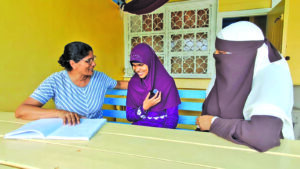
The Skeldon Line Path Secondary School student has secured seven Grade Ones and three Grade Twos at this year’s Caribbean Secondary Education Certificate (CSEC) examinations, completing a remarkable educational journey supported by a grandmother who attended classes with her, teachers who adapted their methods, and classmates who ensured she was included.
At the centre of that journey was her grandmother, 59-year-old Nazra Appalsamy, who sat in the classroom, copied what teachers wrote on the blackboard and later went through the material with her granddaughter at home.
Afeefa said being visually impaired meant finding ways around challenges that most of her classmates did not encounter.
“I think being visually impaired provides some obstacles that people who are not visually impaired don’t have to work around. One of the main things for me is mobility in school and in new places that are not my home. But my teachers, my grandmother, and my friends helped with that. Also, another obstacle for me was getting the notes and understanding diagrams, especially,” she explained.
The arrangement with her grandmother provided a solution to one of those challenges.
“My grandmother was with me in the classroom, and she took the notes that the teacher wrote on the board, and when we got home, she revised me with me. That’s how I studied,” Afeefa related.
Some things, however, could not simply be written down. Diagrams required a different approach.
“The diagrams the teachers drew on the board – I can’t see that, so to explain it to me was a bit of a challenge. We also made the diagrams; we had to improvise and use textile materials so I could feel what they could see,” she recalled.
By Form Four, Afeefa also had to decide how many subjects she could realistically undertake. She had considered Agricultural Science, Biology, and Food and Nutrition, but some of the practical requirements, coupled with the demands of her other subjects, influenced her decision.
“I realised that I couldn’t study Bio and F&H, and focus as much as I could on all of the rest of the subjects. So, I tried to do what I know I could focus on, and I knew I could have done 10,” she explained.
The decision paid off.
Sitting CSEC
For the examinations, Afeefa used a scribe, dictating her answers to a teacher assigned to assist her. Diagrams appearing on examination papers had to be explained to her. She said she was confident her answers were accurately recorded and that there were opportunities to review what had been written and make changes where necessary.
Braille had been another possible avenue for Afeefa, but she said she was unable to develop the skill without specialised training. Technology is now providing her with another means of accessing information independently.
“I did try to learn Braille, but I don’t think it worked too much, and I needed special training, so I never got to learn it. But most of the things that I need to know are now on my computer and phone, which I am getting training in how to use as a visually impaired person,” she said.
Grandmother went back to school
While Afeefa progressed through the education system, Appalsamy effectively went through school all over again.
Beginning at nursery and continuing through the years, she became such a familiar presence that she said teachers and students made her feel part of the school community.
“So good, I wish to be there again. I miss it so much, and the children were so accommodating. They never made me feel as if I am not one of them. Whatever help I needed, they would always help with Afeefa, with getting the notes, and involving her with group work. The teachers ensured that everything was done to help Afeefa also. Even though this was something strange for both me and the teachers, we did try our best,” Appalsamy recalled.
Afeefa’s classmates, she said, ensure her granddaughter was not left behind when they left the classroom.
“She had her special friends who used to drag her with them, hold her two hands at the two sides and say, ‘Afeefa, come, let’s go here,’ you know, wherever. The children were very good children. Very good children,” Appalsamy said.
Years of sitting through lessons and helping The Afeefa study had an unexpected benefit for the grandmother too.
“Oh my God, I could have written the CSEC. I could have, but I chose not to. My focus was Afeefa. That’s why. That’s my focus,” she said.
A difficult beginning
For Afeefa’s mother, Afsana Ally, the achievement is particularly significant given the uncertainty that surrounded her daughter’s earliest months after birth.
“Afeefa was born premature. She was born at six months’ gestation, and so constantly we would take her for check-ups for ears, or eyes, or other organs, to ensure that they were functioning properly. So it was something that we were looking out for, to see whether everything was working for her or not,” Afsana recalled.
The family subsequently learnt that Afeefa was visually impaired.
“When we discovered that she was visually impaired, it wasn’t so much of a surprise, but at the same time, our concerns for her were many: social, educational, and all the concerns that a parent would have for their child. It was compounded with her situation,” she said.
According to Afsana, the family was initially told that Afeefa had cancer of the eye. Unconvinced, they sought another medical opinion and were subsequently told that she had retinopathy of prematurity.
“Initially, the diagnosis for her was cancer of the eye. However, we sought a second opinion, and we learnt that it was retinopathy of prematurity. We did send her to the US for surgery. Unfortunately, that was not very successful. So those were some decisions we had to make. It was a really difficult decision to send her without us, but at that time it was the best decision to make,” Afsana recalled.
Taking a chance on school
Afeefa began her formal education at Prince Town Nursery School before attending Corriverton Primary School, and later Skeldon Line Path Secondary School.
Sending her into a mainstream school environment brought another set of concerns for the family.
“When a child leaves the home, even a child who’s not differently able, you’re worried about them in the school environment, if they’re going to be bullied or if they’re going to be catered for. And with her situation, again, it was compounded because of her visual impairment. But fortunately, the school environment has been very accommodating with her, both the teachers as well as the students, as well as the Ministry. They have provided the support that she needed, both in terms of education as well as the moral support that she needed, and we’re very grateful for that,” Afsana said.
For Appalsamy, however, Afeefa’s ability to learn had been apparent long before she entered a classroom.
“These children are gifted in their own ways. Observe your children, and you will know how far they could go. Like with Afeefa, from baby, when she started to talk, I started to implement a little bit of education. I counted with her fingers, like teaching her ABC, and she was responding so well. So when you see a child respond, you know how far they could go. And you need to be there with them and help them,” she said.
Her advice to other parents and guardians of children with disabilities is not to regard the additional support their children may require as a burden.
“It’s not a hard job. Don’t take it as a job. Take it as a fun thing, because that is how I look at it. Sometimes parents ask me, ‘Aunty Naz, how do you manage this?’ Like especially in the primary school, to go in at lunchtime and feed her and make sure that she gets it. For me, this is fun. This is what I like to do. Don’t take it as a burden,” Appalsamy urged.
A community of support
Looking back at her achievement, Afeefa readily acknowledges the people who helped make it possible.
“I would like to thank the Almighty Allah because without Him none of this would be possible, and I would also like to thank my grandmother, who sat with me and taught me, and my mother, who also helped to teach me, and all of my teachers because they adapted really well to helping a visually impaired person,” she said.
Afeefa singled out several teachers who supported her at different stages of her education, including Ms Paniza, who she said had been with her from Form One; Ms Kofi, who accepted her from Grade One at primary school; and Sir Amzan, whom she could call whenever she needed help understanding concepts.
University next
Seven Grade Ones and three Grade Twos are not the end of Afeefa’s educational journey.
She is already working part-time at a business centre at Palmyra, and plans to attend the University of Guyana to study social work.
And Appalsamy, after years of accompanying her granddaughter through nursery, primary and secondary school, has no intention of ending her own educational journey just yet.
Asked whether she would accompany Afeefa to university, her answer came without hesitation.
“Definitely, yes.”
The post Against odds, visually impaired Afeefa turns determination into 7 Grade Ones at CSEC appeared first on Guyana Times.

