By Danielle Swain
In 1826, Onwerwacht left Plantation Blyendaal in Berbice, where he was enslaved, to spend the weekend with his wife nearby. When he returned, his enslaver locked him up. Onwerwacht complained to the ‘Protector of Slaves’, saying he considered the punishment “unmerited”.
Seven years later, in Georgetown, a woman named Angel went to the same colonial office with a different plea. The father of her children had told her he had freed her, only for her to discover that another man had purchased her. She went to the Protector of Slaves to try to have her freedom confirmed.
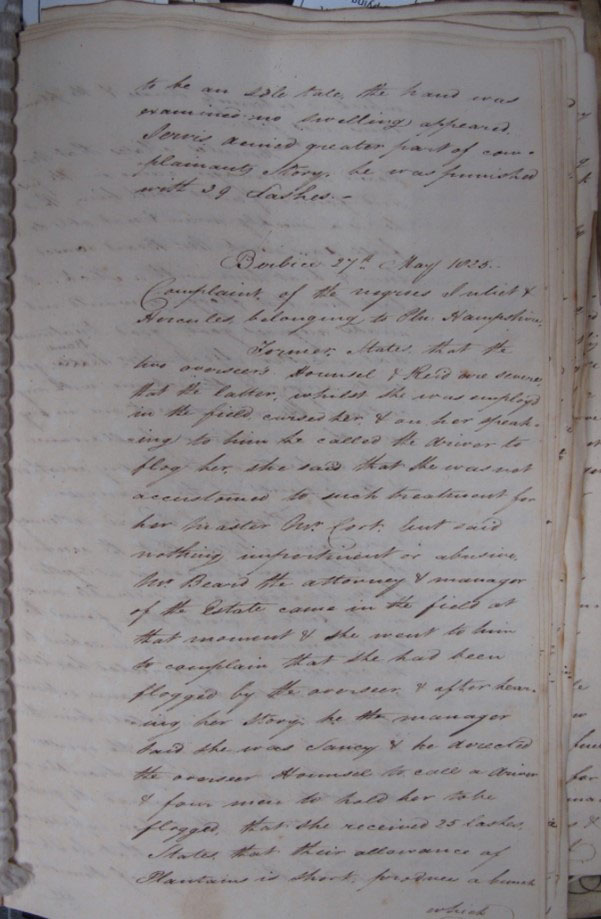
These two summary accounts of records are among thousands preserved in the Reports of the Protector of Slaves, a rare collection of testimonies from enslaved people in British Guiana who reported family separation, overwork, violence and other injustices in the final years before emancipation.
Through the Voices in Slavery’s Archive: Law, Place and Testimony in British Guiana, researchers Estherine Adams, Randy Browne, Juanita Cox, Philippa Hellawell, Linsey McMillan, Diana Paton and Kimberley Thomas are working to make these records more accessible to Guyanese communities.

Now, almost 200 years later, those voices are at the centre of a three-year project seeking to make the records more accessible to Guyanese communities.
The project, which started on March 1, 2026, was introduced in Georgetown on Tuesday at the Walter Rodney National Archives, where participants gathered for the first in a series of workshops being held from June 9 to 11 in Georgetown, New Amsterdam and Anna Regina.
Led by the University of Edinburgh and funded by the Arts and Humanities Research Council (AHRC) of UK Research and Innovation (UKRI), the project brings together partners from Guyana, the United Kingdom and the United States, including the University of Guyana, Xavier University, the University of Sheffield Digital Humanities Institute, The National Archives in the UK, the Walter Rodney National Archives of Guyana and Guyana SPEAKS.
At its centre, the project asks: how should Guyana read, preserve and share the words of enslaved people whose lives were recorded by a colonial system that both constrained and exposed them?

Professor Diana Paton, William Robertson Professor of History at the University of Edinburgh, said the project is a history project that is also concerned with the present and the future.
The documents, she told participants, are from roughly 200 years ago, when slavery dominated British Guiana. Unlike many colonial records, however, they do not only provide anonymous figures, economic data, plantation accounts or demographic details. They offer “snapshots” of individual enslaved people’s lives, often in their own words or close to their own words.
“These individual stories, we think, are very precious,” Paton said, adding that they provide insights few other sources from the period can offer.

But those records have not been easy for Guyanese people to access. Like much of the documentary history of former British colonies, the materials are held overseas, at The National Archives outside London. The project aims to address that distance by digitising, transcribing and mapping the records and making them freely available online.
Over the next three years, researchers plan to make all 26 large volumes of the Protector of Slaves records for British Guiana accessible in a searchable digital form. The collection includes about 2,500 individual cases and many thousands of testimonies. Physical facsimile copies will also be placed at the Walter Rodney National Archives so that researchers, students and members of the public in Guyana can consult them locally.
The records offer something personal for descendant communities. A way to reconnect names, places, plantations and families separated by slavery, migration, silence and colonisation.
The workshops are intended to introduce the project, share early insights, and invite feedback from Guyanese participants on how the material should be interpreted and presented. Attendees are being encouraged to bring their own knowledge of communities, place names and family histories to the process.
Researchers also hope the project will support family and community research, allowing Guyanese people to see how enslaved people used the limited legal mechanisms available to them to resist exploitation and seek redress.
Minister within the Ministry of Culture, Youth and Sport, Steven Jacobs, said the project is of “immense value” to Guyana because it helps recover testimony from one of the most painful chapters in the country’s history.
“These records do not merely document the period of slavery,” he said. “They bring us into closer contact with the lived experience, the struggles, the resilience of men, women and children, whose labour and suffering helped to shape this land.”
Jacobs said too much of Guyana’s history has remained distant, housed in overseas repositories and absent from national discourse. Making these materials available in Guyana, he said, is significant for education, research, cultural identity and justice.

“When Guyanese, particularly our young people, are able to engage with these materials, they gain a fuller and more humane understanding of the foundations of our society,” he said.
The minister also linked the project to the wider digitisation work of the Walter Rodney National Archives, which he said forms part of the government’s efforts to preserve heritage and strengthen public access to national records.
Archivist Nadia Gamel-Carter of the Walter Rodney National Archives described it as a “labour of love” that has been years in the making, highlighting the work that went into building partnerships and securing support for the initiative.
The project will not be without difficulty. The materials include accounts of past violence and racism that may be distressing. Participants in the workshops are being asked to engage with them carefully, with consent procedures in place for discussions, audio recording and possible video interviews.
Still, the project’s ambition remains to move the testimonies of enslaved people from the margins of colonial record-keeping into public memory.
A temporary profile image for the project, an 1833 drawing of the Protector of Slaves Office in Trinidad by lithographer and draughtsman Richard Hicks Bridgens, held in the Yale Centre for British Art’s Paul Mellon Collection, offers a visual reminder of the world in which these complaints were made. It shows the kind of colonial space where people such as Onwerwacht and Angel may have had to appeal to authority for recognition of their humanity.

Historian Emilia Viotti da Costa has described the Reports of the Protector of Slaves as “one of the greatest indictments against slavery ever written”. Their power lies in what they reveal about cruelty, but more importantly in what they preserve of resistance. A husband objecting to punishment after visiting his wife; a mother seeking proof of freedom; enslaved people recording, in the language available to them, that what was done to them was wrong.
As the project develops, researchers say they want Guyanese communities to help shape the work ahead, as participants in deciding how that history is understood, shared and brought into the future.
The post Stories of enslaved Africans return to Guyana through ‘Voices’ archive project appeared first on News Room Guyana.