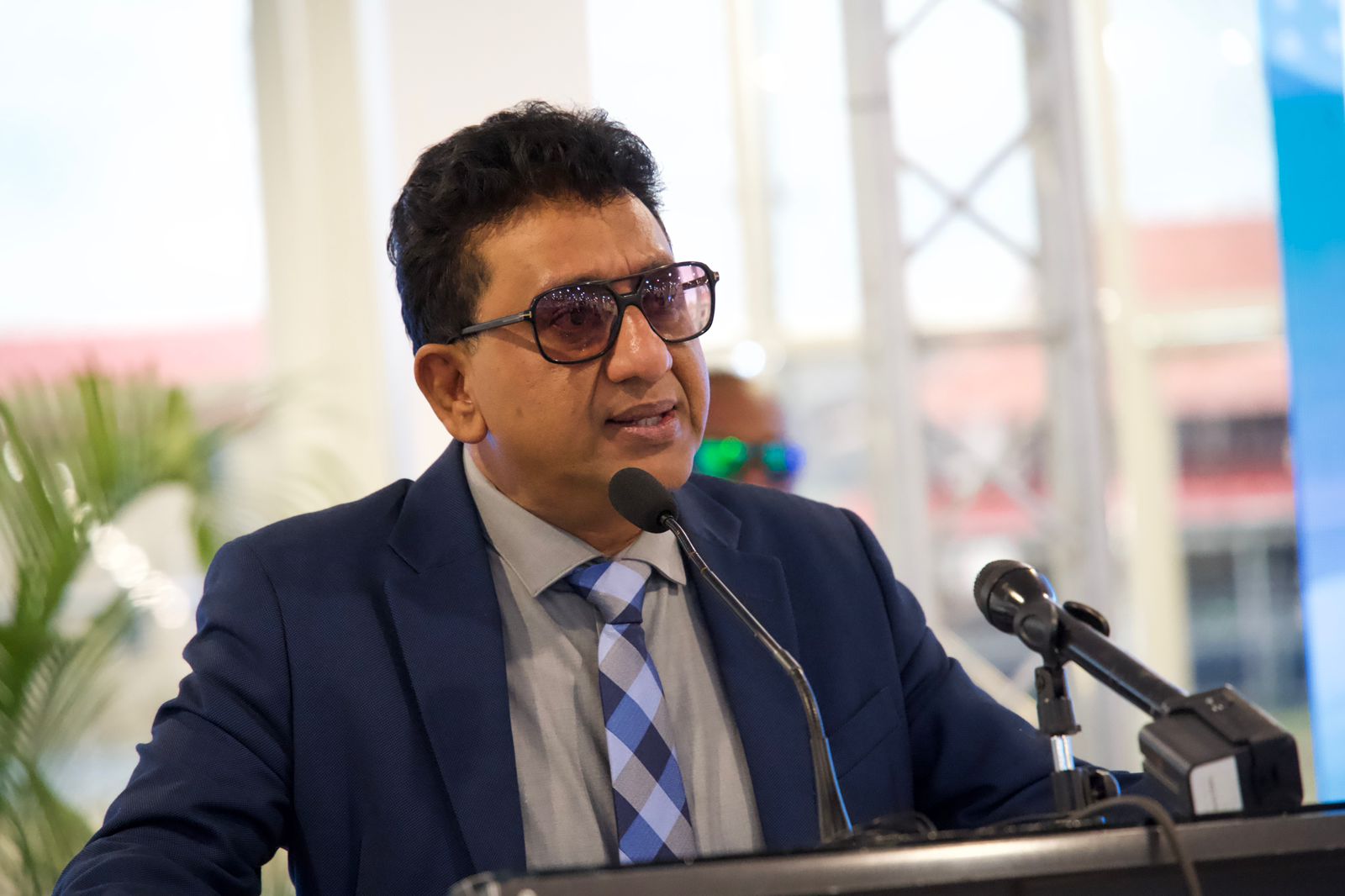
President, Dr. Irfaan Ali reaffirmed Guyana’s territorial integrity and sovereignty in his address to the nation in observance of the country’s 56th Republic Anniversary.
“Let no one be mistaken: history and international law are on our side. Our borders are sacred, and we will defend them,” President Ali declared in his address to the nation from the Public Buildings, Brickdam.
The President’s reaffirmation of the country’s territorial integrity and sovereignty comes just days after the 60th anniversary of the signing of the Geneva Agreement. This treaty established the framework for resolving the long-standing border controversy with neighbouring Venezuela.
This Agreement was created after Venezuela shifted its position in 1962—after having accepted the validity of the 1899 Arbitral Award for more than 60 years—and began claiming that the Award was invalid. Guyana’s position is that the Arbitral Award of October 3, 1899, definitively established the land boundary between what is now Guyana and Venezuela and was accepted and implemented by both parties for decades, including through boundary demarcation in 1905.
Venezuela, however, claims Guyana’s Essequibo region— an area amounting to about two-thirds of the country’s landmass. It has been criticised for several aggressions, while Guyana has taken the border controversy to the International Court of Justice (ICJ) for a final, binding judgement that Essequibo is its own.
As President Ali, who is also the Commander-in-Chief of the Armed Forces of Guyana, spoke about the country’s territorial integrity, he thanked the country’s disciplined forces for their continued service. He also thanked bilateral partners for standing with Guyana.
Guyana became a Republic on February 23, 1970, four years after it gained independence from British rule.
President Dr Mohamed Irfaan Ali on Saturday announced a bold push to ensure that all bottled water consumed locally is produced in Guyana within the next year, as he outlined a transformative vision for the country’s water sector.
Speaking at the commissioning of the Five Miles Water Treatment Plant in Bartica, the head of state said Guyana, known as the “land of many waters,” must move decisively to optimise its freshwater wealth and reduce dependence on imported bottled water.
“You can’t be such a resource-rich country in fresh water and be importing bottled water,” President Ali stated. “The Ministry of Public Utilities and Aviation must set aside a target of ensuring that all our water consumed locally is produced locally in the next 12 months,” he added.
The president explained that achieving this goal will require close collaboration with the private sector and a focus on economies of scale. Rather than having multiple entities duplicating investments, he suggested standardising production systems, such as shared plastic bottle manufacturing, to reduce operational costs and increase competitiveness.
According to Guyana Water Incorporated (GWI), locally treated and bottled water can be produced and sold for approximately $100 per bottle or less when operational costs are efficiently managed.
“We have to look at all the verticals so that we can bring down the cost of water,” he emphasised, adding that “a country known as the land of many waters must have the cheapest water available to its people and its visitors.”
Beyond bottled water, President Ali underscored that water must now be viewed as an economic commodity. Citing global studies that predict increasing water scarcity in the coming decades, he said Guyana must implement Integrated Water Resource Management (IWRM) principles to optimise its total water assets.
The head of state said the new ministry for water must go “beyond the norm,” focusing not just on access to treated water but also on creating value, diversifying the economy, and boosting national competitiveness.
“This is about building a diversified economy in a measurable way,” he said. “Clean water is empowerment. Clean water is nation-building in its purest form.”
Opposition Parliamentarian Ganesh Mahipaul says the APNU refused to be ‘bullied’ by the We Invest in Nationhood (WIN) party during negotiations over how the opposition would function in the 13th Parliament.
And according to him, APNU’s response instead was to outperform, and they “did just that.”
Speaking candidly about tensions inside the 29-seat opposition bench during an extended interview with the News Room’s Kurt Campbell, Mahipaul revealed that shortly after the election results, he moved to establish a working arrangement between WIN (16 seats), APNU (12 seats), and Amanza Walton-Desir (one seat).
He proposed to follow the proportional representation method.
“You have 16, we have 12, Amanza has one. Out of 20 ministries, that means 11 for WIN, eight for us, and one for her,” he said.
Instead, Mahipaul claims WIN pushed for 13 shadow ministries and offered APNU just six while also seeking to determine which six APNU would receive.
“I was not prepared to entertain that kind of bullyism,” he said bluntly.
Even after offering a compromise, taking four ministries of APNU’s choice and allowing WIN to assign four, Mahipaul said the approach did not change.
“They were hell-bent on throwing to us whatever they wanted to throw.”
That, he said, forced APNU to walk away.
“We said fine. You’re the main opposition? Shadow everything.”
Mahipaul also rejects the idea that APNU’s reduced numbers make it weaker.
He argues that ego clashes and fragmentation destroyed the larger APNU/AFC coalition. In contrast, he says the current 12-member APNU bench is disciplined and prepared.
APNU MPs, including first-timers, were praised during the budget debates with Mahipaul himself earning commendation across the aisle.
“We’re going to capture the Speaker’s eye. We’re going to ask our questions. And we’re going to outshine our opponents,” he said.
Mahipaul also dismissed the narrative that WIN’s newness explains its sometimes-lacking performance.
“We have new MPs too,” he said. “And our old MPs guided our new MPs.”
WIN, he pointed out, has returning Parliamentarians who should bring experience to the table.
“It’s not like they don’t know how this place works.”
He even referenced moments during budget scrutiny where he expected WIN to press certain issues and they didn’t.
Despite the friction, Mahipaul insists he wants a united opposition front against the government’s 36-seat majority.
“We need to be a better 29 fighting a giant 36,” he said.
But unity, he stressed, must be rooted in fairness.
“Proportional representation is what put all of us there. You can’t ignore that.”
And if there’s a new political order within the opposition, Mahipaul is signaling that APNU won’t quietly accept a subordinate role.
“We will represent,” he said. “Exactly how we have to.”
Guyana’s first modern, large-scale dairy farm, the US$20 million Demerara Dairies Incorporated (DDI) facility, is on track to begin fresh milk production by mid-2026.
Prime Minister Brigadier (Ret’d) Mark Phillips recently toured the 200-acre facility under construction at Moblissa along the Soesdyke–Linden Highway, where he received an update on progress at what is being described as a technologically advanced dairy operation.
The Prime Minister said the project marks a significant step in modernising Guyana’s agricultural and agri-industrial sectors.
“In addition to producing milk and other dairy products, this facility will serve as a destination for dairy industry practitioners and as a learning centre for educational institutions, ranging from the University of Guyana to schools across Region 10 and the wider country,” Phillips said. “Here, students will observe modern dairy farming practices introduced from other regions.”
The Moblissa savannah, traditionally not associated with large-scale dairy production, has been converted into high-quality pasture to support advanced operations — an effort the Prime Minister described as innovative and transformative.
Beyond milk production, Phillips said the project is expected to contribute to employment, skills development and wider economic participation, particularly in Region 10.
As construction moves into its final stages, approximately 100 Guyanese workers — many from Linden — are expected to be employed. The operation will also be supported by activities linked to Demerara Distillers Limited’s (DDL) production facility at Diamond.
Phillips emphasised that the initiative highlights what can be achieved through collaboration between the private sector, government and local communities.
“This project will benefit Moblissa, Region 10, and Guyana as a whole by advancing food security, providing training and education, and creating employment opportunities,” he said.
He added that collaboration between international experts and young Guyanese technicians, veterinarians and engineers would facilitate knowledge transfer and long-term sector development.
The Prime Minister also commended DDL’s leadership and project partners for maintaining high standards in design, worker facilities and site management, describing the dairy farm as reflective of broader modernization efforts underway across Guyana’s productive sectors.
DDL Executive Chairman Komal R. Samaroo and other company representatives were present during the tour.
Once operational, the DDI facility is expected to significantly boost local milk production and support Guyana’s drive toward greater food security and reduced reliance on dairy imports.
Georgetown ended East Coast winning streak, while East Bank finally tasted victory when Round Three of the Demerara Cricket Board Inter-Association Under-19, 50-over competition was contested on Sunday.
At the LBI Ground, Georgetown thumped East Coast by 181 runs, while over at the Police Ground in the city, East Bank rebounded from defeats in their first two matches to beat Upper Demerara by seven wickets.
Batting first, Georgetown piled up an imposing 300-5 from their 50 overs with opener Khush Seegobin, Jonathan Mentore and West Indies Under-19 player Shamar Apple scoring fifties.
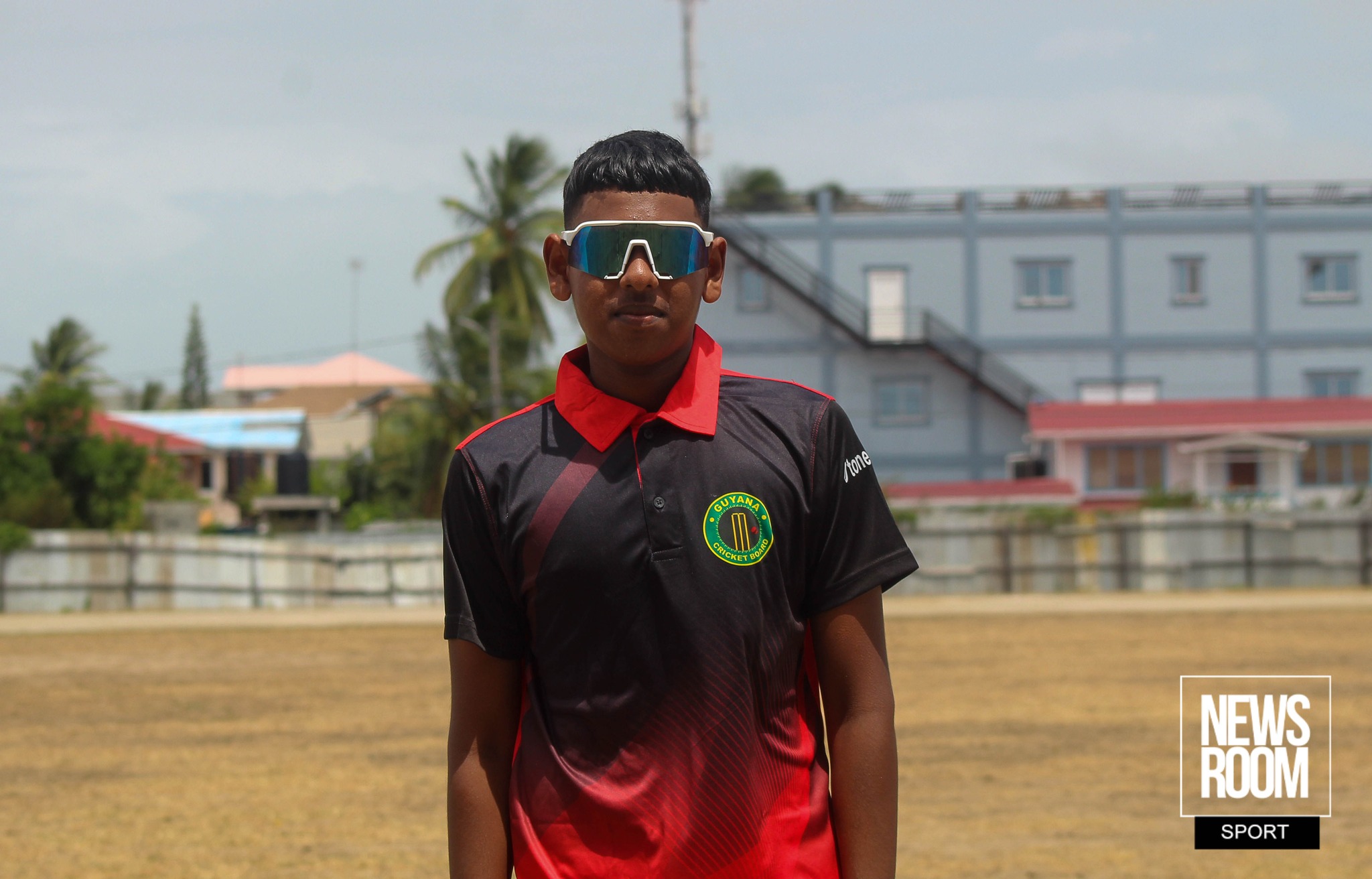
Reyaz Latif collects his Player-of-the-Match trophy from Shaun Massiah
Seegobin stuck 80 off 76 (7x4s, 5x6s), Mentore made an unbeaten 78 off 96 (8x4s, 1×6) and Apple blasted 51 off 41 (4x4s, 2x6s). Dhanesh Persaud chipped in with 32 off 38 (3x4s, 1×6), Kishan Silas made 18 off 33 (3x4s) and Emmanuel Lewis 14 off 13 (3x4s).
Bowling for East Coast, Arun Gainda took 2-38, while there was one each for Jude Andrews, Munesh Outar and Trilok Nanan.
In reply, East Coast had a bright start of 73 in 10.3 overs between the in-form Yannick Newton and Junia Dindyal, but once they were separated the innings nosedived.
Leg-spinner Reyaz Latif ripped through East Coast batting, returning immaculate figures of 7-21 off 10 overs, three of which were maidens, while Ravaldo Pereira took 2-12 and Dave Mohabir 1-8.
Newton topscored with a brisk 45 off 36 (6x4s, 2x6s), Dindyal made 19 off 30 (4x4s), while Outar, batting at number three, remained unbeaten on 14 off 52.
Off-spinner Joshua Budhram (right) and seamer Ravindra Singh combined for seven wickets for East Bank against Upper Demerara (Photo: News Room/Avenash Ramzan/February 22, 2026)
At Police, East Bank rebounded from being bowled out for 38 and 46 in their two defeats against Georgetown and East Coast respectively to beat Upper Demerara, who have now lost both their games following an opening round loss to West Demerara.
Upper Demerara made a paltry 72 all out from 18.4 overs with Errol Alder and Tyric Henry making a joint top score of 16 each. Extras were also 16.
Off-spinner Joshua Budhram was the pick of the bowlers with 4-12 off four overs, while seamer Ravindra Singh was impressive in the opening Powerplay, finishing with 3-22 off five overs.
Yeshua Hutson (1-1) and Leon James (1-22) were the other wicket-takers.
East Bank coasted to victory in 18.1 overs with opener Dilshan Latchman anchoring the chase with a resolute 29 not out off 55 balls (3x4s). Shane Shivbarran and Shane Kissoondeo contributed 15 and 10 respectively, while Hutson closed off the game with a six.
Alder, Alex Ragubeer and Nathan Bishop were the wicket-takers for Upper Demerara.
Romario Shepherd, who has been on the sidelines for the past week, has a chance to play for West Indies in their first Super Eight game against Zimbabwe on Monday.
Shepherd, 31, lends a lot of power to the West Indies batting line-up, some of which he showcased at training on Saturday. With strapping running from his right knee all the way down to his calf, he was still launching balls up over the roof of the Wankhede Stadium.
Team-mates sitting and watching just behind the nets where he was batting welcomed him back after his hit with fanfare, which made Shepherd shadow bat the shot that cleared the ground – a front-foot swat over long-on.
“He practised well yesterday,” West Indies coach Daren Sammy said. “Bowled quite well, you know, hit the ball very, very cleanly. The good thing for us is that everybody is available for selection. Going into the Super Eight, that’s what you want. So I’m glad to know and happy to know that all my soldiers are ready to go out to war.”
Shepherd was among the first at the nets on Sunday too, bowling off his usual run-up with little to no discomfort. He took a five-for against Scotland, including a hat-trick, earlier in the tournament, but hasn’t played since February 11.
Sammy was able to step into the shoes of the opposition waiting for his team. “Zimbabwe missing out the last [T20] World Cup, you know,” he said. “They are led well. Sikandar [Raza], very confident, he leads by example. And they’ve got six fans in the stands who sound like one million. So there are a lot of things that go for them. And I could understand from that standpoint where nobody gives you a chance – how you could use that as inspiration.”
West Indies have played four T20Is against Zimbabwe and won three of them. The one they lost happened 16 years ago, almost to the day, when the visitors to Port-of-Spain were able to defend a total of 105. Sammy was there that day, along with Ravi Rampaul, who is the team’s bowling coach now.
Sammy offered his thoughts on teams entering the Super Eight with pre-appointed seedings, but also said “that’s not my thing”.
“I guess if you take the logistics that come into it, trying to give the fans who probably travel an opportunity to plan ahead. Ideally, I think the big thing for most people is they say, oh, West Indies came out of the group. Oh, Zimbabwe came out of the group. That means somebody they seeded there did not come out. Zimbabwe did what they had to do.
“If we were not seeded or so, and I saw like this person is going to play there, that gives me motivation. And I’m pretty sure Zimbabwe, looking at that group there, gave them motivation and inspiration to come out and play the way they play.” (ESPNcricinfo)
South Africa underlined their credentials as serious challengers for the T20 World Cup with an eye-catching 76-run victory against defending champions India in their opening match of the Super Eights phase.
In a repeat of the 2024 final in Barbados which India won by seven runs, South Africa set the co-hosts a target of 188 as a 35-ball 65 from David Miller and Dewald Brevis’ 29-ball 45 helped them recover from a precarious 20-3 after four overs.
India, who came into the game with a perfect record of four wins in the group stage, produced an uncharacteristically timid chase in Ahmedabad and looked resigned to their fate after slipping to 51-5 by the 10th over before being bowled out for 111.
Opting to bat first, South Africa were in trouble after losing captain Aiden Markram, Quinton de Kock and Ryan Rickelton for single digits inside the powerplay and needed Miller and Brevis to rebuild their innings.
Miller, who previously played for Ahmedabad-based Gujarat Titans in the Indian Premier League, looked right at home from the start, finding boundaries with ease as Brevis was happy to play second fiddle.
Brevis then picked up the pace and fell five runs short of a half-century, but Miller soldiered on to reach his half-century in 26 balls and by the time he departed in the 16th over, South Africa were well poised at 152-5.
David Miller and Dewald Brevis put up a big stand after an early wobble (Photo: Getty Images)
Some good death bowling from Jasprit Bumrah and Arshdeep Singh reined them back but a late flourish from Tristan Stubbs, who added 20 off Hardik Pandya’s final over, in an unbeaten 44 took them to 187-7.
Markram gave the Proteas the perfect start with the ball by sending back the dangerous Ishan Kishan for a duck in the first over before Marco Jansen removed Tilak Varma three balls later.
Kishan’s opening partner Abhishek Sharma ended his run of three consecutive ducks, but could only muster 15 before falling to Jansen while captain Suryakumar Yadav became the fifth India batter to fall halfway through their innings.
With him went India’s remaining hopes as Keshav Maharaj, who picked up three wickets in the 15th over, and Jansen, who took two in the 19th to finish with 4-22, wrapped up the tailenders.
India will need to defeat Zimbabwe in Chennai on Thursday to stay alive in the competition, while South Africa will remain in Ahmedabad to face former champions West Indies on Wednesday. (BBC)
A superb bowling performance ignited England’s T20 World Cup campaign as Harry Brook’s side beat co-hosts Sri Lanka by 51 runs in their opening match of the Super Eights phase.
England remained unconvincing with the bat in posting 146-9, but their bowlers took full advantage of a tricky surface to knock over their hosts for 95.
Jofra Archer dismissed key batter Pathum Nissanka and fellow opener Kamil Mishara, but even more impressive were the three wickets for all-rounder Will Jacks inside the powerplay.
Jacks, who has struggled with the ball at times in this tournament, removed Kusal Mendis and Pavan Rathnayake in consecutive deliveries and added the scalp of Dunith Wellalage as Sri Lanka crumbled to 34-5 under the pressure of a chase.
After Kamindu Mendis chipped back a catch to Liam Dawson and Dushan Hemantha hit his own wicket, Jacks combined with Tom Banton to complete a fine relay catch on the boundary to dismiss Dasun Shanaka, Sri Lanka’s captain and the last recognised batter, for 30.
That England’s batting remains far from perfect is pushed to another day. Jos Buttler made a tortured seven from 14 balls, Jacob Bethell fell to a wild slog and Tom Banton ran himself out.
Phil Salt’s 62 and 21 from Jacks, who was the next highest scorer in a fine all-round display, were crucial.
England play Pakistan on Tuesday and New Zealand on Friday in their remaining Super Eights matches.
Two wins would guarantee a semi-final place. One may be enough. (BBC)
In what can only be described as a landslide “overtake” for the leadership of Guyanese motorsport, Mohamad Shairaz Roshandin has been elected President of the Guyana Motor Racing and Sports Club (GMR&SC).
At the Annual General Meeting on Saturday evening, Roshandin, the former Vice-President, secured a commanding 123-61 victory over incumbent Mahendra ‘Raj’ Boodhoo.
Other elected members were Alain Hopkinson (Vice President), Azim Jafar (Secretary), Azaad Hassan (Treasurer), Ritesh Singh (Assistant Secretary/Treasurer), Rameez Mohamed (Club Captain), Stefan Jeffrey (Technical Advisor), Elan Rahaman (Committee Member), Shemroy Ramsingh (Committee Member), Ashley Persaud (Committee Member) and Krishna Ramseywack (Committee Member).
The result marks a definitive turn in the paddock’s political climate, as members turned out in unprecedented numbers to decide the club’s future trajectory.
The change in leadership comes at a critical juncture for the South Dakota Circuit. Roshandin’s primary mandate will be overseeing a “seismic shift” in the region’s racing profile: the arrival of the GT Challenge de las Americas on July 11-12.
For the first time since the conclusion of the Caribbean Motor Racing Championship (CMRC), an FIA-sanctioned international series will touch down on Guyanese soil.
This is not merely a regional meet; it is a “full-factory spectacle” featuring the kind of high-performance GT3 machinery usually reserved for legendary circuits like Silverstone or Spa-Francorchamps.
Fans can expect a grid bristling with iconic powerhouses from Ferrari, Lamborghini, McLaren, Aston Martin, Porsche, Mercedes-Benz, and Audi.
Roshandin, who campaigned on a platform of “inclusion and unity,” has committed to a collaborative approach to governance, reaching out even to those who sat across the aisle during the election.
Some members of the new GMR&SC Executive
“The goal is to show the best of Guyana,” Roshandin noted, emphasising that track upgrades remain at the top of his technical agenda.
Ensuring the South Dakota Circuit meets the stringent requirements for such a high-spec international grid is expected to be the new executive’s first major hurdle.
In a move to ensure administrative stability during this period of growth, a motion, presented by Jad Rahaman, was adopted to extend the executive’s term from one year to two years.
While the leadership will now have a longer tenure to execute their vision, the club will continue to hold its annual AGM for financial transparency.
Chartered Accountant Harryram Parmesar performed the duties of Returning Officer for the Elections.
Desma Pitt, 59, lost her limb after a minor injury worsened due to diabetes complications. What began as a small wound quickly became life-threatening.
“I didn’t even feel the injury at first. Then it started turning black, and I got very sick. The doctors tried to save it, but eventually they had to amputate. I thanked my foot for the 59 years of service it gave me,” she said.
Pitt is among twenty persons who benefitted from an outreach programme over the past week through which the Ministry of Health in collaboration with a team from US-based ProsthetiKa has worked with the Ptolemy Reid Rehabilitation Centre to assess, fit, and train 20 patients in the use of prosthetic limbs while simultaneously strengthening local technical capacity.
After receiving her prosthetic leg during the programme, she described overwhelming excitement.
Dr Frank Anthony, Minister of Health and members of ProsthetiKa and the Ministry’s Rehabilitation and Disability Services.
“I dreamt about walking again. Now I can. I’m so thankful to the team, my children, and everyone who encouraged me. This is another phase of life, and I’m ready for it.”
The Ministry in a statement disclosed that the outreach was completed last week through its Rehabilitation and Disability Services.
Minister of Health, Frank Anthony, noted that the programme represents more than clinical care; it restores livelihoods and social participation.
“These services transform lives. Our goal is not only to provide prostheses but also to ensure patients regain confidence, independence, and the ability to work and care for their families,” the Minister said.
Dr Anthony expressed appreciation for the collaboration, noting that the initiative not only restored mobility but also improved the quality of life for patients.
“Many patients cannot afford prosthetic services, yet these devices transform lives. Through partnerships like this, we are improving accessibility while building our own technical expertise to sustainably serve our population,” the Minister stated.
He further highlighted the importance of prevention, explaining that a significant number of amputations result from complications of diabetes. The Ministry is therefore strengthening multidisciplinary management to reduce future limb loss while expanding rehabilitation services for those already affected.
The US-based organisation of international consultants aims to provide appropriate and sustainable assistance for persons with disabilities in developing countries.
Led by Jon Batzdorff, Certified Orthotist/Prosthetist (CPO) and ProsthetiKa founder, this year’s team also consisted of CPOs John Morales and Meghan Wright, and Clinical Physiotherapist in vascular and amputee rehabilitation, Laura Burges, Clinical Physiotherapist, ProsthetiKa.
Batzdorff commended the Ministry’s policy direction.
“Providing access to prosthetics is a powerful policy because it restores independence and dignity to people’s lives,” Batzdorff said.
He emphasised that the week’s achievements were the result of extensive teamwork and preparation.
“We assessed and fitted 20 patients. Each prosthesis requires assessment, casting, plastic moulding, assembly, and rehabilitation training; it takes a full team to make it happen.”
Batzdorff underscored the critical role of local healthcare workers and trainees who participated in every stage of the process.
“This work would not have been possible without the local team, from mixing plaster to casting and fitting. We didn’t just ask people to watch; we asked them to try.”
A central objective of the programme was sustainability. Rather than creating reliance on visiting specialists, the initiative prioritised empowering local professionals with the knowledge and practical skills necessary to continue providing services independently.
Ivor Fordyce shows off his confidence and ability to walk again
“We are not here to create dependence. We want the skills to stay here so repairs and future prostheses can be done locally, long after we leave.”
Meanwhile, Director of Rehabilitation and Disability Services, Dr Ariane Mangar, stated that the initiative represents a significant advancement in local rehabilitation services. In addition to restoring mobility and independence to 20 persons with amputations, the programme strengthened national capacity through the training of six new prosthetic technicians, an essential investment in sustainable service delivery.
She further noted that, while this milestone is being celebrated, a considerable waiting list of patients remains. The Ministry, therefore, anticipates collaboration with Jaipur Foot, which is expected to support the fitting of approximately 100 additional individuals in the coming months.
“Together, these efforts are not only restoring limbs, but also restoring dignity, productivity, and quality of life for many Guyanese,” she said.
Another beneficiary, Ivor Fordyce, explained that his amputation followed an unnoticed injury caused by a fragment of broken glass while working around his home.
“It started small but spread fast. Within hours, my foot turned black, and doctors had to amputate.”
After being fitted with a prosthetic limb, he now feels hopeful about returning to normal daily activity.
“I don’t like to sit down. Even before this, I tried helping at home. Now I feel better and encouraged. This will help me become independent again and provide for my family.”
He expressed gratitude for the opportunity:
“God bless the whole institution for putting us back on track.”